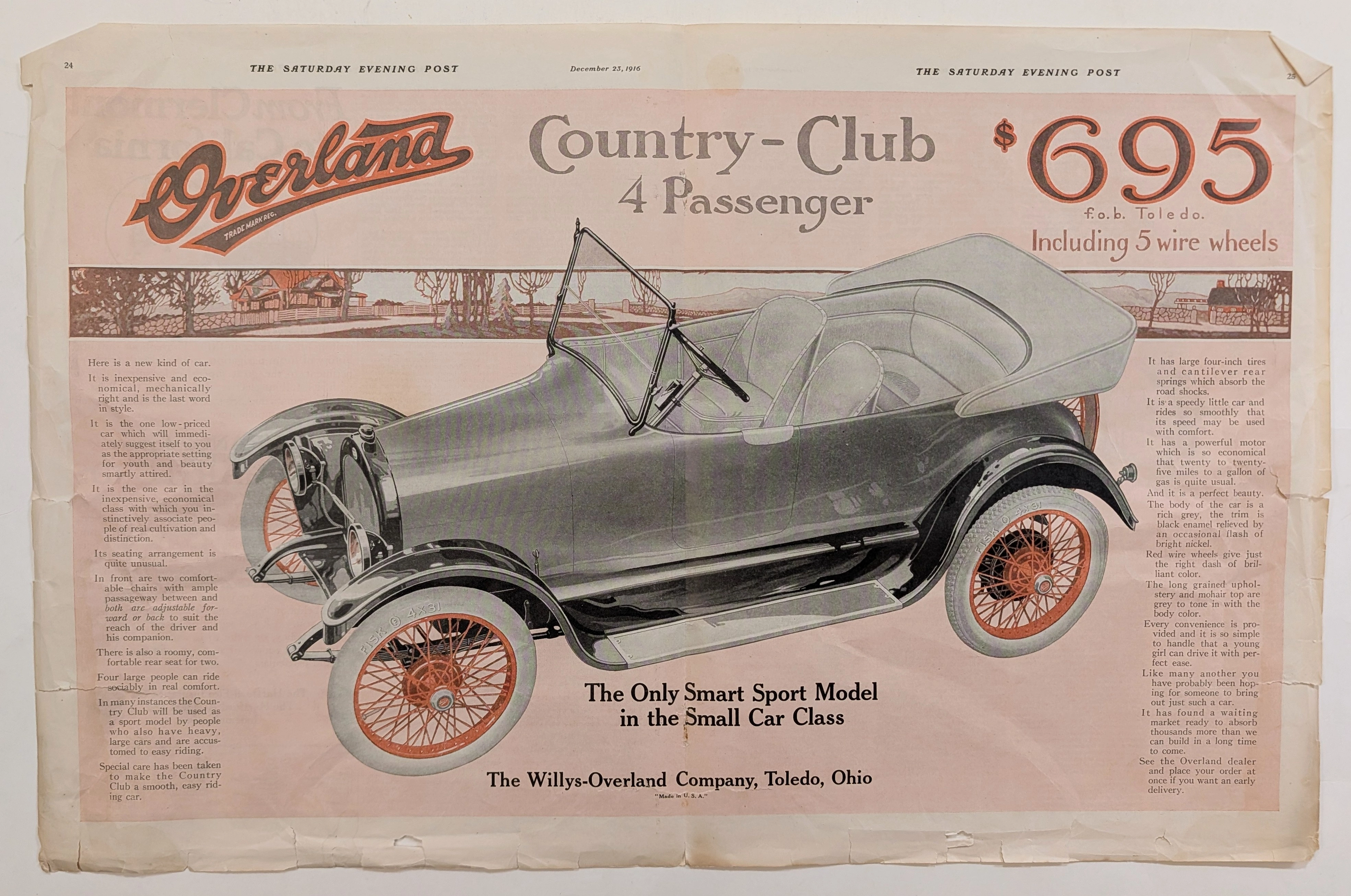
1916 Willys-Overland Country-Club Automobile Vintage Advertisement
1916 Willys-Overland Country-Club 4 Passenger Vintage Advertisement In 1916, The Willys-Overland Company of Toledo, Ohio, was one of the largest automobile manufacturers in the world, second only to Ford. While Ford dominated the bare-bones utilitarian market with the Model T, John North Willys positioned his vehicles to offer more style, comfort, and advanced features at a highly competitive price point. This December 23, 1916, advertisement from The Saturday Evening Post perfectly encapsulates this market strategy. By introducing the "Country-Club" 4 Passenger model for $695, Willys-Overland essentially invented the accessible "Smart Sport Model in the Small Car Class." The ad highlights luxury features uncommon at this price: adjustable front seats, cantilever rear springs for absorbing
Category: Cars
Year: 1916
Rarity Class: SS
Paper & Print Condition
This artifact is a centerfold spread printed on standard, lightweight, uncoated newsprint-grade magazine stock typical of early 20th-century periodicals. The piece demonstrates the technical capabilities of two-color offset lithography from 1916, utilizing black ink alongside a specialized reddish-orange spot color. The ink registration is commendable for its time, particularly in the intricate spokes of the red wire wheels and the distinctive Overland logotype. Condition-wise, the document exhi
Provenance & Rarity
Sourced directly from the December 23, 1916, issue of The Saturday Evening Post, this advertisement represents a crucial artifact from the zenith of early American print media. While this magazine boasted a massive national circulation, the survival rate of complete, intact double-page spreads over a century later is exceedingly low. The highly acidic paper used during World War I-era production was designed for immediate consumption, not long-term preservation, making it highly susceptible to e
Rarity & Condition Summary
Rarity Classification: Class SS (Extremely Rare / Museum Grade) A remarkably well-preserved, century-old double-page spread that serves as a vital document of early automotive history. While The Saturday Evening Post had a massive circulation in 1916, this artifact earns its Class SS rating due to a confluence of hostile preservation factors. Format vulnerability is the primary reason: double-page spreads, particularly centerfolds, have the highest attrition rate in magazine ephemera. They are p