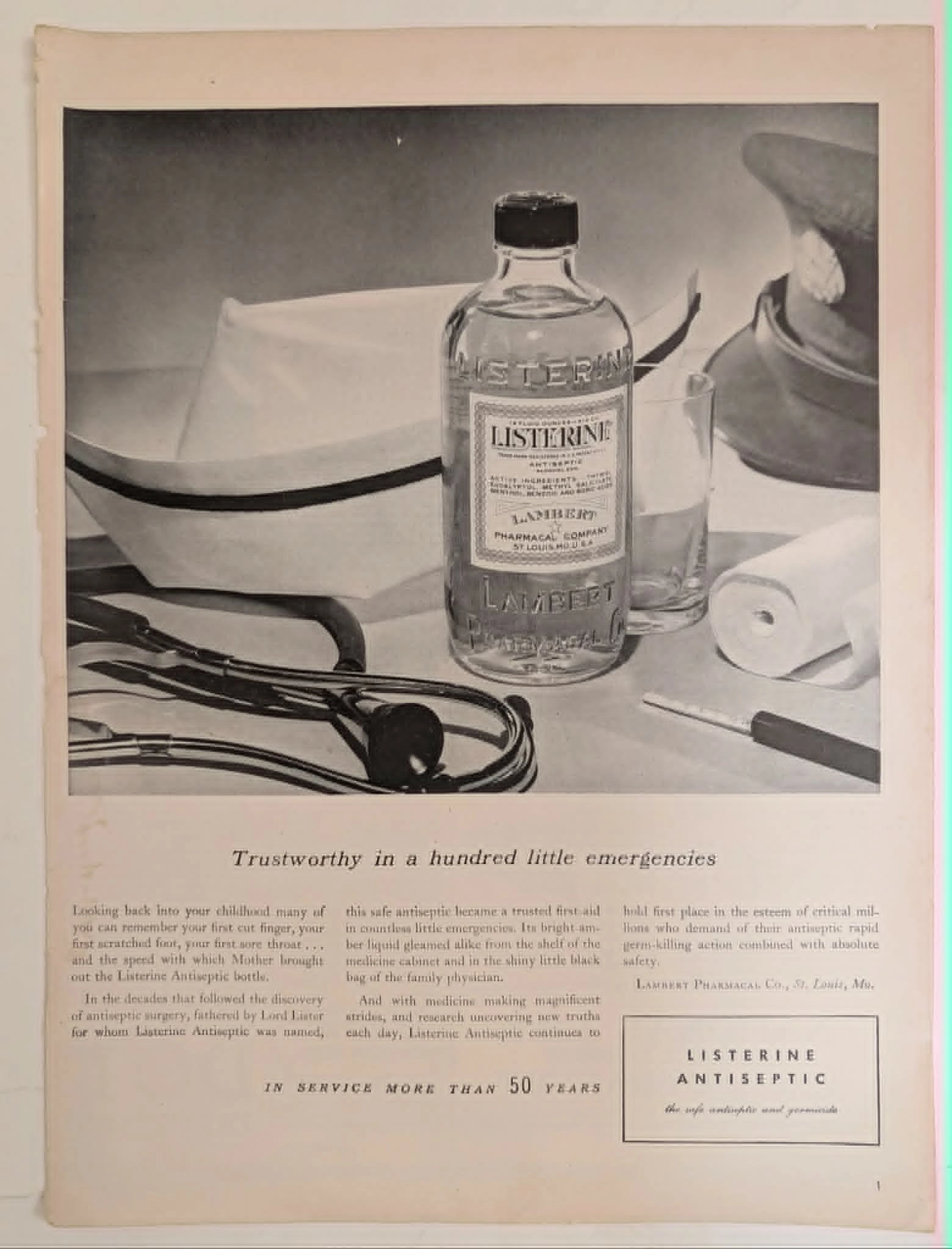
1930s Listerine Antiseptic: "Trustworthy in a Hundred Little Emergencies" Vintage Advertisement
Long before it was primarily known as a daily oral hygiene product, Listerine was marketed as a powerful, multi-purpose surgical antiseptic and household germicide. Formulated in 1879 by Dr. Joseph Lawrence and named in honor of Dr. Joseph Lister—the pioneer of antiseptic surgery—the product was later commercialized by the Lambert Pharmacal Company of St. Louis, Missouri. This specific advertisement, celebrating "more than 50 years" of service, marks a fascinating era in pharmaceutical marketing where the lines between clinical medicine and over-the-counter remedies were deeply intertwined. The campaign's tagline, "Trustworthy in a hundred little emergencies," strategically positions Listerine as the ultimate safeguard for the American family. Moving beyond their famous 1920s "halitosis" (bad breath) campaigns, this ad pivots back to the product's medical roots. The copy directly appeals to maternal care and household safety, reminding readers of their "first cut finger" or "first sore throat" and the speed with which the iconic Listerine bottle was deployed. Visually, the composition is a masterclass in establishing authority by association. The iconic glass bottle is deliberately staged alongside the tools of trusted professionals: a nurse's cap, a doctor's stethoscope, a clinical thermometer, sterile gauze, and an officer's cap. This still-life arrangement subliminally transfers the respect and trust associated with the medical and civil service professions directly onto the product. Furthermore, the detailed label shown in the ad proudly lists its active ingredients—Thymol, Eucalyptol, Methyl Salicylate, Menthol, Benzoic and Boric Acids, alongside a robust 25% alcohol content. In an era before the widespread availability of antibiotics, a reliable, safe germicide was a critical component of any medicine cabinet. This artifact perfectly encapsulates the transitional period of modern medicine, reflecting the public's growing trust in scientifically backed pharmaceutical interventions.
Category: Perfume & Cosmetics
Year: 1930
Rarity Class: B
Paper & Print Condition
The artifact displays excellent monochromatic contrast, preserving the subtle gradients of the black-and-white photography. The paper exhibits an authentic, even oxidative toning (mild yellowing) typical of mid-century wood-pulp magazine stock. The typography remains remarkably crisp, with no significant smudging or moisture degradation.
Provenance & Rarity
Sourced from a widely circulated American publication from the 1930s. While Listerine ads from this era are generally accessible, finding one that specifically emphasizes the broad-spectrum "first aid" positioning, complete with highly detailed product labeling and medical iconography, elevates its archival value.
Rarity & Condition Summary
A robust historical document for scholars of consumer health history and early advertising psychology. Graded Class B, its strong structural integrity and high-fidelity print make it an excellent reference piece for the study of interwar pharmaceutical branding.