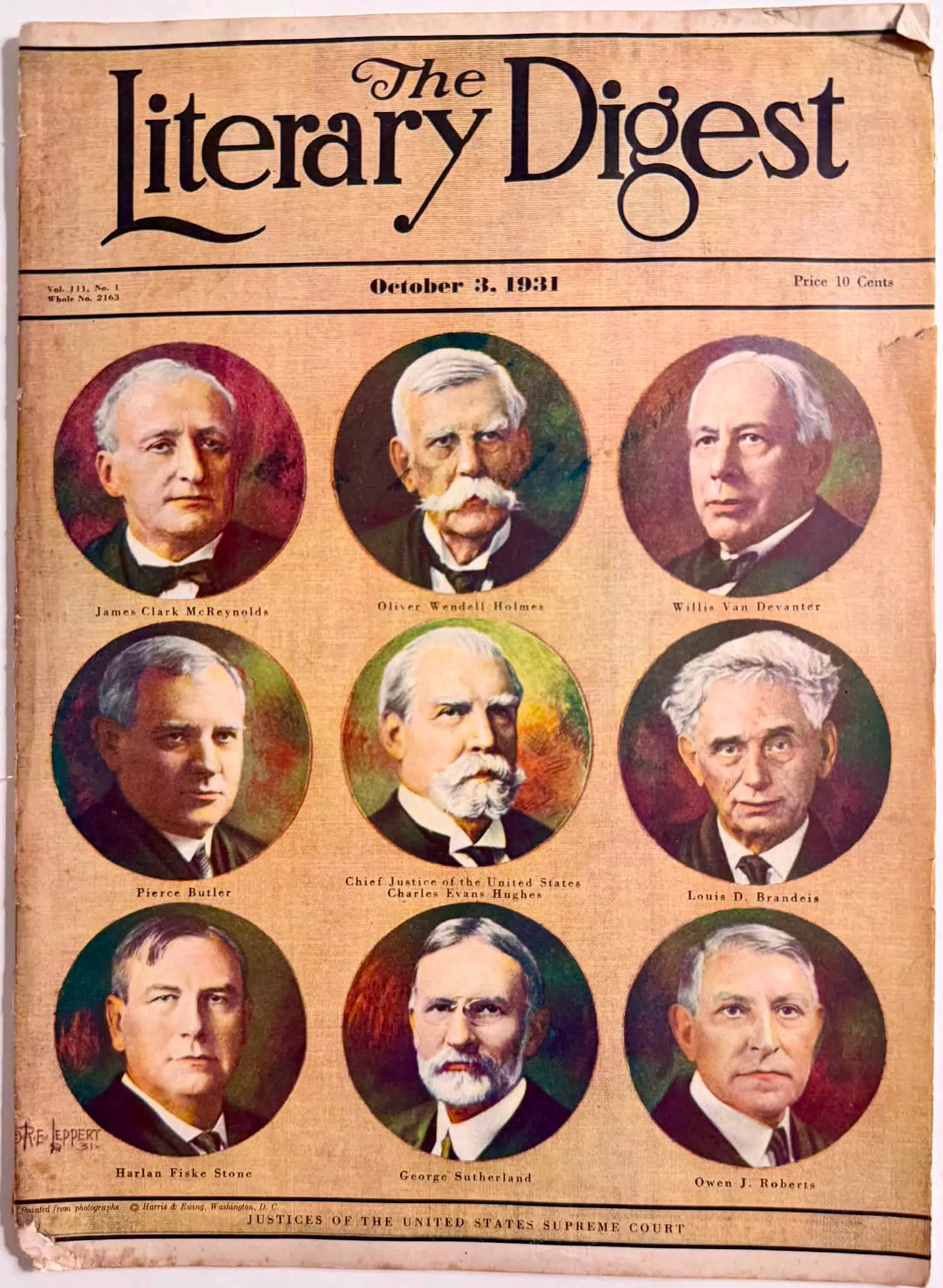
1931 The Literary Digest Supreme Court Justices Cover Art by R.E. Leppert
The visual evidence presented in the supplied digital proxy reveals the front cover of a historical American news magazine, The Literary Digest, dated October 3, 1931. The vertical composition is anchored at the top by the prominent, ornate black serif masthead typography reading "The Literary Digest," situated above a structured dateline banner displaying volume and issue numbers ("Vol. 111, No. 1, Whole No. 2163"), publication date ("October 3, 1931"), and cover price ("Price 10 Cents"). The central pictorial field consists of a symmetrical three-by-three grid containing nine circular portrait medallions depicting the members of the United States Supreme Court. Each portrait features a color-tinted likeness of a jurist set against a dark, mottled background of reddish-brown and green ton
Category: Real Estate
Year: 1931
Rarity Class: S
Paper & Print Condition
The digital proxy reveals a warm, tan-toned paper substrate exhibiting visible horizontal ribbed texture lines and light overall toning consistent with aging pulp-based newsprint. Minor edge wear, slight chipping along the right margin, and gentle handling creases are evident, reflecting functional use as a periodical cover. The printed typography is sharp with deep black ink transfer across masthead and text zones. The nine circular portrait medallions display clear color-tinted halftone or lit
Provenance & Rarity
Original front cover of The Literary Digest, Vol. 111, No. 1, Whole No. 2163, published October 3, 1931 (digital proxy review based on photographic captures). Historical Rarity Analysis: The artifact's scarcity is underscored by the ephemeral nature of 1930s news weeklies. Published during the Great Depression, The Literary Digest was a disposable consumer item meant for immediate reading and discarding. Finding surviving covers or issues from late 1931—particularly featuring a complete visual r
Rarity & Condition Summary
The artifact survives as a well-preserved news magazine cover from October 1931, exhibiting stable pulp paper toning, minor edge wear, and crisp printed typography, placing it in a solid tier of historical scarcity and curatorial interest for interwar periodical ephemera.