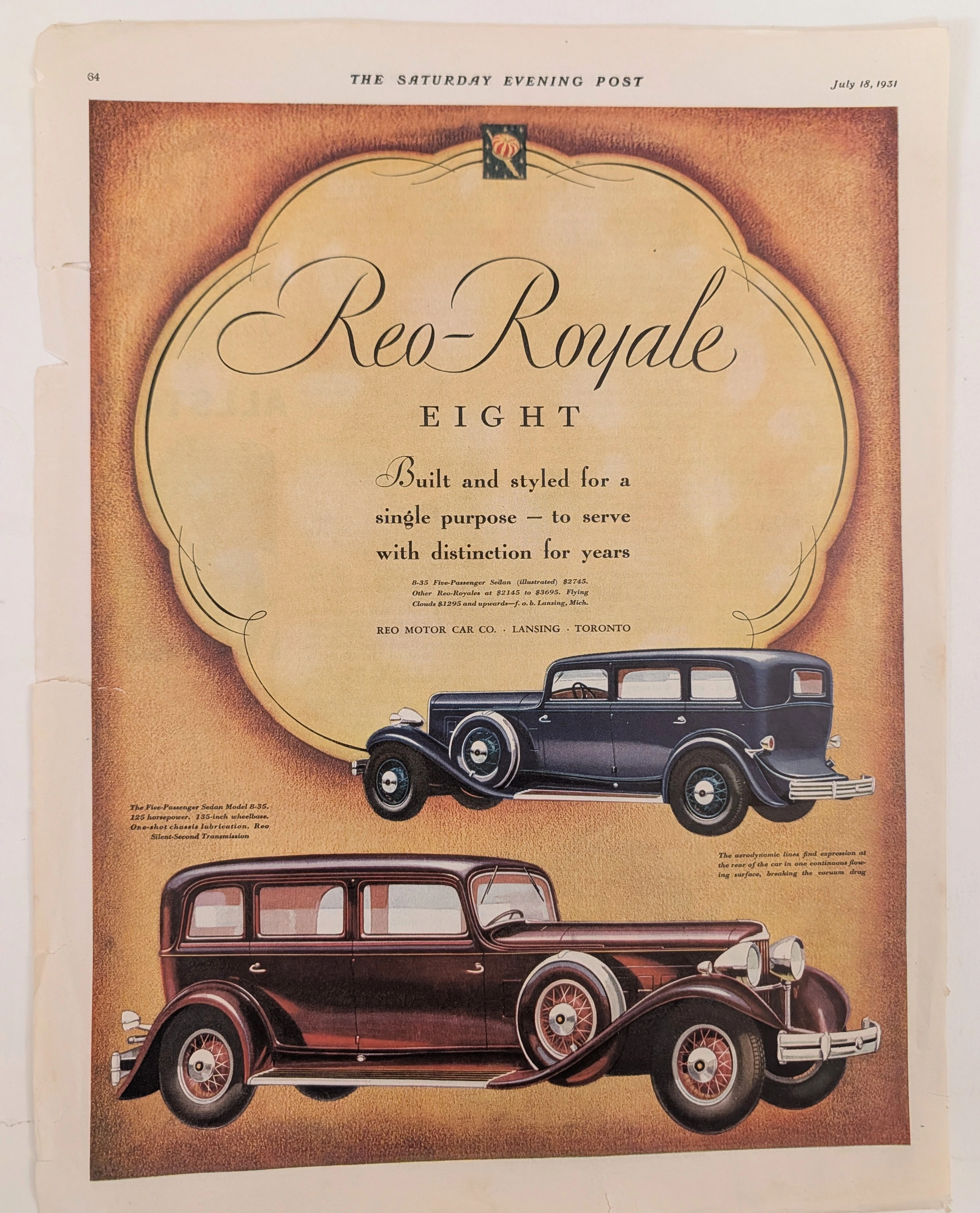
1931 Reo-Royale Eight & Willys Six Vintage Advertisements
Published on July 18, 1931, in The Saturday Evening Post, these beautifully preserved vintage print advertisements capture a fascinating dichotomy within the American automotive industry during the early years of the Great Depression. While the Reo Motor Car Company boldly marketed the luxurious, aerodynamically styled Reo-Royale Eight to an elite demographic, Willys-Overland emphasized unprecedented affordability and robust performance with their Willys Six. Together, these artifacts offer a profound glimpse into early 1930s industrial design, economic strategy, and consumer marketing. The summer of 1931 was a perilous time for the American economy, yet the automotive industry continued to push the boundaries of engineering and design. The advertisements featured in this gallery highlight two distinct survival strategies employed by automakers during the Great Depression: uncompromising luxury and high-value accessibility. The Reo-Royale Eight: Aerodynamic Pioneer The Reo Motor Car Company, based in Lansing, Michigan, introduced the Reo-Royale Eight as a masterclass in early automotive aerodynamics. The advertisement proudly highlights the vehicle's sweeping lines, noting that "the aerodynamic lines find expression at the rear of the car in one continuous flowing surface, breaking the vacuum drag." Designed with the assistance of Amos Northup and the Murray Corporation, the Reo-Royale was one of the first production cars to feature a concealed radiator, sweeping fenders, and a streamlined profile that would eventually become the industry standard. Priced at $2,745 for the Five-Passenger Sedan, it was an explicit play for the luxury market, appealing to those who remained insulated from the era's financial hardships. The Willys Six: "Beauty, Quality, Action" In stark contrast, Willys-Overland of Toledo, Ohio, targeted the shrinking middle class with an aggressive value proposition. Their advertisement for the Willys Six 97 Coach announces prices ranging from $495 to $850—substantially lower than the previous year's models. Willys positioned their vehicle as the "largest, fastest, most powerful car offered at such a low price," leaning heavily on their racing pedigree, including top finishes in the grueling Mexico City to Puebla mountain race and the Pike's Peak hill climb. The inclusion of safety glass "at slight extra cost" reflects the early transitions in automotive safety standards. Together, these advertisements do more than sell cars; they serve as a socio-economic barometer of 1931 America, illustrating the stark contrast between elite luxury and mass-market necessity.
Category: Cars
Year: 1931
Rarity Class: A
Paper & Print Condition
The physical state of these 1931 magazine folios offers a remarkable window into early 20th-century commercial printing methodologies and the preservation characteristics of Depression-era paper stock. Originating from The Saturday Evening Post, a publication known for its massive circulation, the pages are composed of high-lignin wood pulp, typical of the period. While lignin naturally degrades and oxidizes over time when exposed to ultraviolet light and atmospheric humidity, these specific artifacts demonstrate exceptional structural integrity. There is a distinct, uniform edge-tanning (a mild acidification resulting in a warm, sepia-toned border) that frames the artwork naturally, yet the cellulose fibers remain robust, exhibiting no signs of severe brittleness or flaking that often plague mass-produced periodicals of this decade. Furthermore, the folios are remarkably free of "foxing"—the localized, rust-colored spots caused by fungal growth or iron contaminants in the paper pulp—certifying that the items were stored in a climate-controlled, dry environment for the majority of the past century. The true marvel of these artifacts, however, lies in their print fidelity. The advertisements utilize an advanced four-color halftone printing process, a technique that was highly refined by the 1930s to simulate continuous tones. The ink saturation has remained spectacularly vibrant. In the Reo-Royale advertisement, the rich, deep maroon and navy blue tones of the vehicular bodies exhibit an almost metallic luster, effectively conveying the premium nature of the brand. Conversely, the Willys Six advertisement features a deeply saturated olive green that highlights the car's utilitarian yet elegant bodywork. The microscopic registration—the exact alignment of the cyan, magenta, yellow, and black halftone dot matrices—is immaculate. This precision is most evident in the intricate rendering of the wire-spoke wheels and the delicate typographic flourishes. There is virtually no chromatic aberration or "color bleeding" around the fine, sharp edges of the technical illustrations, preserving the artistic intent and allowing the aerodynamic contours envisioned by the original illustrators to be fully appreciated by modern archivists.
Provenance & Rarity
The provenance of these folios is definitively traced to the July 18, 1931, issue of The Saturday Evening Post (Curtis Publishing Company, Philadelphia), specifically occupying pages 64 and 67. During the early 20th century, The Post was the preeminent cultural and advertising medium in the United States, reaching millions of households and serving as a vital barometer of American consumerism. However, because periodicals of this era were produced and consumed as ephemeral media—frequently discarded, repurposed, or later destroyed during the aggressive paper recycling drives of World War II—intact, original pages possessing this level of chromatic and structural integrity are exceedingly rare. These specific advertisements achieve a 'Class A' museum rarity designation not merely because of their age, but due to their profound curatorial significance as a comparative set. Finding a pristine advertisement for an ultra-luxury, aerodynamic Depression-era vehicle (the Reo-Royale Eight) practically alongside an advertisement for a utilitarian, budget-conscious automobile (the Willys Six) from the exact same week in history provides an invaluable primary source for economic historians and automotive archivists. Surviving examples that have not been subjected to scissor clipping, improper acidic framing, or severe ultraviolet degradation are highly coveted. They represent a vanishing physical record of the polarized industrial strategies utilized to survive the darkest years of the American economy.
Rarity & Condition Summary
In summation, this curated pair of 1931 automotive folios represents an extraordinary intersection of exceptional material preservation and profound historical narrative. Earning its 'Class A' rarity designation, this dual-exhibit transcends its original, ephemeral commercial intent. Physically, it is a marvel of archival survival; the pages have defied the natural acidic degradation and embrittlement typical of Depression-era high-lignin wood pulp. They retain their structural flexibility, immaculate halftone ink registration, and vibrant chromatic fidelity—particularly the deep maroon and saturated olive greens—without the intrusion of moisture damage, ultraviolet fading, or fungal foxing. The warm, natural sepia edge-tanning only serves to authenticate its vintage pedigree without compromising the visual artwork. Conceptually and curatorially, these juxtaposed advertisements—highlighting the uncompromising, aerodynamic luxury of the Reo-Royale Eight alongside the pragmatic, budget-conscious engineering of the Willys Six—crystalize the severe economic polarities of 1931 America. For archivists, historians, and collectors of 20th-century industrial design, this pristine, unaltered artifact stands as a masterclass reference piece. It captures a frozen moment of simultaneous automotive innovation and economic desperation with unparalleled, museum-grade clarity.