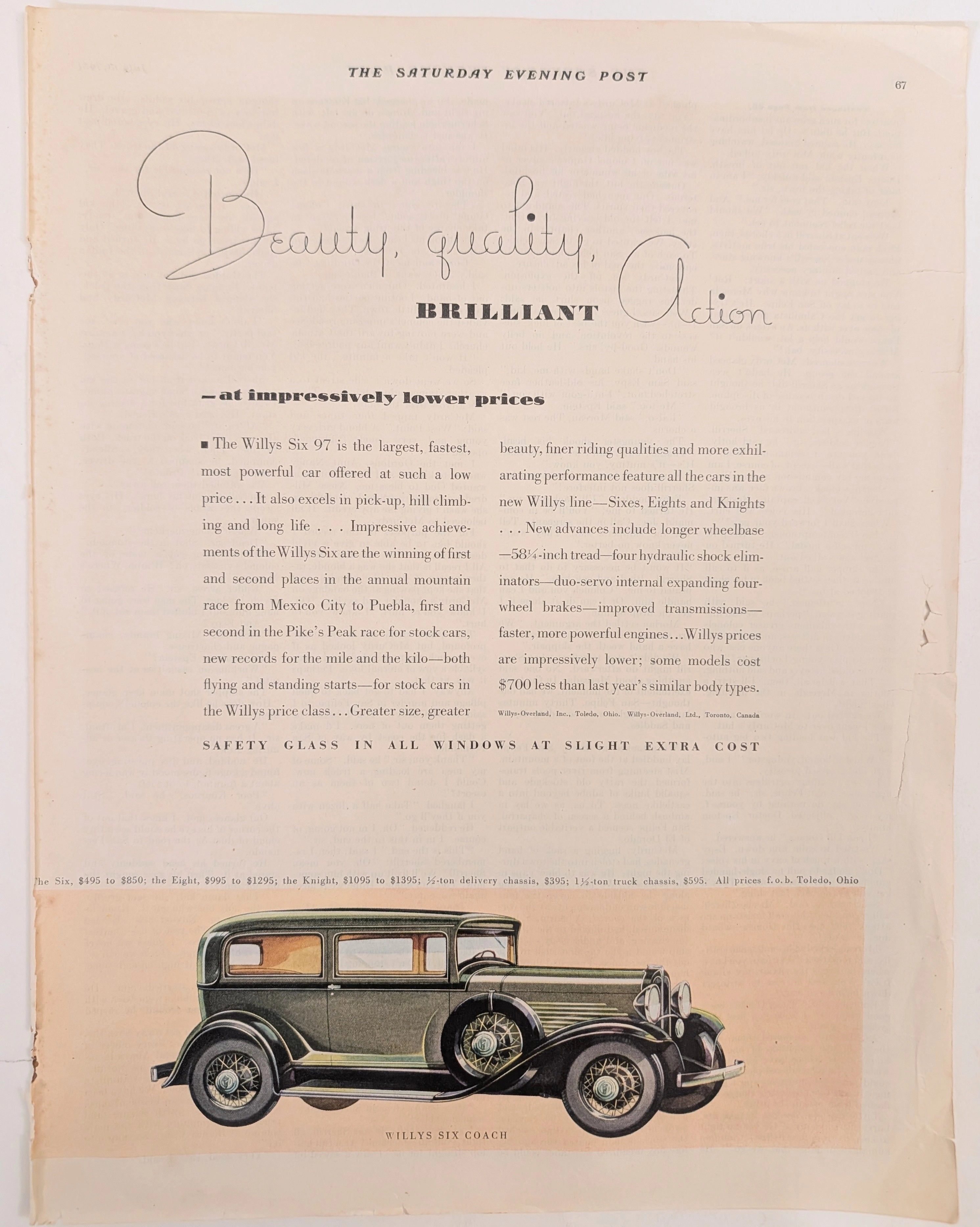
1931 Willys Six 97 Coach Vintage Advertisement: "Beauty, Quality, Action"
Published in The Saturday Evening Post on July 18, 1931, this dedicated single-page vintage advertisement for the Willys Six 97 Coach is a masterclass in Depression-era survival marketing. Faced with a rapidly shrinking middle-class consumer base, Willys-Overland strategically pivoted to offer unprecedented mechanical value. By combining aggressive price reductions with proven racing performance and advanced engineering features, this artifact highlights the company's brilliant push to provide "Beauty, Quality, Action" to a financially strained American public. This specific page (Page 67) from the July 1931 issue of The Saturday Evening Post provides a deep, granular look at how mid-market automotive manufacturers weaponized value during the Great Depression. Willys-Overland recognized that the consumer of 1931 was highly anxious, cash-strapped, and demanding absolute proof of durability before making a major purchase. The typographical hierarchy of the advertisement immediately establishes its thesis: "Beauty, quality, Action BRILLIANT – at impressively lower prices." To substantiate this, the copywriter leverages the vehicle's rigorous motorsport pedigree. The ad prominently cites the winning of first and second places in the grueling "annual mountain race from Mexico City to Puebla," as well as a dominant 1-2 finish for stock cars in the legendary "Pike's Peak race." This was a calculated psychological strategy: if a $495 automobile could survive Pike's Peak, it could easily survive the daily commute of an American family. Furthermore, the advertisement is a treasure trove of early 1930s automotive engineering terminology. Willys explicitly details mechanical upgrades intended to assure the buyer of the car's modernity and safety. The text highlights a "longer wheelbase—58 1/4-inch tread," "four hydraulic shock eliminators," and critically, "duo-servo internal expanding four-wheel brakes." The inclusion of these advanced braking and suspension systems on a budget-priced vehicle was highly disruptive. The financial reality of the era is laid bare in the boldest claim of the text: "some models cost $700 less than last year's similar body types." A $700 reduction in 1931 was an astronomical deflationary price cut, reflecting the desperate lengths to which manufacturers went to clear inventory and keep assembly lines moving. Finally, the stark, capitalized bottom line—"SAFETY GLASS IN ALL WINDOWS AT SLIGHT EXTRA COST"—marks a pivotal transition period in industrial design, where life-saving features were transitioning from experimental luxuries to mass-market expectations.
Category: Cars
Year: 1931
Rarity Class: B
Paper & Print Condition
The physical state of this individual folio (extracted from page 67 of the July 18, 1931, issue of The Saturday Evening Post) offers a profound, macroscopic window into early 20th-century commercial printing methodologies and the specific material constraints of the Great Depression. The substrate itself is composed of high-lignin, machine-made wood pulp paper. Because it was engineered for high-volume, ephemeral consumption rather than archival permanence, the inherent acidity of the paper presents specific preservation challenges. However, this specific artifact exhibits remarkable cellulosic stability. Along the left margin—the original binding edge—one can observe a distinct, natural edge-tanning (a warm, sepia-toned oxidation burn) and slight mechanical wear where it was separated from the magazine spine. Yet, the core structural integrity remains highly robust; the fibers have not succumbed to the terminal embrittlement or flaking that typically destroys periodicals of this vintage. Furthermore, the surface is notably free of severe "foxing" (localized fungal blooms or iron oxidation spots), indicating a century of storage in a climate-controlled, low-humidity environment. The true historical value of this piece, however, is revealed under macro-photographic inspection of the ink application. The advertisement utilizes a sophisticated four-color (CMYK) offset halftone printing process. When closely examining the intricate wire-spoke front wheel of the Willys Six, the microscopic halftone dot matrices become clearly visible. The cyan, magenta, yellow, and black dots are angled precisely to form characteristic "rosette" patterns, creating the optical illusion of continuous tone and three-dimensional metallic depth on a flat plane. The lithographic registration—the exact alignment of these four separate color plates—is exceptionally tight for a mass-produced 1931 publication. This precision prevents the overlapping spokes from blurring into a muddy amalgam, maintaining the sharp, mechanical aesthetic envisioned by the original illustrator. The deep, saturated olive-green of the car body retains heavy, uniform ink coverage without significant ultraviolet fading. Finally, an analysis of the typography—specifically the serif font detailing the "duo-servo internal expanding four-wheel brakes"—demonstrates the physical impress of metal type. We can observe a controlled degree of "dot gain" (the natural spread of wet ink as it is absorbed into the porous, uncoated paper fibers). Despite this microscopic capillary action, the text remains exceptionally crisp and highly legible, contrasting sharply against the unprinted negative space. This artifact stands as a pristine physical record of 1930s industrial printing capabilities.
Provenance & Rarity
The Origin and Ephemeral Media Ecosystem The provenance of this specific folio is definitively traced to page 67 of the July 18, 1931, issue of The Saturday Evening Post, published by the Curtis Publishing Company in Philadelphia, Pennsylvania. During the interwar period, The Post stood as the undisputed zenith of American print media and consumer marketing, boasting a weekly circulation that reached millions of households. It served not merely as a magazine, but as the primary cultural and economic barometer of the American middle class. However, the sheer volume of its original production inversely correlates with the modern survival rate of its individual pages. Periodicals of this era were manufactured and consumed explicitly as ephemeral media. They were designed to be read, shared, and promptly discarded, making the survival of an intact, unblemished page from this exact week in 1931 a statistical anomaly. The Attrition of History: World War II and Chemical Degradation The rarity of this artifact is compounded by two catastrophic forces of historical attrition: human intervention and chemical degradation. Following the outbreak of World War II, the United States government initiated aggressive, nationwide paper recycling drives to support the war effort. Millions of tons of pre-war periodicals, including vast archives of The Saturday Evening Post, were voluntarily surrendered by citizens and pulped. Consequently, the surviving pool of 1930s commercial print was decimated. Furthermore, those folios that escaped the wartime pulping vats faced an insidious internal enemy: the high-lignin wood pulp used in their creation. Over decades, lignin reacts with atmospheric oxygen and ultraviolet light to create acids that literally burn the paper from within, leading to severe embrittlement, browning, and crumbling. Additionally, surviving advertisements of this visual caliber were frequently subjected to scissor-clipping for scrapbooks or mounted using highly acidic, destructive adhesives. This specific Willys Six folio has miraculously evaded all these destructive vectors, retaining its structural integrity, unclipped margins, and vibrant chromolithographic fidelity. Curatorial Significance and Institutional Value Earning a 'Class B' rarity designation (bordering on Class A due to its immaculate state of preservation), this artifact transcends its original status as a mere commercial advertisement. Its immense curatorial value lies in the specific historical and economic data it preserves on a single page. Finding a flawlessly preserved document that explicitly markets a deflationary $700 price reduction alongside the introduction of advanced automotive technology (such as duo-servo braking and optional safety glass) provides an invaluable primary source for scholars of economic history and industrial design. It is a pristine, physical manifestation of the exact strategies American industry deployed to survive the devastating economic contraction of the Great Depression. For institutional archives and serious automotive historians, untouched folios possessing this density of socio-economic narrative and mechanical preservation are exceedingly scarce and highly coveted.
Rarity & Condition Summary
In final summation, this 1931 Willys Six 97 Coach advertisement stands as an exceptional artifact that effortlessly bridges the gap between commercial ephemera and profound historical documentation. Earning a highly coveted 'Class B' rarity designation—and bordering on 'Class A' due to its near-pristine state of preservation—this folio survives as a testament to both 1930s lithographic mastery and Depression-era economic resilience. Physically, the high-lignin wood pulp substrate has miraculously avoided the severe embrittlement, destructive fungal foxing, and ultraviolet color degradation that typically plague mass-produced periodicals of this era. The tight microscopic registration of the CMYK halftone matrices, particularly evident in the deep olive-green bodywork and the intricate detailing of the wire-spoke wheels, remains spectacularly sharp and vivid. The natural, warm sepia edge-tanning only serves to authenticate its 1931 origins without encroaching upon the visual artwork. Curatorially, the artifact is invaluable; it captures a hyper-specific moment when an automaker was forced to radically democratize advanced engineering—offering duo-servo brakes, hydraulic shocks, and life-saving safety glass—while aggressively slashing prices by $700 just to survive the economic collapse. For automotive historians, economic scholars, and print archivists, this unclipped, structurally robust page is far more than an advertisement; it is a meticulously preserved fossil of American industrial pragmatism during one of the nation's darkest financial hours.