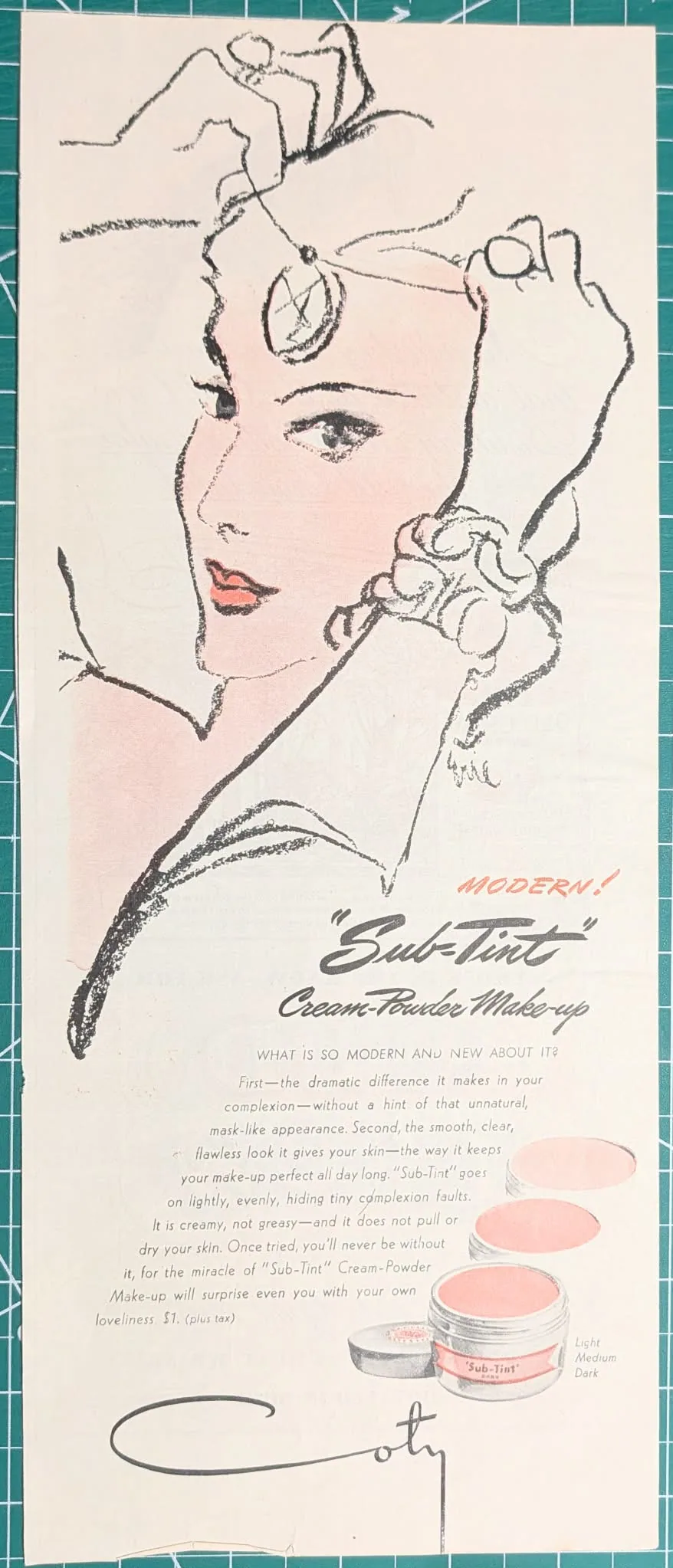
1940s Coty Sub-Tint Cream-Powder Make-up Vintage Advertisement
During the mid-twentieth century, the cosmetics industry experienced a rapid evolution in both product formulation and marketing aesthetics. This advertisement for Coty’s "Sub-Tint" Cream-Powder Make-up perfectly encapsulates this transitional era. Positioned as a "modern" solution, the advertising copy explicitly distances the product from the "unnatural, mask-like appearance" of older formulas. Instead, it promises a "smooth, clear, flawless look," highlighting a cultural pivot toward naturalized beauty standards that would dominate the post-war period. The introduction of shades like Light, Medium, and Dark reflects the industry's gradual movement toward more personalized complexion matching. Artistically, the piece is a masterclass in minimalist commercial illustration. The artist employs a textured, charcoal-like stroke to render the sophisticated female subject adjusting her necklace, providing a sense of dynamic elegance and immediacy. Rather than relying on full-color processing, the ad utilizes a strategic pink spot color applied exclusively to the cosmetic product, the typography, and the subtle blush on the model’s skin. This deliberate restriction of the color palette draws the viewer's eye directly to the product’s intended effect, merging artistic restraint with commercial efficacy. The expressive brush-script of the "Sub-Tint" logo contrasts beautifully against the clean, italicized typography of the body copy, creating a balanced and visually striking composition.
Category: Perfume & Cosmetics
Year: 1940
Rarity Class: B
Paper & Print Condition
The archival substrate exhibits a pronounced, authentic mid-century paper grain, characterized by a warm, off-white patina and subtle micro-abrasions consistent with historical handling. Close inspection of the lithographic transfer reveals exceptional preservation of the original artist's intent; the black keyline ink maintains the gritty, particulate texture of a hand-drawn charcoal or litho-crayon stroke without severe fading or offset. The secondary pink spot color is applied via a precise halftone screen, with the dot matrices remaining distinctly visible under magnification, providing a masterclass in cost-effective yet striking 1940s mechanical color separation. Minor undulations in the paper surface speak to its original binding and decades of archival storage, ultimately enhancing its provenance as a tactile historical artifact.
Provenance & Rarity
Sourced from the mainstream American print media landscape of the mid-twentieth century, this advertisement represents a definitive shift in Coty's brand positioning and mid-century cosmetic marketing. Artifacts of this nature were inherently ephemeral, printed on acidic paper stock intended for brief consumer engagement rather than long-term archival preservation. The survival of this specific piece, devoid of significant foxing, water damage, or structural tears, elevates its historical standing. The pristine visual fidelity of the charcoal-style illustration, combined with the unblemished textual areas and vibrant pink halftone spot color, marks it as an uncommon survivor of the era's wartime and post-war paper drives. Within the archives of The Record Institute, this piece is classified as a Class B artifact, signifying its high desirability and scarcity in such an exceptional state of preservation. It serves as a vital primary document for researchers studying the intersection of commercial lithography and shifting feminine beauty standards in the 1940s.
Rarity & Condition Summary
A highly collectible Class B artifact, this piece demonstrates exceptional preservation of mid-century cosmetic marketing and specialized two-color print techniques. The remarkable integrity of the archival paper substrate, combined with the pristine clarity of the spot-color halftones and unblemished charcoal-style linework, elevates its status from a transient consumer advertisement to a museum-grade historical document.