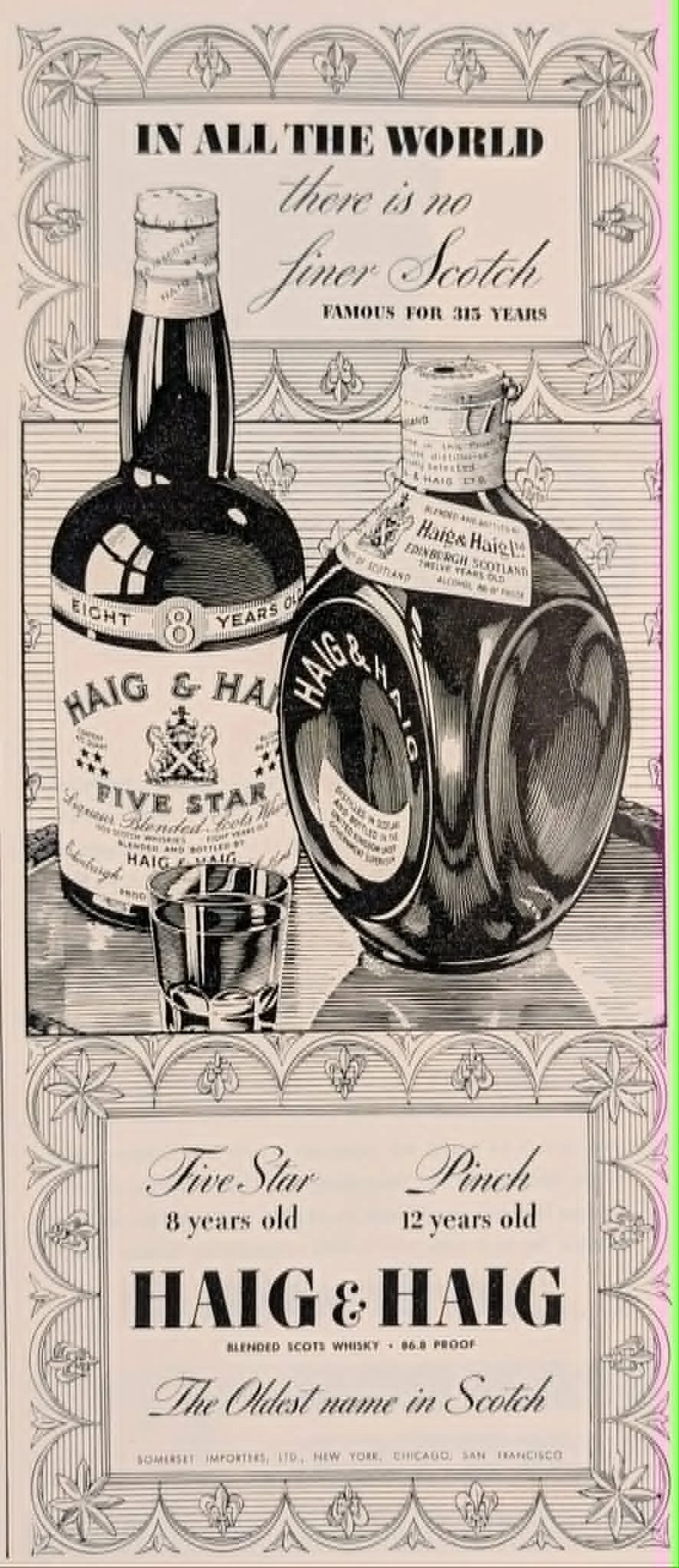
1942 Haig & Haig "Five Star" & "Pinch" Scotch Whisky Vintage Advertisement
The mid-20th century was a golden era for print advertising, heavily reliant on striking illustration and masterful typography before the universal adoption of color photography. This circa 1942 Haig & Haig advertisement is a prime example of this transitional period, utilizing high-contrast, meticulous line-art to render its two flagship bottles with almost photorealistic depth. The illustration technique brilliantly captures the distinct wire wrapping and dimpled glass of the iconic "Pinch" bottle—a unique design patented in the late 19th century to prevent the bottle from slipping from the hands of sailors—alongside the traditional, stout profile of the "Five Star" bottle. Strategically, the marketing message is built entirely around heritage, permanence, and unshakeable quality. By prominently proclaiming that the brand has been "Famous for 315 Years," the copy directly connects this product to the historical record of Robert Haig, who began distilling in 1627. In the context of the early 1940s, a time heavily marred by the anxieties and global uncertainties of the Second World War, leaning on a multi-century legacy offered consumers a psychological anchor. It provided a sense of stability, permanence, and enduring refinement when the modern world felt entirely unpredictable. Furthermore, the American spirits market at this time was still maturing in the post-Prohibition era. Imported blended Scotch was the ultimate symbol of status and affluence. By distinctly marketing the age statements—8 years for the Five Star and 12 years for the Pinch—Haig & Haig educated the consumer on the correlation between barrel-aging and luxury. The composition is elegantly framed by an ornate, architectural border featuring stylized fleur-de-lis and botanical motifs. This framing acts as a visual certificate of authenticity, elevating the advertisement from a mere commercial pitch to an official decree of quality, positioning Haig & Haig as the aristocratic choice for discerning consumers.
Category: Lifestyle & Vice
Year: 1942
Rarity Class: A
Paper & Print Condition
The substrate is composed of uncoated, mechanical wood pulp typical of wartime mid-century periodicals, exhibiting a uniform, warm ivory patination. This even oxidation indicates stable atmospheric exposure over the past eight decades, with no severe acidic embrittlement. The ink saturation remains remarkably dense, providing stark, high-contrast visibility to the intricate cross-hatching and stippling techniques used by the illustrator to render the glass texture and dimpled contours of the "Pinch" bottle. Typographical elements, including the delicate scripts and the ornate architectural border, maintain crisp edge definition without ink bleed or micro-fracturing. Crucially, the visual field is free from active biological degradation, with no significant structural tearing, deep creasing, or distracting foxing (ferrous oxidation spots) present within the primary layout.
Provenance & Rarity
Sourced from a premier U.S. mid-century publication, this artifact represents a crucial intersection of international trade and wartime advertising. Vintage advertisements featuring explicit age statements—specifically the 8-year-old "Five Star" and the 12-year-old "Pinch"—from the early 1940s are exceptionally rare. During the height of the Second World War, the British government severely restricted domestic distillation to conserve grain for the war effort, while simultaneously prioritizing whisky exports to the United States to generate vital foreign exchange reserves. Consequently, pre-war aged stocks were rapidly depleted, making documentation of these specific, mature age-statements highly sought after by spirits historians and archivists. The presence of the "Somerset Importers, Ltd." credential further contextualizes the piece within the post-Prohibition luxury import boom, solidifying its status as an invaluable primary source document of mid-20th-century global beverage commerce.
Rarity & Condition Summary
This artifact stands as an exhibition-grade specimen of mid-20th-century luxury beverage marketing, exceptionally well-preserved despite the inherent fragility of wartime print materials. Designated as a Class A artifact within our archival taxonomy, it represents a synthesis of highly stable structural condition—free from significant acidic decay or physical trauma—and profound historical rarity. It retains its full visual command, showcasing the zenith of hand-drawn illustration and classic typographic design before the widespread dominance of color photography. As a surviving relic of 1940s global commerce, it offers archivists, historians, and collectors a pristine, unaltered window into the heritage of Scotland's oldest distilling legacy during a period of profound global transformation.