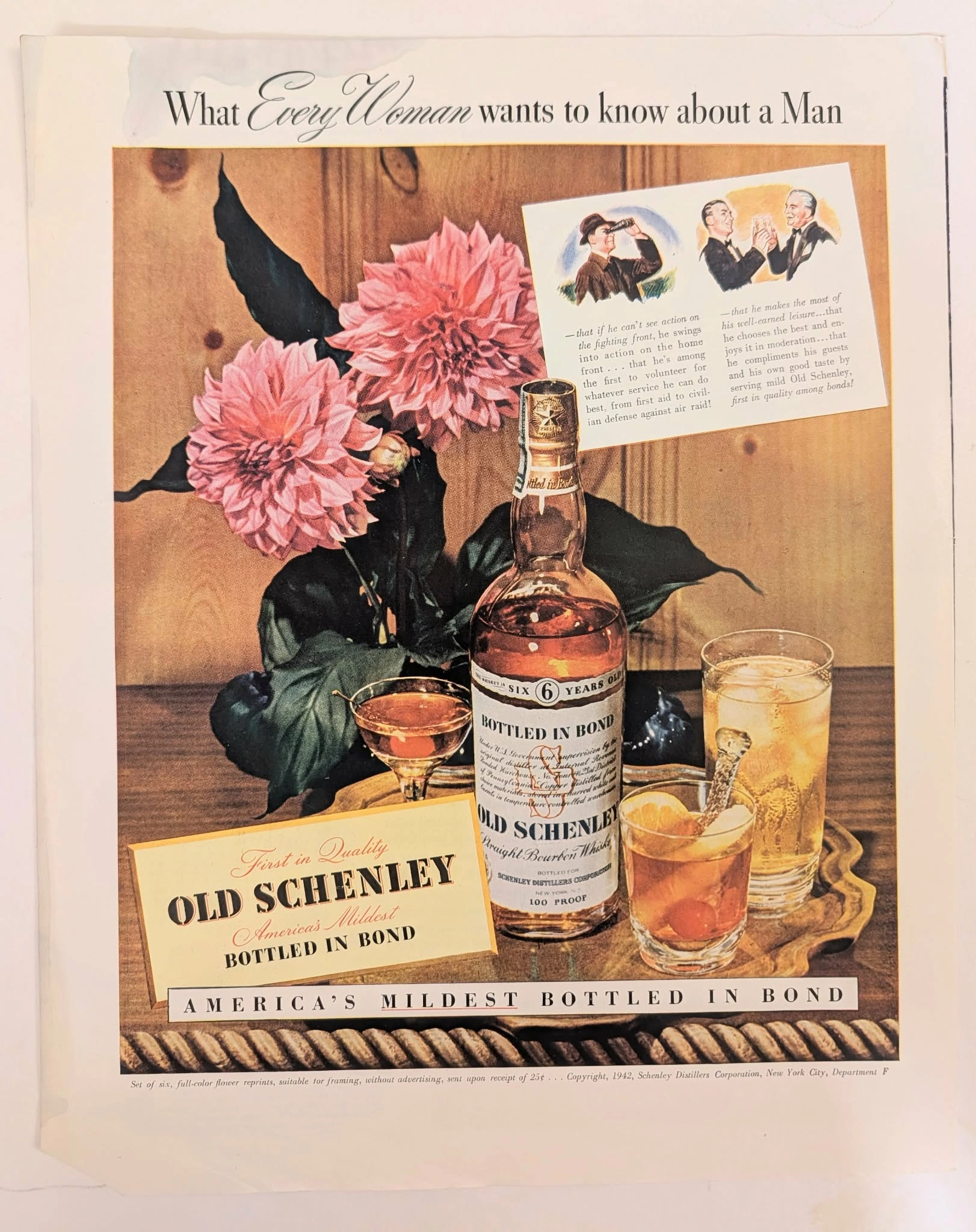
1942 Old Schenley Straight Bourbon Whiskey Vintage Advertisement
During the early 1940s, the landscape of American advertising underwent a seismic shift to align with the national war effort. This 1942 Old Schenley print advertisement masterfully bridges the gap between domestic luxury and wartime duty, operating under the compelling headline: "What Every Woman wants to know about a Man." The campaign constructs a dual expectation of the contemporary American gentleman. The first vignette illustrates a rugged dedication to civilian defense, showing a man scanning the skies with binoculars. The copy praises him because "he swings into action on the home front," explicitly honoring volunteers in first aid and air raid defense. The second vignette juxtaposes this civic duty with sophisticated leisure, depicting men in tuxedos enjoying a well-earned drink, emphasizing moderation and good taste. The paramount archival significance of this piece lies in its clever linguistic double entendre regarding the word "bond." The advertisement proudly declares Old Schenley as "first in quality among bonds!" On an industry level, this references the stringent 1897 Bottled-in-Bond Act—a government quality assurance demanding the whiskey be 100 proof, aged at least four years in a federally bonded warehouse, and the product of a single distillation season. On a cultural level, it served as a deeply patriotic nod to the aggressive national push for citizens to purchase War Bonds to fund the military. Visually, the composition relies on striking emotional contrasts. The vibrant, soft pink dahlias and the amber warmth of the whiskey in heavy crystal glasses evoke tranquility and abundance, providing psychological comfort against the austere realities of global conflict. Furthermore, this ad represents the twilight of an era; by late 1942, the Schenley Distillers Corporation and the broader American distilling industry were ordered by the War Production Board to pivot operations entirely toward producing industrial alcohol for munitions and synthetic rubber, making this commercial campaign one of the last of its kind before the industry went dormant.
Category: Lifestyle & Vice
Year: 1942
Rarity Class: A
Paper & Print Condition
Printed on medium-weight, uncoated vintage magazine stock from the wartime era, the paper exhibits moderate marginal toning (foxing) and natural light oxidation typical of wood-pulp paper from the early 1940s. The halftone color registration remains exceptionally tight, preserving the rich amber hues of the bourbon and the vivid pinks of the dahlias without significant fading or color shift. There is minor micro-tearing along the binding edge and subtle surface abrasions visible under raking light, but the central image area remains pristine, ensuring excellent structural integrity and display quality.
Provenance & Rarity
This artifact is a certified original, single-sheet extraction from an American periodical published in the second half of 1942. Its provenance can be traced back to a private northeastern United States print collection focusing on wartime industrial history and commercial ephemera. It represents a critical inflection point in American distilling history, as the War Production Board ordered all US distilleries to halt civilian spirit production by October 8, 1942, to manufacture high-proof industrial alcohol for the war effort. Consequently, commercial bourbon campaigns from this specific transitional year are highly sought after by social historians and numismatists of advertising, representing the final reserves of mature whiskey before the industry went "dry" for the military. Classified as Class A rarity, its preservation is exceptional given the domestic paper drives of WWII, which systematically destroyed over 12 million tons of paper for recycling into military packaging, making unblemished surviving prints increasingly scarce.
Rarity & Condition Summary
Designated as a Class A archival artifact, this 1942 Old Schenley advertisement achieves a remarkable 'Fine to Very Fine' condition grading. Its exceptional rarity stems from its position as an end-era commercial artifact, printed mere months before the American distilling industry halted consumer production for the WWII effort, compounded by its survival through the aggressive paper recycling drives of the 1940s. Structurally, the print exhibits only minor marginal toning and light natural oxidation, devoid of severe structural compromises such as deep creases or moisture damage. The preservation of the halftone ink registry—vibrantly capturing the golden amber of the bourbon and the deep pinks of the florals—elevates this piece from a mere commercial print to a museum-grade visual document of mid-century home-front history.