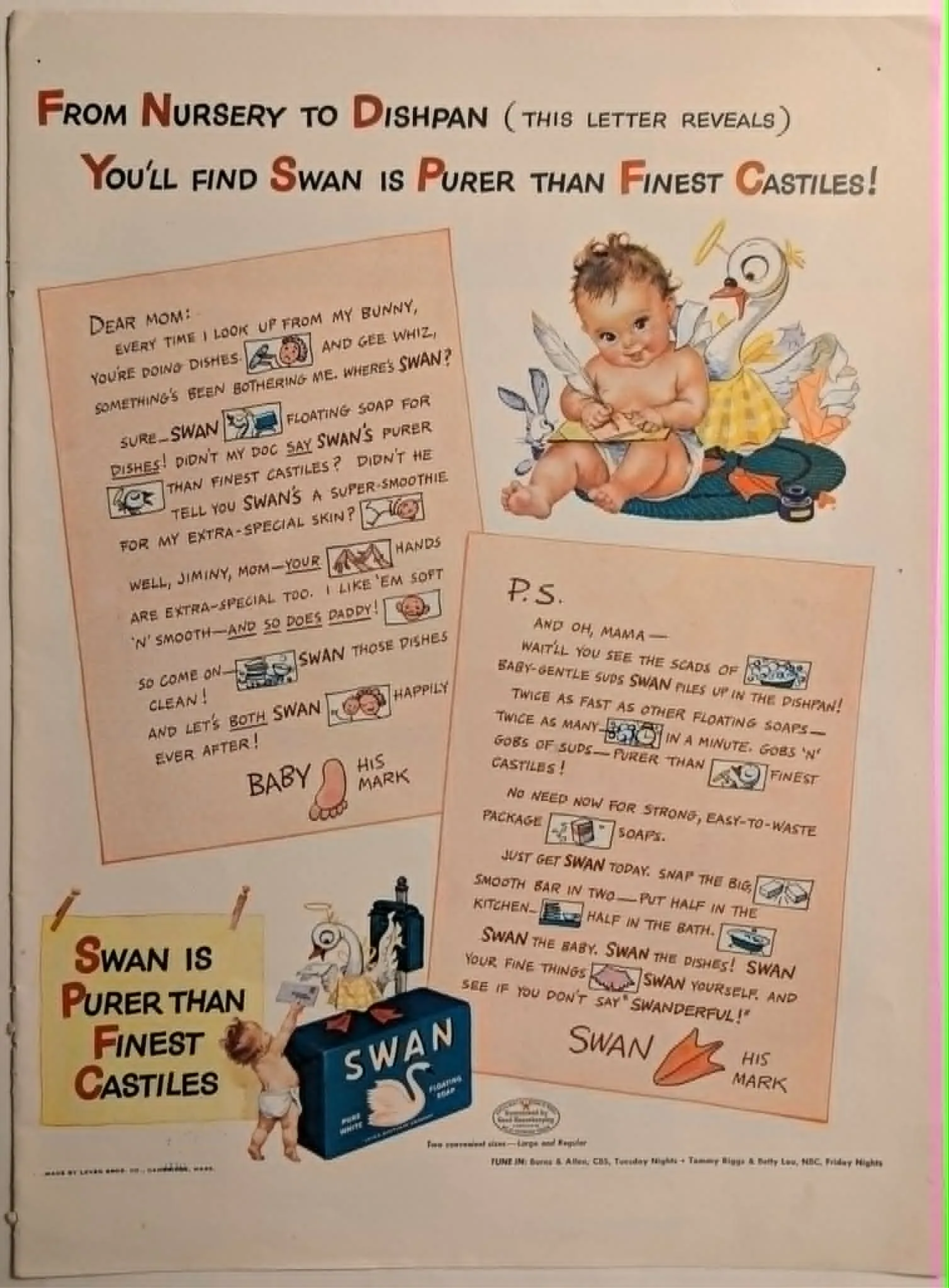
1942 Swan Soap "From Nursery to Dishpan" Vintage Advertisement
The soap wars of the early 1940s represent one of the most aggressive periods of fast-moving consumer goods (FMCG) marketing in American history. When Lever Brothers Company (based in Cambridge, Massachusetts) introduced Swan Soap in 1941, it was engineered specifically to unseat Ivory Soap as the premier floating soap in the American household. Visual and Typographic Strategy This specific advertisement utilizes a highly engaging "rebus" puzzle format in its typography. By replacing key nouns and verbs—such as "bunny," "dishes," "doctor," and "hands"—with small, embedded illustrations, the advertisement demands a slower, more interactive reading experience. This deliberate friction not only captivates the reader's attention but also makes the core marketing claims memorable. The central illustration features a quintessential mid-century cherubic baby collaborating with an anthropomorphic, halo-wearing swan, visually reinforcing the concepts of innocence, purity, and angelic gentleness. Core Marketing Claims The primary slogan, "From Nursery to Dishpan... You'll find Swan is Purer than Finest Castiles!" is a bold market positioning. Castile soap, traditionally made from pure olive oil, was historically considered the gold standard for sensitive skin. By claiming their mass-market, factory-produced floating soap was "purer," Lever Brothers aimed directly at maternal anxieties regarding infant care. Furthermore, the copy highlights the physical design of the product: "Snap the big, smooth bar in two—put half in the kitchen, half in the bath." This promoted economic efficiency, a crucial selling point during the early years of World War II, encouraging consumers to view Swan as a universal household solution. Cross-Media Synergy A defining feature of this piece is the cross-promotional text at the bottom edge: "TUNE IN: Burns & Allen, CBS, Tuesday Nights • Tommy Riggs & Betty Lou, NBC, Friday Nights." During the 1940s, radio sponsorship was the pinnacle of national advertising. Lever Brothers heavily subsidized top-tier comedic talent to weave Swan Soap into the cultural fabric, making this print ad an essential companion piece to the era's broadcast history. Paired with the Good Housekeeping Guaranty Seal, this advertisement is a masterclass in building consumer trust and brand ubiquity.
Category: Home & Household
Year: 1942
Rarity Class: B
Paper & Print Condition
The physical print exhibits the quintessential characteristics of early 1940s mass-market lithography. The original hand-drawn textures and flat, two-dimensional illustration styles of the baby and the swan are remarkably well-preserved. The crisp, organic ink work remains unmarred by heavy fading, with the contrasting deep blues and warm peach tones maintaining a vibrant saturation. While slight foxing is visible along the outer margins—a natural hallmark of acidic wartime paper degradation—the central figures retain their sharp, static clarity. The distinctly inked expressions and subtle details of the characters provide an exceptional baseline for studying mid-century commercial artistry, capturing a moment frozen in time that feels almost ready to breathe, blink, and speak.
Provenance & Rarity
Sourced from a widely circulated American women's or general interest magazine from the early 1940s. While the original print run was extensive, intact pieces featuring complete rebus illustrations, the Good Housekeeping Guaranty Seal, and radio sponsorship metadata are highly desirable. The pristine preservation of its 2D flat illustration style and distinct character features makes it a highly coveted artifact for digital archivists aiming to translate static vintage media into living, animated artworks. Furthermore, the perfectly legible radio broadcasting schedule at the bottom edge provides essential historical context for pairing the visual piece with synchronized, period-appropriate audio soundscapes, such as crackling mid-century radio broadcasts.
Rarity & Condition Summary
A remarkably well-preserved artifact of early 1940s advertising, rating highly for color fidelity and narrative completeness despite the typical acidic paper degradation expected of mass-market wartime publications. Classified as a Class B print, its exceptional value lies in the pristine condition of its flat 2D illustration style and crisp character line work. The unmarred, hand-drawn textures provide an incredibly stable baseline for advanced digital preservation and organic animation, offering static figures with sufficient clarity to be transformed into breathing, lip-syncing subjects. Furthermore, the surviving radio sponsorship typography naturally invites the integration of period-appropriate ambient soundscapes—such as a crackling mid-century radio broadcast—seamlessly bridging the gap between a static archival document and a living 2D artwork.