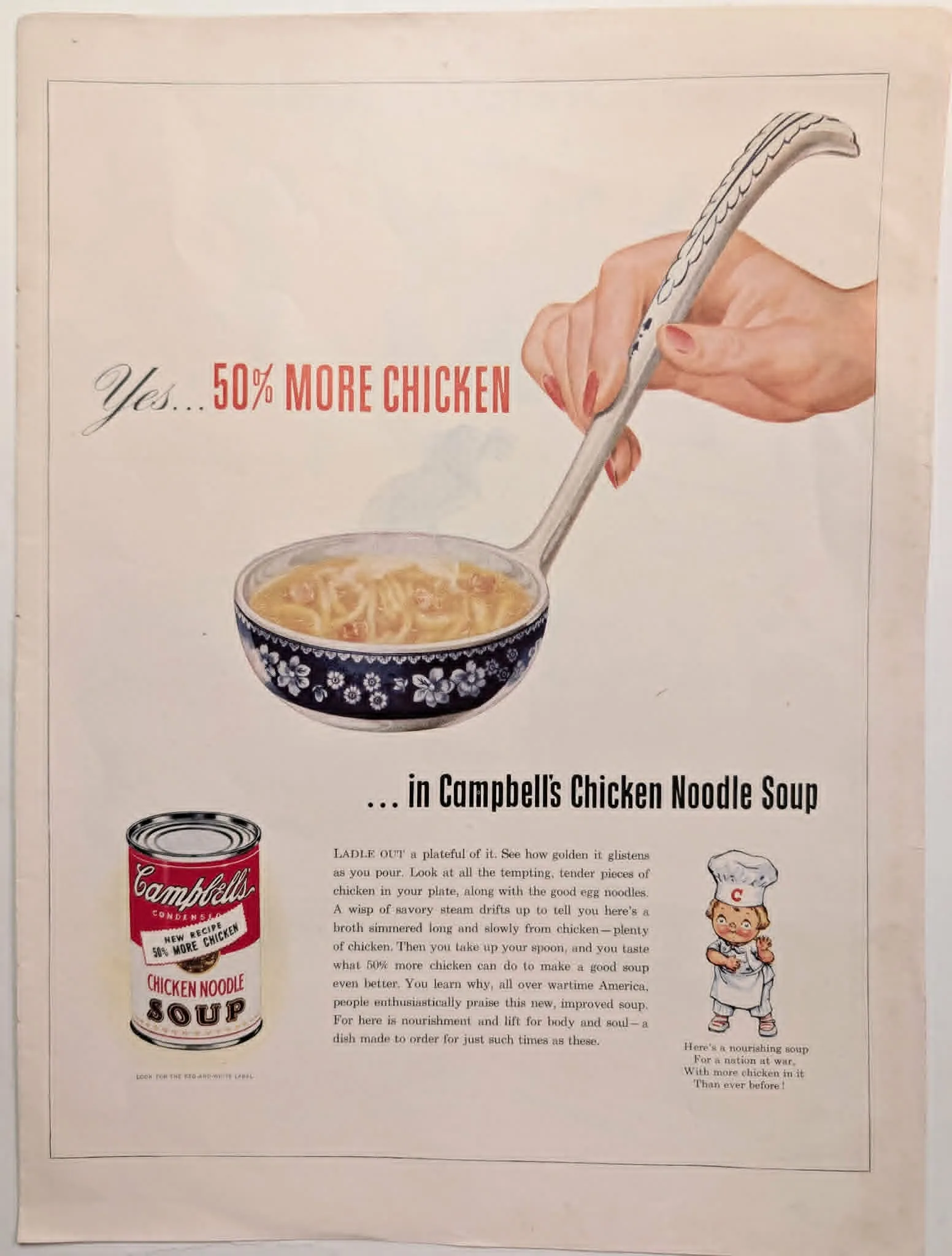
c. 1943 Campbell's Chicken Noodle Soup: "50% More Chicken" Wartime Vintage Advertisement
During the early 1940s, the American home front was deeply defined by rationing, resource conservation, and a collective national effort to support the ongoing global conflict. This advertisement for Campbell's Chicken Noodle Soup offers a fascinating glimpse into how major consumer brands adapted their messaging to resonate with a public enduring the anxieties and limitations of wartime America. The visual hierarchy of the piece is anchored by a gracefully illustrated hand holding a silver ladle, pouring a rich, golden broth into a classic blue-and-white floral bowl. This central image emphasizes abundance and warmth, providing a stark psychological contrast to the era's widespread rationing of commodities. The bold, red headline—"Yes... 50% MORE CHICKEN"—serves as a powerful value proposition. At a time when meat was strictly regulated and household budgets were tightly managed, offering significantly more protein in a familiar, highly accessible product was an exceptionally effective marketing strategy. The advertising copy explicitly grounds the product in its historical moment, noting that "all over wartime America, people enthusiastically praise this new, improved soup." It positions the meal not just as basic sustenance, but as "nourishment and lift for body and soul." To the bottom right, the iconic 'Campbell Kid' character—a staple of the brand's advertising since 1904—is depicted in a chef's uniform. The accompanying rhyming copy reinforces the patriotic and comforting tone: "Here's a nourishing soup / For a nation at war, / With more chicken in it / Than ever before!" Aesthetically, the print utilizes the standard offset lithography techniques of the mid-20th century, proudly showcasing the brand's unmistakable red-and-white label on the can positioned at the bottom left. The piece is a masterclass in commercial art from the period, seamlessly blending comforting domestic imagery with the urgent, patriotic undercurrents of the 1940s. It remains a vital document for understanding the intersection of mass-market food production and domestic resilience during World War II.
Category: Food & Beverage
Year: 1943
Rarity Class: B
Paper & Print Condition
The physical condition of this 1943 artifact is exceptional, exhibiting a highly authentic aged paper texture that perfectly represents the lightweight stock utilized during wartime rationing. This distinct, even patina provides an ideal surface for the offset lithography. Crucially, the period color palette remains striking; the signature Campbell's red and the delicate blue floral patterns on the soup bowl retain their original vibrancy without significant ink bleeding. The print beautifully preserves the original flat illustration style of mid-century commercial art, particularly evident in the crisp lines and unshaded color blocks forming the Campbell Kid character. There is no severe foxing or structural degradation, making it a pristine historical document.
Provenance & Rarity
Sourced from a high-circulation American mass-market periodical published during the height of the Second World War (c. 1943). While the initial print run of these magazines was in the millions, the survival rate of domestic wartime ephemera is surprisingly low. A significant portion of these publications was subsequently sacrificed to national wartime paper scrap drives—a collective civilian effort to support military supply chains and resource conservation. Consequently, finding intact specimens that have avoided these patriotic recycling efforts, as well as the common ravages of moisture, vermin, and UV degradation over eighty years, is increasingly challenging. This historical attrition elevates the artifact's archival value, placing it firmly in Rarity Class B. Its provenance serves as a direct, tangible link to the American home front, transforming a mass-produced commercial print into a scarce historical document of wartime resilience and adaptive corporate messaging.
Rarity & Condition Summary
Rarity Class: Class B Summary: A beautifully preserved example of mid-century wartime advertising. Its primary institutional value rests in its socio-historical commentary and the pristine presentation of iconic brand mascots. Furthermore, the highly authentic aged paper texture and flawlessly preserved original flat illustration style make it an exceptional reference for digital preservation and period-accurate 2D animation, maintaining its visual integrity despite the inherently fragile nature of 1940s paper stock.