1943 Mallory Hats "The Ranger" Vintage Advertisement (1943) — Class B vintage Lifestyle & Vice
CLASS B
1 of 7

1943 Mallory Hats "The Ranger" Vintage Advertisement

Category|Lifestyle & Vice
Year|1943
Rarity Class|CLASS B
Archive Views|7
Heritage AdvertisementsFashion & BeautyClothing
Ad Content TypeLifestyle

Last updated: 16 Apr 2026

Historical Context

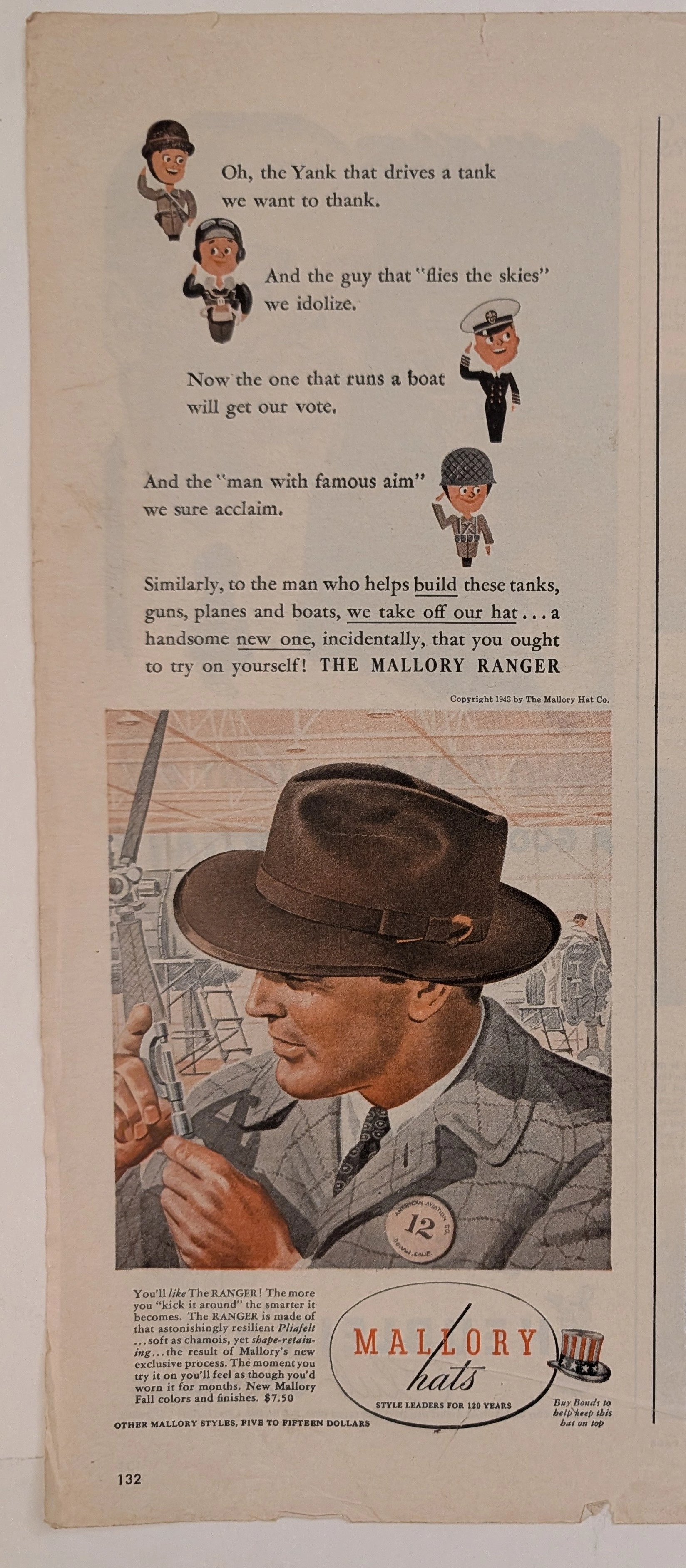
1943 Mallory Hats: The Ranger Fedora Vintage Print Advertisement This 1943 print advertisement by The Mallory Hat Co. provides a remarkable window into the sociological and economic landscape of the American home front during World War II. At a time when consumer goods were increasingly rationed and advertising space was frequently repurposed for government messaging, Mallory Hats strategically aligned its brand with the patriotic war effort. The ad's focal point is a smartly dressed civilian worker meticulously inspecting a machined part with a micrometer. His lapel prominently displays an identification badge reading "American Aviation Co., 12, Downey, Calif.," immediately establishing him as a crucial contributor to the aerospace defense industry. This visual narrative is reinforced by the accompanying poetic verse, which acknowledges the valor of soldiers, sailors, and airmen, but transitions to its primary thesis: "Similarly, to the man who helps build these tanks, guns, planes and boats, we take off our hat." Beyond its cultural commentary, the advertisement introduces "Pliafelt," a proprietary manufacturing process developed by Mallory. Described as "astonishingly resilient" and "soft as chamois, yet shape-retaining," Pliafelt represents the mid-century push toward material innovation, even amid wartime restrictions. The durability emphasized by the phrase "the more you 'kick it around' the smarter it becomes" resonated deeply with a consumer base transitioning to utilitarian, long-lasting goods rather than fleeting fashion trends. Furthermore, the advertisement seamlessly integrates the civic duty of war financing. The iconic Uncle Sam top hat illustration, accompanied by the directive "Buy Bonds to help keep this hat on top," serves as a stark reminder of the era's pervasive socio-political responsibilities. Retailing at $7.50, "The Ranger" was positioned as a premium yet accessible staple for the working American man, securing Mallory's legacy as "Style Leaders for 120 Years."

Paper & Print Condition

The piece exhibits standard newsprint/magazine stock characteristics typical of the mid-1940s. The halftone printing of the main illustration is remarkably well-preserved, and the color saturation of the deep browns and greys remains notably strong despite the acidic nature of period paper.

Provenance & Rarity

A wartime issue, likely extracted from a prominent national magazine of the era. Advertisements from 1943 featuring specific regional defense plant badges (Downey, California) are of particular interest to industrial, aerospace, and military historians.

Rarity & Condition Summary

A highly authentic, well-preserved artifact of WWII home-front advertising. Its structural integrity is excellent, making it a vital piece for studying the intersection of mid-century men's fashion and wartime industrial propaganda.
Share This Archive

From the Journal

Related Articles

The Time Traveller's Dossier: The Architecture of Masculine Dominance – Pierre Cardin Editorial Illustration (Circa 1980s) — related article
Read Article

The Time Traveller's Dossier: The Architecture of Masculine Dominance – Pierre Cardin Editorial Illustration (Circa 1980s)

History is not merely written; it is tailored, draped, and aggressively padded at the shoulders. Long before digital algorithms dictated the sterile parameters of modern menswear, and before the casualization of the corporate wardrobe stripped the modern executive of his sartorial armor, societal engineering was executed through the calculated geometry of the designer suit. The historical artifact before us is not a mere disposable magazine tear sheet; it is a perfectly weaponized blueprint of 1980s hyper-masculinity, a visual manifesto of corporate dominance, and an unwavering testament to an era when clothing was utilized as a tool for physical and psychological intimidation. ​This museum-grade, academic archival dossier presents an exhaustive deconstruction of a late-analog editorial illustration featuring the revolutionary menswear of Pierre Cardin, dating to the pivotal "Power Suit" era of the 1980s. Operating on a profound, ruthless binary structure, this document records a calculated paradigm shift within the global fashion industry. It captures the precise historical fracture where menswear transitioned conceptually from the conservative, conformity-driven "Organization Man" of the mid-20th century into the aggressive, space-commanding "Power Broker" of the 1980s. Through the highly specialized lens of late-analog commercial artistry and stringent visual forensics, this document serves as a masterclass in the psychological marketing of gender and power. It established the foundational archetype for the modern, alpha-male aesthetic—an archetype that unconditionally dictates the visual and strategic totems of corporate dominance even today.

The Time Traveller's Dossier : WWII War Bonds - Corporate Conscription — related article
Read Article

The Time Traveller's Dossier : WWII War Bonds - Corporate Conscription

A nation does not wage war with steel alone. It wages war with capital. It fights with belief. Before 1941, the American consumer was a creature of comfort, trained by an emerging advertising industry to desire soda, automobiles, and modern conveniences. Then came the sudden violence of global conflict. The factories pivoted. The supply chains froze. The consumer economy ground to a sudden, devastating halt. Yet, the advertising machinery did not sleep. It was conscripted. The artifacts presented here—fragments of print from 1943, embedded within the commercial messaging of companies like The Seven-Up Co. and Autocar Trucks—represent a monumental shift in human behavior. This was the moment the public was asked to purchase the future instead of the present. The strategy was unprecedented. Convert the civilian into a shareholder of the state. Transform the act of saving into the ultimate act of aggression against an unseen enemy. This is not merely a collection of vintage advertisements. It is the exact inflection point where corporate marketing was weaponized for national survival.

The Time Traveller's Dossier: The Sanctuary of the Highway – The 1968 Ford LTD and the Democratization of Silence — related article
Read Article

The Time Traveller's Dossier: The Sanctuary of the Highway – The 1968 Ford LTD and the Democratization of Silence

The evolution of the American domestic automobile during the mid-twentieth century was fundamentally propelled by a relentless pursuit of accessible luxury and physical isolation from the rapidly expanding, concrete-laden modern world. The historical artifact elegantly and securely positioned upon the analytical table of The Record Institute today is a striking, full-page print advertisement for the 1968 Ford LTD, originating from a highly volatile and transformative year in American history. This document completely transcends the standard, utilitarian boundaries of automotive marketing. It operates as a highly sophisticated, multi-layered cultural mirror, reflecting the precise era when raw horsepower was momentarily subjugated to the pursuit of absolute silence, and European-grade luxury was explicitly packaged and sold to the American middle-class consumer. This world-class, comprehensive dossier conducts a meticulous, unyielding, and exceptionally exhaustive examination of the artifact, operating under the absolute most rigorous parameters of historical, sociological, and material science evaluation. With the vast majority of our analytical focus dedicated to its immense historical gravity (80%), we will decode the brilliant marketing psychology embedded within Ford's audacious "Quiet" campaign, analyze the brutalist architectural juxtaposition of the concrete overpass against the sleek lines of the vehicle, and dissect the profound corporate semiotics of the iconic "Ford has a better idea" lightbulb logo. Furthermore, as we venture deeply into the chemical and physical foundations of this analog printed ephemera (10%), we will reveal the precise mechanical fingerprints of the CMYK halftone rosettes captured in the macro imagery of the wheel hubcap. Finally, we will assess its archival rarity (10%), exploring how the graceful, natural oxidation of the paper substrate cultivates a serene wabi-sabi aesthetic—a natural, irreversible phenomenon that serves as the primary engine driving up its market value exponentially within the elite global spheres of Vintage Commercial Ephemera and Automotive Archives.

The Time Traveller's Dossier: The Alchemy of Royal Rebellion – Drambuie "Bonnie Prince Charlie" Advertisement (Circa Mid-20th Century) — related article
Read Article

The Time Traveller's Dossier: The Alchemy of Royal Rebellion – Drambuie "Bonnie Prince Charlie" Advertisement (Circa Mid-20th Century)

History is rarely an objective chronicle of facts; it is a malleable narrative, continually rewritten, romanticized, and ultimately weaponized by those seeking to legitimize their power or, in the modern era, their products. Long before digital algorithms could synthesize artificial heritage, the supreme manifestation of corporate alchemy was executed through the calculated precision of the four-color offset press and the appropriation of historical iconography. The artifact presented before us is not merely a vintage magazine tear sheet selling a Scottish liqueur. It is a masterclass in the commodification of myth, a visual distillation of romantic rebellion, and a foundational blueprint for what is now known as "Heritage Branding." This museum-grade, academic archival dossier presents an exhaustive, microscopic deconstruction of a mid-20th-century print advertisement for Drambuie Liqueur. Operating on a profound binary structure, this document records a calculated paradigm shift within the global spirits industry. It captures the precise historical fracture where a highly specific, geographically isolated alcoholic beverage was conceptually transmuted into a literal draught of royal rebellion and aristocratic romance. Through the highly specialized lens of late-analog commercial artistry and stringent visual forensics, this document serves as a masterclass in psychological marketing. It established the foundational archetype for linking the consumption of a physical product with the ingestion of an epic, historical fantasy—an archetype that unconditionally dictates the visual and strategic totems of the modern luxury spirits industry today.