1943 Mobiloil & Mobilgas "Winterproof" Vintage Advertisement (1943) — Class B vintage Automotive
CLASS B
1 of 5

1943 Mobiloil & Mobilgas "Winterproof" Vintage Advertisement

Category|Automotive
Year|1943
Rarity Class|CLASS B
Archive Views|9

Last updated: 19 Apr 2026

Historical Context

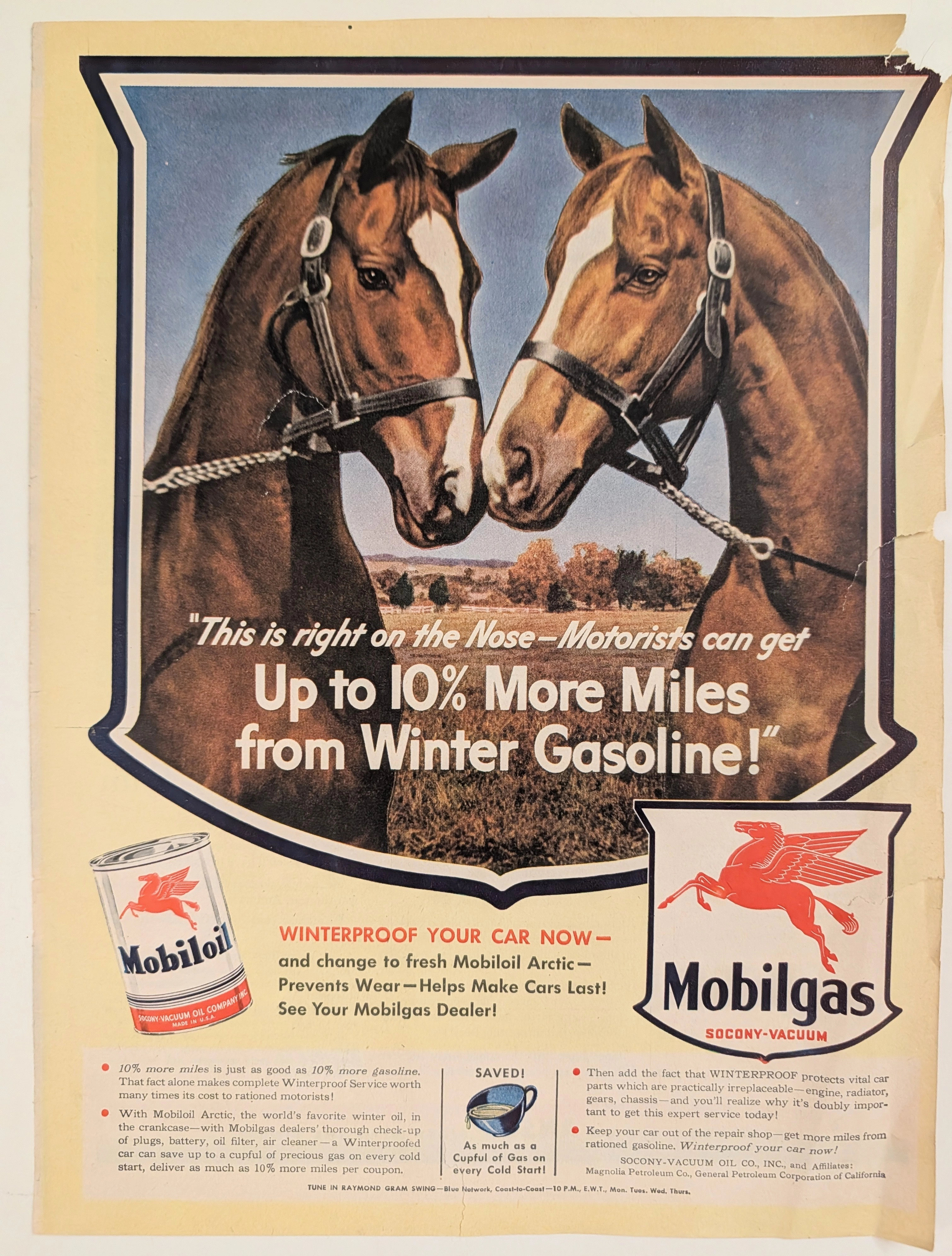
1943 Mobiloil & Mobilgas "Winterproof" Vintage Advertisement The onset of US involvement in World War II brought about strict rationing of essential goods, with gasoline and rubber being among the most heavily restricted. This advertisement by Socony-Vacuum (the predecessor to ExxonMobil) reflects the immediate shift in automotive marketing from performance and luxury to conservation and longevity. The Equine Idiom and Americana: The visual hook features two horses face-to-face, illustrating the phrase "This is right on the Nose." By utilizing familiar, comforting, and distinctly American equestrian imagery, the brand effectively softens the anxiety surrounding wartime fuel shortages. It bridges traditional agrarian reliability with modern industrial necessity. Marketing Conservation: The core message explicitly targets "rationed motorists." Instead of promising speed or power, the advertisement sells efficiency—up to "10% More Miles" and saving "As much as a Cupful of Gas on every Cold Start!" The striking illustration of a blue teacup spilling precious fuel masterfully visualizes the micro-economics of wartime driving, where every ounce of gasoline was a heavily regulated commodity. Brand Iconography: The iconic red Pegasus, a symbol of power and speed since the 1930s, is prominently featured on both the oil can and the Mobilgas shield. Its presence reassures the consumer of the brand's enduring quality and stability in an era of global uncertainty, while subtly aligning corporate endurance with the national war effort.

Paper & Print Condition

Printed on standard mid-century magazine stock. The paper exhibits mild age-toning. Noticeable edge wear and slight paper loss are present along the right margin, indicative of its extraction from a bound periodical. However, the lithographic print quality remains high; the rich browns of the equine illustration, the vibrant red of the iconic Pegasus, and the deep blue of the teacup graphic maintain striking clarity and contrast.

Provenance & Rarity

Sourced from an American mass-market publication circulated during the Second World War. While these advertisements were widely printed, well-preserved examples that successfully capture the intersection of corporate branding and civilian rationing psychology are highly valued by historians of mid-century commercial art and automotive history.

Rarity & Condition Summary

An authentic and highly communicative historical artifact. The marginal wear authenticates its provenance, while the well-preserved central imagery provides a vivid window into wartime consumer conservation efforts.
Share This Archive

From the Journal

Related Articles

The Time Traveller's Dossier: Engineering as High Art – 1981 Honda CBX Advertisement — related article
Read Article

The Time Traveller's Dossier: Engineering as High Art – 1981 Honda CBX Advertisement

History is not written; it is printed. Before digital algorithms dictated human behavior, societal engineering was executed through the calculated geometry of the four-color offset press. The historical artifact before us is not merely an advertisement; it is a weaponized blueprint of mechanical aspiration and a testament to the golden age of Japanese technological supremacy. This museum-grade archival dossier presents an academic deconstruction of a 1981 print advertisement for the legendary Honda CBX. Operating on a profound binary structure, it documents a calculated paradigm shift within the global motorcycle industry. It illustrates the precise historical fracture where the motorcycle was conceptually transitioned from a stigmatized symbol of counter-culture rebellion into a highly sophisticated, aerodynamic marvel tailored for the affluent connoisseur. Through the lens of late-analog commercial artistry and precise visual forensics, this document serves as a masterclass in psychological marketing, establishing the archetype of the high-tech superbike that unconditionally dominates modern automotive pop culture.

The Time Traveller's Dossier: The Architecture of Command and Authority – The 1956 Chrysler "PowerStyle" Manifesto — related article
Read Article

The Time Traveller's Dossier: The Architecture of Command and Authority – The 1956 Chrysler "PowerStyle" Manifesto

History is not merely chronicled through written texts; it is forged in cold steel, sculpted in gleaming chromium, and dictated by the absolute, ruthless triumph of industrial design. Long before the modern world was infected and subdued by sterile digital algorithms and soulless autonomous vehicles, there was an era where the guttural roar of a V-8 engine was the ultimate symphony of American prosperity. In this bygone epoch, automotive architecture was a literal weapon—a physical manifestation used to declare a man’s absolute sovereignty over space and time. The historical artifact that stands before us is not merely a decaying magazine advertisement ravaged by the decades. It is an absolute "Blueprint of Victory." It is the visual manifesto utilized by Chrysler in 1956 to violently obliterate the mundane complacency of its rivals, aggressively establishing the "Era of Pushbutton Command" as the mandatory new standard for the American elite. ​This museum-grade academic archival dossier will execute an exhaustive, uncompromising deconstruction of the 1956 Chrysler New Yorker "PowerStyle" campaign—the absolute zenith of the legendary "Forward Look" design philosophy. Through the highly specialized lens of visual forensics and commercial semiotics, we will expose how every single brushstroke, every shadow, and every line of copywriting was deployed in a calculated psychological war to transform the ordinary "driver" into a sovereign "pilot." This document serves as an undeniable testament to how Chrysler artificially engineered "America's most smartly different car," weaponizing the zeitgeist of the Jet Age to monopolize consumer desire. This is a Class S marketing relic that has survived the destructive progression of time to validate its supremacy in your hands today.

The Time Traveller's Dossier : VW Type 3 Automatic - The Compromise of Engineering — related article
Read Article

The Time Traveller's Dossier : VW Type 3 Automatic - The Compromise of Engineering

We often remember early Volkswagen history through the lens of simplicity, air-cooled engines, and rugged manual transmissions. But as the American market matured, the demand for comfort began to clash with the brand's original philosophy. This document is historical evidence capturing that moment of compromise. It is not just a car advertisement; it is an engineering confession and a declaration. After a decade of hesitation, Volkswagen of America introduced a fully automatic transmission for the 1969 models. It is a turning point showing that even the most stubborn brand had to adapt to the American consumerism trend that sought ultimate convenience.

The Time Traveller's Dossier: Gridline Velocity – Kenwood Car Stereo and the Cybernetic Dawn of Automotive High-Fidelity — related article
Read Article

The Time Traveller's Dossier: Gridline Velocity – Kenwood Car Stereo and the Cybernetic Dawn of Automotive High-Fidelity

The evolution of 1980s American consumer electronics was fundamentally defined by the aggressive pursuit of portable and automotive high-fidelity sound. Elegantly and securely positioned upon the analytical table of The Record Institute today is a visually arresting, neon-drenched full-page print advertisement for Kenwood Car Stereo. This document completely transcends the standard, utilitarian boundaries of automotive accessory marketing. It operates as a highly sophisticated cultural mirror, reflecting a precise era in consumer psychology where auditory power was directly equated with vehicular performance. By utilizing a breathtaking, airbrushed illustration of a futuristic, aerodynamic race car accelerating over a cybernetic gridscape, Kenwood brilliantly positioned its audio equipment not just as radios, but as extreme, high-octane performance upgrades capable of generating sound that will literally "blow your doors off." This world-class, comprehensive dossier conducts a meticulous, unyielding, and exceptionally exhaustive examination of the artifact, operating under the absolute most rigorous parameters of historical, sociological, and material science evaluation. Dedicating the overwhelming majority of our analytical focus (80%) to its immense historical gravity, we will decode the brilliant marketing psychology embedded within the "neon grid" visual narrative, analyze the profound cultural shift toward aftermarket car audio customization, and dissect the aggressive, performance-based copywriting. Furthermore, as we venture deeply into the chemical and physical foundations of this analog printed ephemera (10%), we will reveal the precise mechanical fingerprints of the CMYK halftone rosettes captured in the stunning macro imagery of the airbrushed car. Finally, we will assess its archival rarity (10%), exploring how the graceful, natural oxidation of the paper substrate cultivates a serene wabi-sabi aesthetic—a natural, irreversible phenomenon that serves as the primary engine driving up its market value exponentially within the elite global spheres of Vintage Commercial Ephemera, Audio History, and Outrun/Synthwave Art Archives.