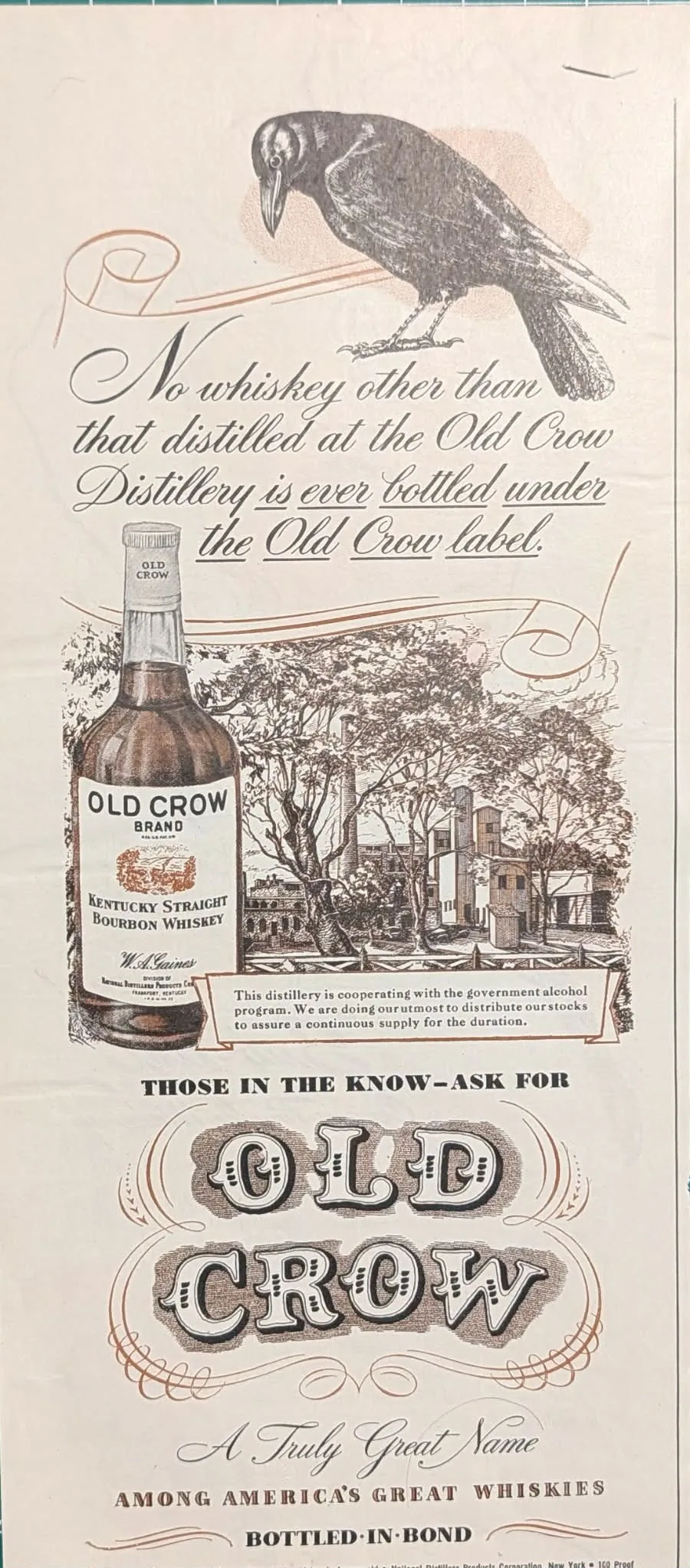
1943 Old Crow Kentucky Straight Bourbon Whiskey Vintage Advertisement
During the mid-twentieth century, the American spirits industry navigated a complex landscape of shifting consumer demands and federal regulations. This remarkable 1943 advertisement for Old Crow stands as a definitive testament to that era, bridging commercial heritage with the socio-economic realities of the World War II home front. The inclusion of a highly specific disclaimer—noting the distillery’s cooperation with the "government alcohol program" to assure a continuous supply "for the duration"—firmly anchors this piece in wartime history. During this period, distilleries were mandated to pivot toward producing industrial alcohol for munitions and synthetic rubber, making aged whiskey stocks a carefully allocated commodity. Artistically, the advertisement is a masterclass in mid-century commercial lithography and visual authority. The composition is anchored by a meticulously detailed, etching-style illustration of the avian mascot, rendered with exquisite cross-hatching that mimics the tactile aesthetic of 19th-century steel engravings. This classical, grounded approach reinforces the brand’s deep legacy and the "Bottled in Bond" guarantee of 100-proof quality. Below the central text, a finely drawn vignette of the W.A. Gaines distillery visually roots the product in its authentic Kentucky origins. The restrained use of mechanical color separation further elevates the piece. Instead of relying on full-color processing, the artist utilized a strategic copper-brown spot color. Applied to the swirling decorative borders, the dimensional shading of the typography, and the atmospheric background elements, this sepia-toned palette evokes the rich, amber warmth of the bourbon itself. The expressive, hand-drawn script elegantly contrasts with the sturdy, shaded serif fonts of the main header, resulting in a beautifully balanced, historically significant piece of advertising art.
Category: Alcohol
Year: 1943
Rarity Class: A
Paper & Print Condition
The archival substrate—a classic example of the slightly acidic stock typical of wartime publications like The Saturday Evening Post—displays a beautiful, authentic aged paper texture. It has developed a warm, even patina that enhances its historical visual impact without compromising structural integrity. Close examination reveals the pristine clarity of the black lithographic line work, which expertly captures the intricate cross-hatching and deep contrast of the original etching style. Furthermore, the strategic copper-brown spot color remains remarkably vibrant; the halftone patterns show no severe spreading or fading, standing as a testament to the resilient ink formulations used despite 1940s supply constraints.
Provenance & Rarity
Sourced from the mainstream American print media landscape during the height of World War II, this piece possesses exceptional historical provenance. It is highly notable for its specific messaging regarding the distillery's cooperation with the wartime government alcohol program, a mandate that forced distilleries to divert resources toward industrial alcohol production. Surviving paper artifacts that so explicitly bridge commercial brand marketing with home-front socio-economic realities are increasingly scarce, as much of the era's paper was recycled in wartime scrap drives. Within the archives of The Record Institute, this piece is classified as a Class A artifact, signifying its high rarity and immense value as a primary historical document.
Rarity & Condition Summary
A highly collectible Class A artifact, this piece exemplifies museum-grade preservation of mid-century advertising and wartime socio-economic history. The remarkable integrity of the acidic paper stock, combined with the unblemished clarity of the etching-style lithography and resilient copper-toned spot color, elevates it from a transient WWII-era consumer print to a vital primary document of American distilling heritage.