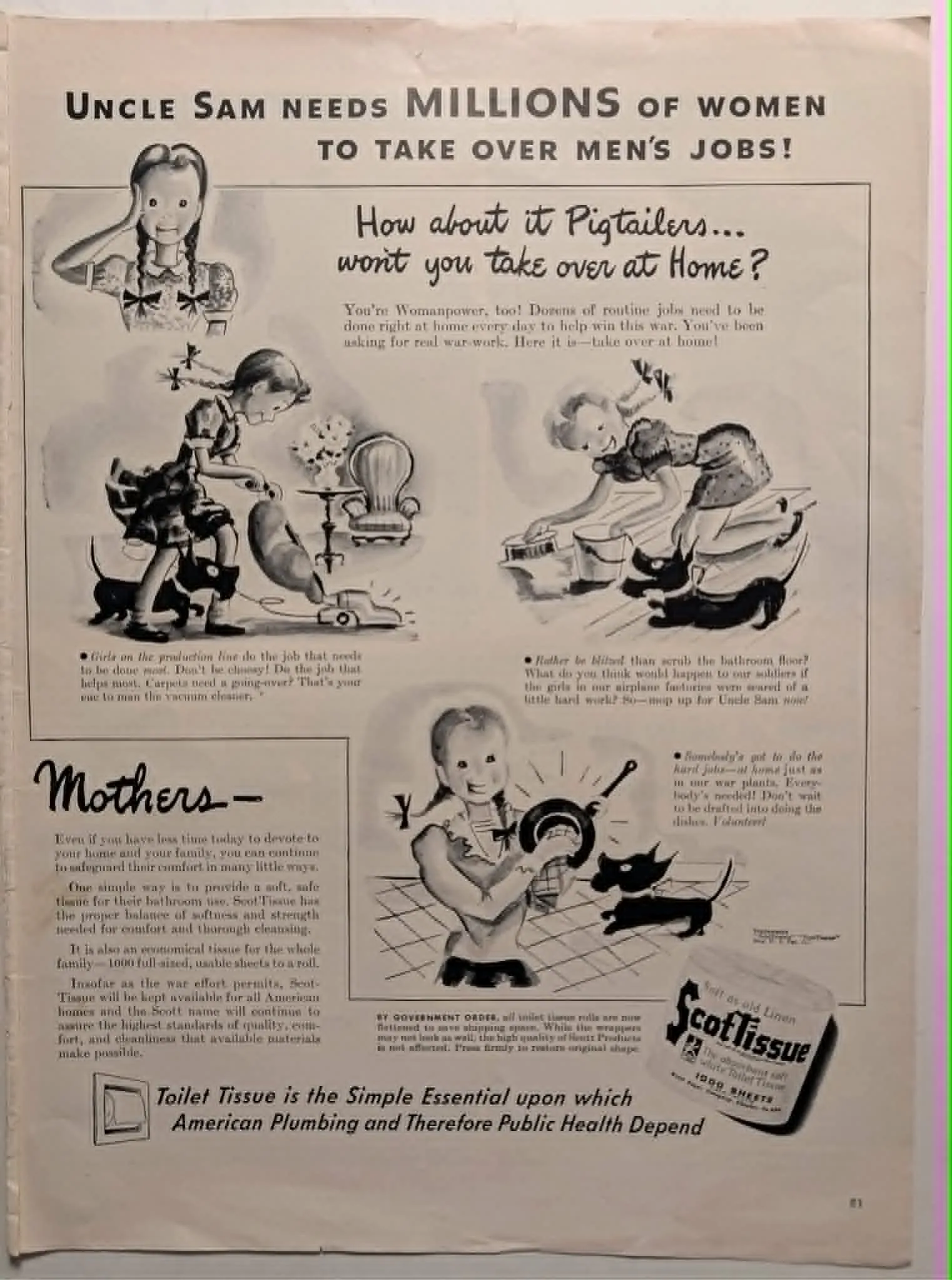
1943 ScotTissue "Uncle Sam Needs Millions of Women" Vintage Advertisement
This ScotTissue advertisement is a quintessential example of World War II-era commercial messaging, where brands intricately wove patriotism and wartime necessity into their standard marketing copy. The "Pigtailer" and Domestic Mobilization The campaign cleverly taps into the broader "Womanpower" movement—most famously associated with adult icons like Rosie the Riveter—and extends its reach to female children. By urging "Pigtailers" to take over the vacuuming, floor scrubbing, and dishwashing, the advertisement suggests that even children can perform "real war-work." The copy asserts that freeing up adult women from these tasks allows them to be drafted into airplane factories and war plants. The illustrations feature young girls enthusiastically completing these chores, accompanied by the iconic Scottish Terrier, a longstanding mascot for the Scott Paper Company that adds a layer of innocent domesticity to the heavy wartime themes. Wartime Rationing and Logistics Beyond its social messaging, the advertisement stands as a primary source document for wartime supply chain logistics. A critical historical detail is found in the fine print near the product illustration: "BY GOVERNMENT ORDER, all toilet tissue rolls are now flattened to save shipping space. While the wrappers may not look as well, the high quality of Scott Products is not affected. Press firmly to restore original shape." This reflects the profound impact of government agencies like the War Production Board on everyday consumer goods. Maternal Reassurance Amidst Scarcity A dedicated sidebar addressed to "Mothers" serves to assuage fears regarding the decline of product quality during a period of intense rationing. The brand reassures consumers that despite the aesthetic changes to the flattened packaging, ScotTissue retains its "proper balance of softness and strength," ensuring that public health and basic American plumbing standards are maintained during the global conflict.
Category: Home & Household
Year: 1943
Rarity Class: A
Paper & Print Condition
Printed on standard mid-century magazine stock, this artifact prominently features an authentic aged paper texture characteristic of wartime publications. The paper exhibits noticeable oxidation and a warm, period-appropriate patina along the margins. The black and white ink contrast remains relatively sharp, beautifully preserving the original flat illustration style and the delicate, hand-drawn stroke quality of the wash-style artwork. The typography maintains its crisp legibility against the historically weathered background.
Provenance & Rarity
Sourced from a mass-market American periodical circulated during the height of the Second World War, this advertisement serves as a vital primary document of domestic mobilization. Its rarity is significantly elevated by the explicit inclusion of a government-mandated product alteration—specifically, the flattening of toilet tissue rolls to conserve essential military shipping space. While generalized patriotic advertising was ubiquitous in the 1940s, commercial artifacts that document direct logistical interventions by the War Production Board onto everyday consumer goods are notably scarce. Furthermore, its sociological framing, which aggressively targets young girls ("Pigtailers") to assume adult domestic duties in support of the industrial "Womanpower" initiative, makes it a highly sought-after piece for scholars of wartime gender dynamics and advertising history. This confluence of material scarcity and historical weight secures its Class A rarity status.
Rarity & Condition Summary
Rarity Class: Class A Summary: This artifact is a remarkably preserved piece of wartime mobilization messaging. While it exhibits moderate, expected age-related wear—such as margin oxidation and yellowing inherent to mid-century newsprint—it remains structurally sound and visually striking. Its explicit documentation of government-mandated rationing policies, combined with its highly specific sociological approach to mobilizing female children for the home front, solidifies its immense cultural, historical, and archival value.