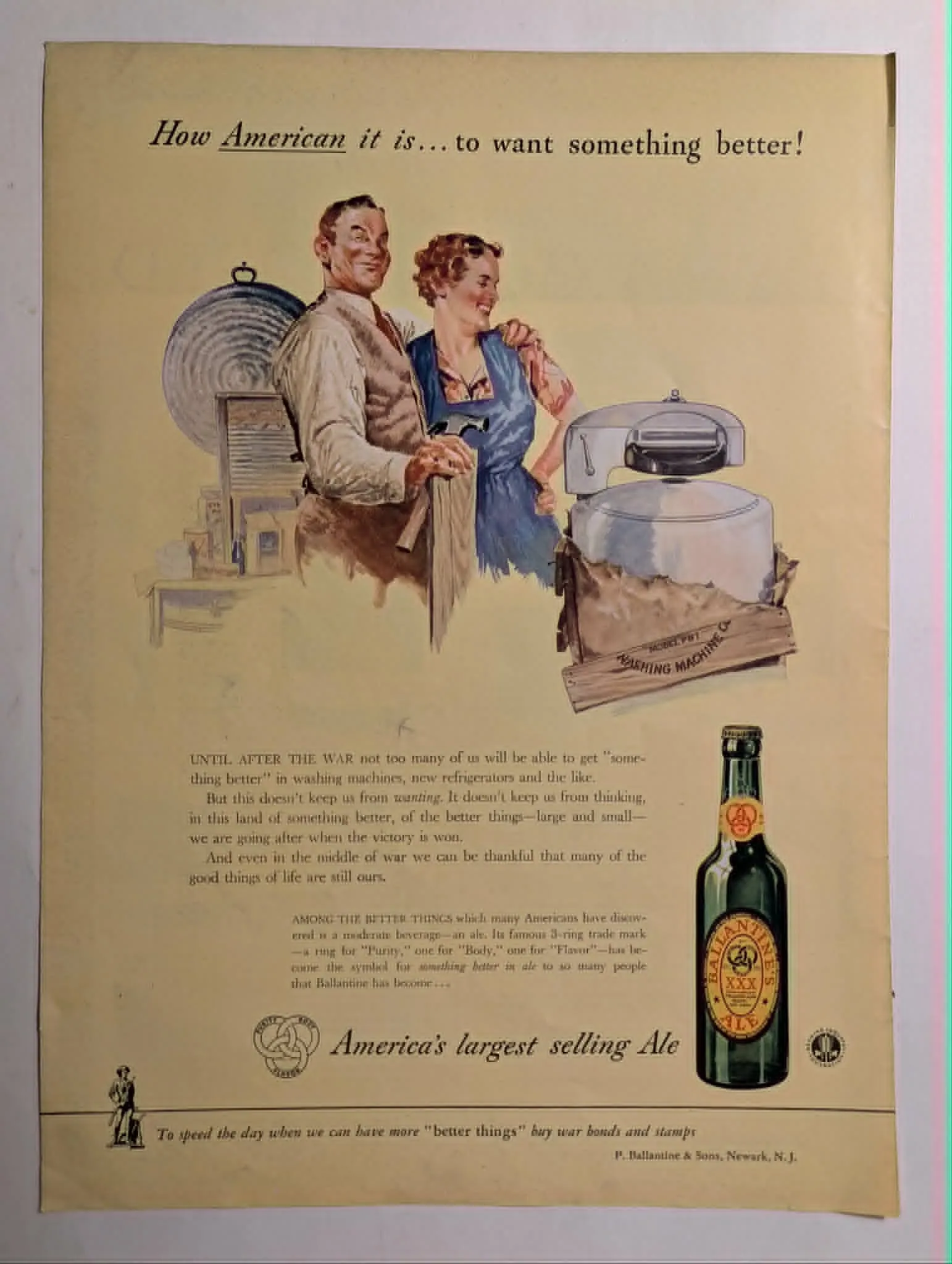
1944 Ballantine Ale "Something Better" Vintage Advertisement
The mid-1940s represented a fascinating pivot point in American advertising. With factories repurposed for the war effort, domestic appliances like refrigerators and washing machines were virtually impossible to acquire. P. Ballantine & Sons, brewing in Newark, New Jersey, capitalized on this shared national yearning in their "How American it is... to want something better!" campaign. Visual and Narrative Strategy The advertisement's composition centers on a jubilant husband and wife unboxing a pristine "Model PG1" washing machine. The accompanying copy gently grounds this image in wartime reality: "UNTIL AFTER THE WAR not too many of us will be able to get 'something better' in washing machines... And even in the middle of war we can be thankful that many of the good things of life are still ours." By positioning Ballantine Ale as one of those accessible "good things," the brand aligned itself with both patriotic patience and the American Dream. The inclusion of the Minuteman iconography at the bottom left, urging citizens to "buy war bonds and stamps," further cements the piece in its historical era, operating simultaneously as a product pitch and a public service announcement. Artistry and Digital Preservation Potential From an archival standpoint, the visual execution is a masterclass in mid-century commercial art. The piece avoids hyper-realistic rendering, instead relying on a beautiful, flat 2D illustration style. The characters are rendered with visible, organic hand-drawn textures—from the folds of the man's vest to the subtle blush on the woman's cheek. These stylistic choices make this artifact an exceptional candidate for digital transformation into a living artwork. The distinct, well-defined character line work provides a highly stable baseline for organic animation. One can easily envision these static figures breathing naturally, blinking, and sharing a short, era-appropriate phrase with synchronized lip movement. Furthermore, the domestic wartime setting naturally invites the integration of an ambient period-appropriate soundscape. The visual narrative is profoundly enhanced when imagined alongside the subtle audio of a crackling 1940s radio broadcasting in the background, seamlessly bridging the gap between a static print and an immersive historical experience.
Category: Alcohol
Year: 1944
Rarity Class: B
Paper & Print Condition
The lithographic print exhibits the quintessential characteristics of wartime mass-market publications. The original hand-drawn textures and flat, two-dimensional illustration styles of the couple and the appliance are remarkably well-preserved. The warm, organic ink washes remain unmarred by heavy fading. Minor edge wear is present, but the central figures retain their sharp, static clarity, free of any modern 3D rendering artifacts.
Provenance & Rarity
Sourced from a widely circulated American publication during WWII. Complete with the Brewing Industry Foundation seal, the iconic Ballantine 3-ring logo (Purity, Body, Flavor), and Minuteman war bond messaging. The pristine preservation of its 2D flat illustration style makes it a highly coveted artifact for digital archivists aiming to translate static vintage media into living, animated artworks.
Rarity & Condition Summary
A well-preserved Class B print from the 1940s. The sharp linework and vibrant hand-drawn textures offer an incredibly stable baseline for organic animation, allowing static figures to be transformed into breathing, lip-syncing subjects. The piece naturally invites the integration of synchronized audio, such as a crackling period-appropriate radio, seamlessly merging historical archiving with living 2D artwork.