1944 Eveready Batteries "Lighter Moments" WWII Vintage Advertisement
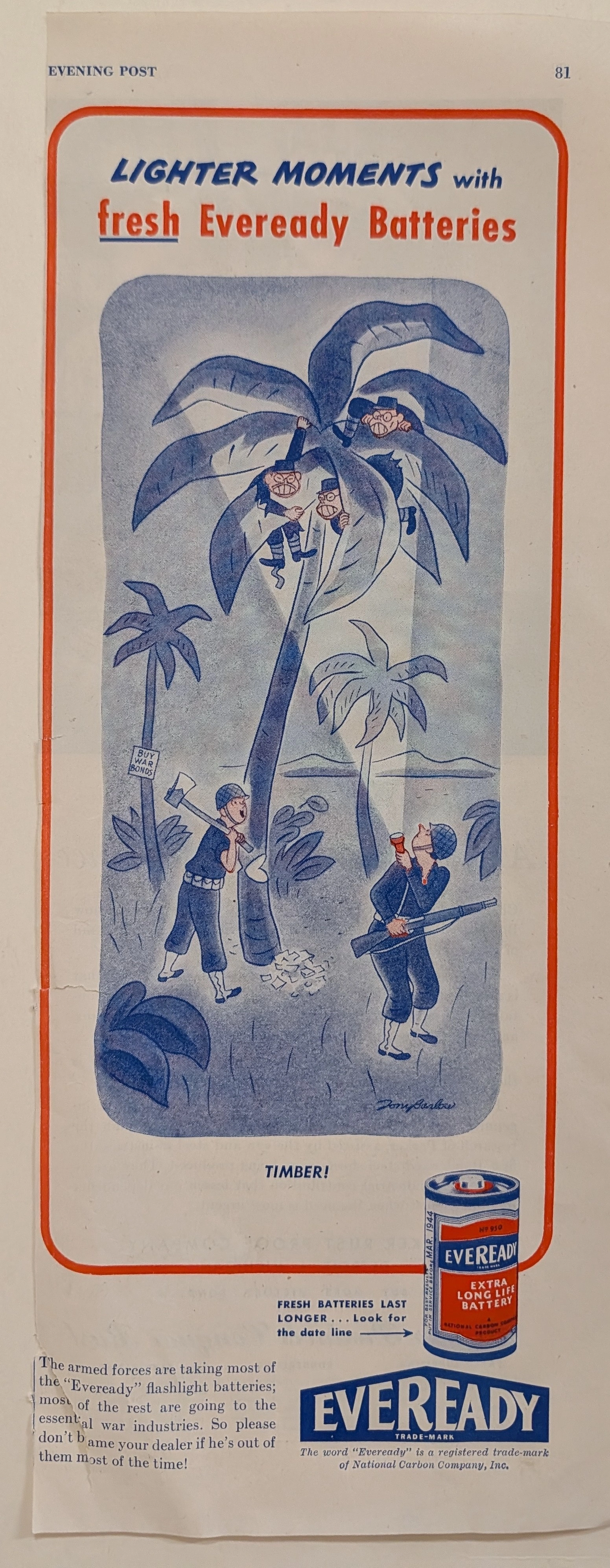
1944 Eveready Batteries "Lighter Moments" WWII Vintage Advertisement Published in 1944 during the height of the Second World War, this Eveready battery advertisement is a profound example of American home-front marketing. During this period, civilian manufacturing was heavily restricted, and raw materials were diverted to the war effort. The advertisement explicitly addresses this rationing with the text: "The armed forces are taking most of the 'Eveready' flashlight batteries... So please don't blame your dealer if he's out of them most of the time!" This strategy, known as "apology advertising," allowed brands to maintain public presence and brand loyalty even when their products were unavailable to the average consumer, framing the shortage as a patriotic sacrifice. To maintain consumer
Category: Electronics
Year: 1944
Rarity Class: A
Paper & Print Condition
This document is printed on standard, uncoated magazine stock characteristic of wartime publications. Due to wartime paper rationing and conservation efforts, the paper is relatively thin. The printing utilizes a restricted two-color offset lithography process—navy blue and a vibrant red-orange. Macro-archival inspection reveals the distinct halftone rosette patterns in the shading of the blue jungle background and the precise, solid ink application of the Eveready battery graphic. The document
Provenance & Rarity
As indicated by the header text "EVENING POST" and the page number "81", this advertisement was extracted from an issue of The Saturday Evening Post, one of the most widely circulated and influential American magazines of the 20th century. While the publication had a massive readership, surviving individual pages from 1944 are surprisingly scarce. During World War II, massive paper drives encouraged citizens to recycle their old magazines and newspapers to support the war effort. Consequently, a
Rarity & Condition Summary
An outstanding and highly significant surviving example of World War II "apology advertising" and home-front propaganda. This 1944 Eveready artifact transcends consumer marketing to serve as a poignant historical record of rationing, wartime humor, and the sociological "othering" pervasive in 1940s media. Its pristine two-color printing and documented provenance make it a museum-grade piece, highly prized by historians of mid-century advertising, WWII memorabilia collectors, and sociologists stu