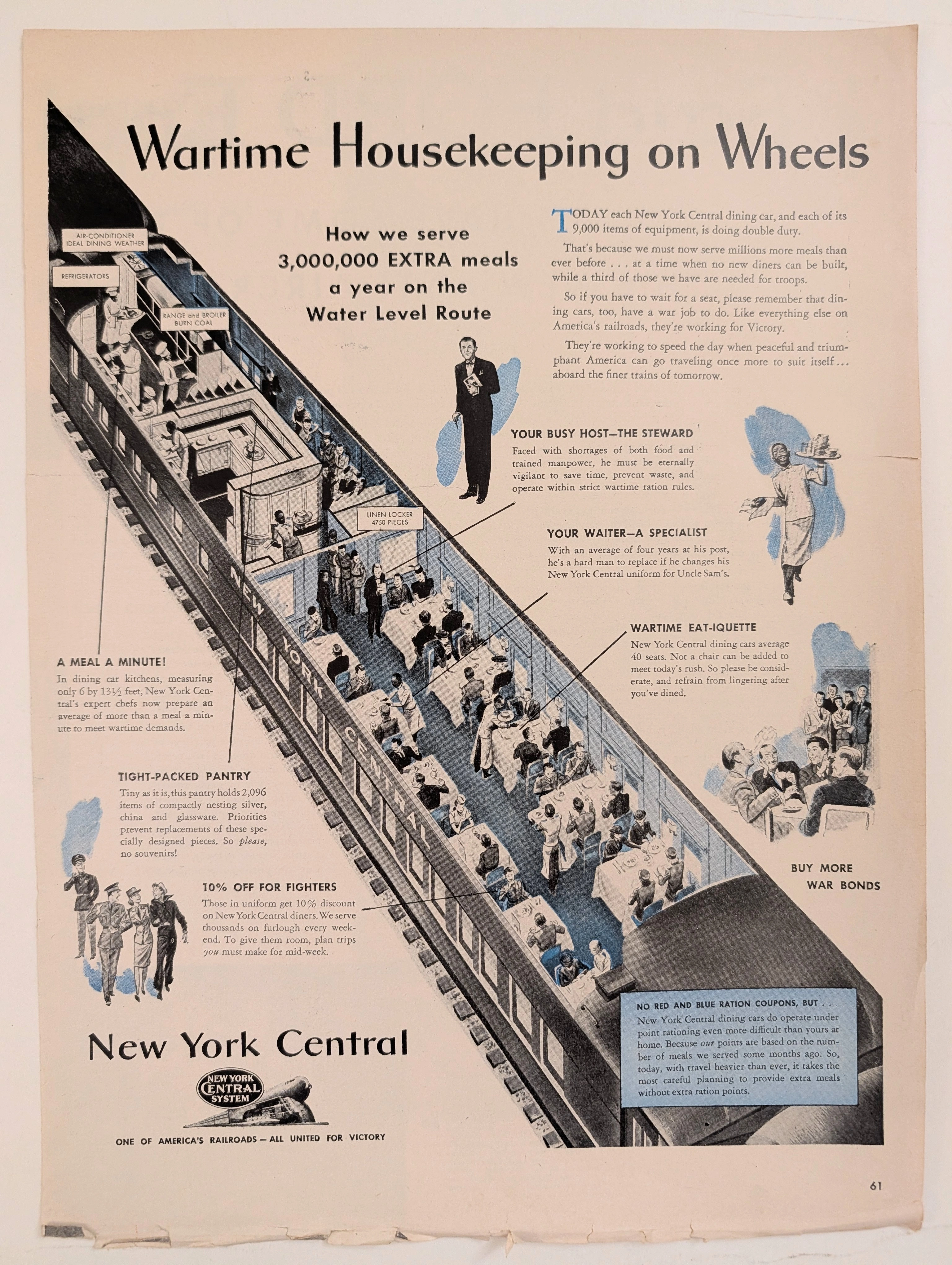
1944 New York Central "Wartime Housekeeping on Wheels" Vintage Advertisement
Last updated: 17 Apr 2026
Historical Context
Paper & Print Condition
Provenance & Rarity
Rarity & Condition Summary
Related by Classification
Related Articles

The Time Traveller's Dossier : WWII War Bonds - Corporate Conscription
A nation does not wage war with steel alone. It wages war with capital. It fights with belief. Before 1941, the American consumer was a creature of comfort, trained by an emerging advertising industry to desire soda, automobiles, and modern conveniences. Then came the sudden violence of global conflict. The factories pivoted. The supply chains froze. The consumer economy ground to a sudden, devastating halt. Yet, the advertising machinery did not sleep. It was conscripted. The artifacts presented here—fragments of print from 1943, embedded within the commercial messaging of companies like The Seven-Up Co. and Autocar Trucks—represent a monumental shift in human behavior. This was the moment the public was asked to purchase the future instead of the present. The strategy was unprecedented. Convert the civilian into a shareholder of the state. Transform the act of saving into the ultimate act of aggression against an unseen enemy. This is not merely a collection of vintage advertisements. It is the exact inflection point where corporate marketing was weaponized for national survival.

The Time Traveller's Dossier : 1943 Interwoven Socks - The Fabric of Wartime Endurance
Then, apparel was a matter of aristocratic vanity. Now, it is a calculus of survival. The problem in 1943 was not the pursuit of fashion; it was the absolute degradation of the human body in the brutal, unforgiving theaters of global war. Trench foot. Jungle rot. The relentless, humid friction of the Pacific front. The solution, as framed by the Interwoven Stocking Company, was not merely a woven textile. It was engineered morale. It was endurance. This artifact is a portal. It transports us to a specific socio-economic and psychological pivot: the exact moment consumer goods were weaponized as tools of patriotic resilience. It is an advertisement, yes. But deeper than that, it is a strategic blueprint of how a society in total war convinced itself that ordinary comforts could conquer extraordinary horrors.

The Time Traveller’s Dossier: The Graphology of Supreme Power – A Forensic Deconstruction of the 35 Presidential Signatures
The exercise of supreme executive power is not exclusively documented through monumental architectural achievements, the mobilization of armed forces, or the grand rhetoric of inaugural addresses. Frequently, the ultimate manifestation of absolute authority is captured in a single, decisive moment of physical friction: the precise instant a quill, steel nib, or fountain pen touches paper to forge a leader's signature. A signature is the ultimate physical projection of political will; it is the legal instrument that declares wars, emancipates millions, and authorizes humanity's journey to the stars. The historical artifact presented before us today for museum-grade forensic analysis is an exceedingly rare and profound educational print. Rendered in a striking reverse lithography technique—featuring a deep, commanding navy blue background with brilliant white text—it displays the Seal of the President of the United States, completely enveloped by the radiating facsimile signatures of the first thirty-five individuals to hold the highest office in the land. This exhaustive, world-class academic archival dossier will dissect the artifact with microscopic precision. We will conduct an individual forensic breakdown of all thirty-five presidential signatures, exploring the graphological (handwriting) structures that mirror their personalities, their educational backgrounds, and their historical eras. Furthermore, we will decode the profound engineering logic behind the radial visual design and conduct a rigorous material science analysis of this reverse-printed substrate. In an analog era devoid of digital fonts and electronic authorizations, a leader's penmanship was their ultimate visual DNA. We will meticulously explore the chemical mechanics of the aging paper beneath this sea of dark ink—the elegant wabi-sabi oxidation process that serves as the primary engine driving up its market value exponentially.

The Time Traveller's Dossier: The Architecture of Unrestricted Mobility – Avis "Rent it Here - Leave it There" Advertisement (Circa 1956)
History is not merely recorded; it is engineered, paved, and conquered through the relentless expansion of commercial logistics. Long before digital networks rendered physical distances obsolete, and before the globalized travel infrastructure became a mundane background hum of modern life, the conquest of geography was executed through bold, capital-intensive logistical paradigms. The historical artifact before us is not merely a nostalgic mid-century magazine advertisement for a car rental agency. It is a perfectly weaponized blueprint of post-war American expansionism, a visual manifesto of the "fly-drive" revolution, and an unwavering testament to an era when mastering the vast North American continent was sold as the ultimate consumer luxury. This museum-grade, academic archival dossier presents an exhaustive deconstruction of a mid-1950s print advertisement for the Avis Rent-a-Car system, specifically introducing their groundbreaking "Rent it here - Leave it there" service. Operating on a profound, dual-narrative storyboard structure, this document records a calculated paradigm shift within the global travel and transportation industry. It captures the precise historical fracture where the American public conceptually transitioned from the localized, static constraints of pre-war rail and personal automobile travel into the hyper-mobile, fluid, and aerospace-integrated era of the 1950s. Through the highly specialized lens of late-analog commercial illustration and stringent visual forensics, this document serves as a masterclass in the psychological marketing of freedom and corporate efficiency. It established the foundational archetype for the modern, frictionless travel economy—an archetype that unconditionally dictates the logistical strategies of the global tourism and business travel sectors today.