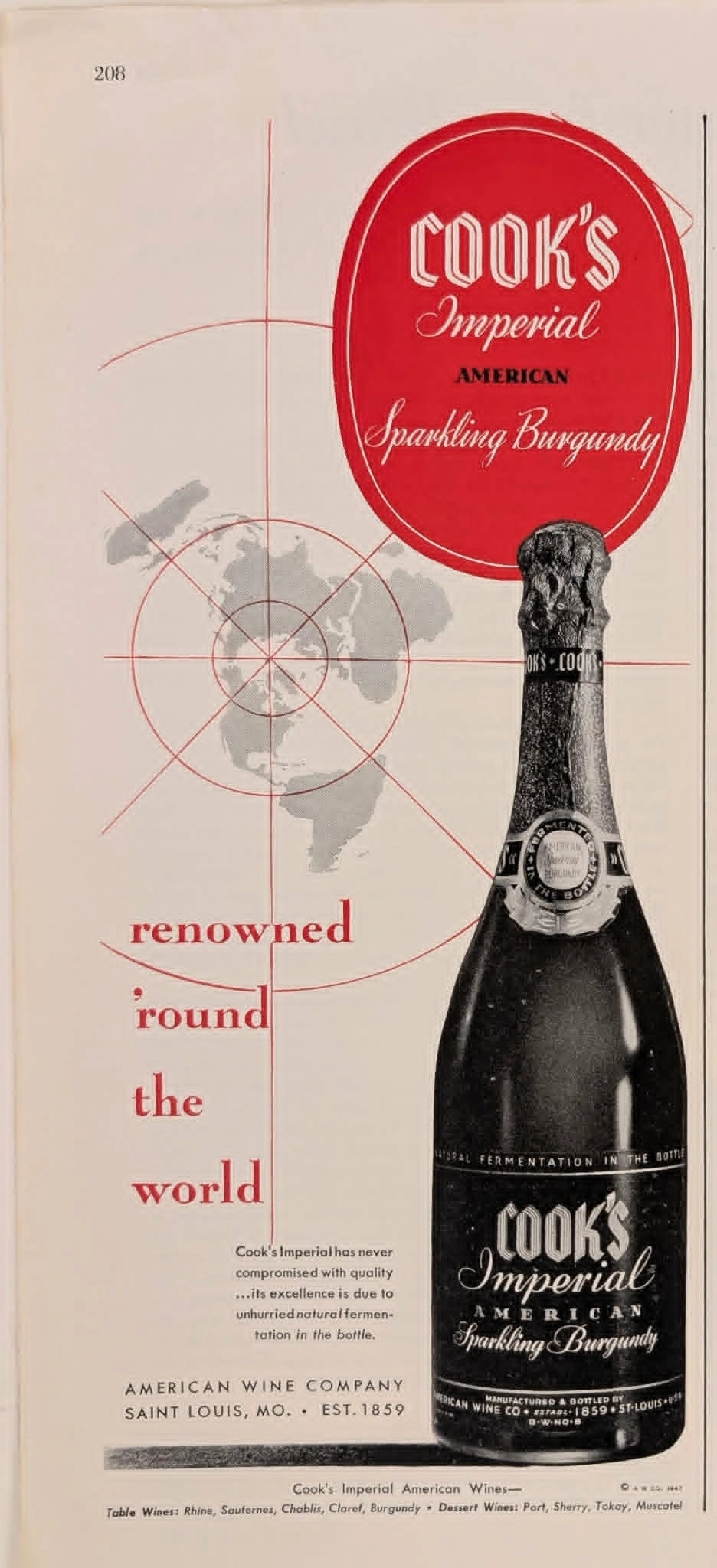
1947 Cook's Imperial American Sparkling Burgundy Vintage Advertisement
The American Wine Company, founded in 1859 in Saint Louis, Missouri, holds a unique and vital place in the history of American viticulture. Long before California completely dominated the domestic wine conversation, Missouri was a pioneering powerhouse of American wine production. Cook's Imperial served as their flagship brand, gaining significant domestic and international acclaim. Following the devastation of Prohibition and the economic disruptions of World War II, legacy brands like Cook's had to forcefully re-establish their pedigree and market share. This 1947 advertisement perfectly encapsulates that aggressive, post-war repositioning. Artistically, the advertisement commands attention by utilizing a sleek, minimalist two-color halftone design featuring deep black and a striking vermilion red. A target-like wireframe globe anchors the background—this is not merely a decorative element, but a bold visual metaphor supporting the claim that Cook's Imperial is "renowned 'round the world." The intersecting crosshairs symbolize precision, global reach, and a direct challenge to the supremacy of French and Italian imports that had historically cornered the luxury sparkling wine market in the United States. Furthermore, the advertising copy emphasizes that the wine's excellence is due to "unhurried natural fermentation in the bottle." This is a critical point of quality assurance aimed at the discerning mid-century consumer. It acts as a direct nod to the traditional méthode champenoise, reassuring the post-war American middle class—who were increasingly adopting European-style dining and drinking habits—that domestic craftsmanship could rival, if not equal, European tradition. Sparkling Burgundy, a rich, robust, and highly effervescent red wine, was immensely popular in mid-20th-century America as a versatile celebratory beverage. Through highly structural graphic design and confident copywriting, this advertisement successfully elevates Cook's Imperial from a historical Midwestern product to a sophisticated, globally recognized luxury commodity.
Category: Lifestyle & Vice
Year: 1947
Rarity Class: B
Paper & Print Condition
Printed on period-accurate publication stock, this artifact exhibits a beautiful, authentic aged paper texture with a natural patina. The piece effectively utilizes a striking vertical aspect ratio that perfectly frames the composition. The sharply registered printing process precisely preserves the traditional 2D, hand-drawn stroke qualities of the original artwork, completely avoiding any artificial gloss. It maintains deep ink saturation and crisp typographical contrast, showing only the minimal, expected edge wear typical of carefully preserved historical periodicals. The overall structural integrity and visual fidelity remain in museum-grade condition.
Provenance & Rarity
Circulated in prominent American periodicals in 1947 by the American Wine Company of Saint Louis, Missouri. During the post-war era, as American consumers increasingly embraced European-style dining, domestic brands fiercely competed for luxury market share. Cook's Imperial advertisements from this specific period are highly notable for meticulously documenting the mid-century phenomenon of "Sparkling Burgundy"—a robust, effervescent red wine that became a staple of American celebrations. While mid-century beverage advertisements are generally accessible, this particular piece stands out due to its striking, minimalist 2D graphic design and bold positioning against European imports. It remains a highly valuable artifact for enological historians and collectors of post-war Americana.
Rarity & Condition Summary
This 1947 Cook's Imperial print advertisement is classified as Rarity Class B (Collectible). It stands as a superb example of traditional 2D commercial art from the post-war era. Its excellent condition is highlighted by an authentic aged paper texture that enhances, rather than detracts from, its historical visual appeal. The striking vertical composition and perfectly preserved two-color halftone printing make it a highly desirable asset for both institutional archival display and advanced academic study of mid-20th-century beverage marketing.