1948 Bicycle Playing Cards "Quiz No. 4" Vintage Advertisement (1948) — Class B vintage Lifestyle & Vice
CLASS B
1 of 6

1948 Bicycle Playing Cards "Quiz No. 4" Vintage Advertisement

Category|Lifestyle & Vice
Year|1948
Rarity Class|CLASS B
Archive Views|23
Ad Content TypeBrand Building/Lifestyle
Theme/SubjectHistorical

Last updated: 20 Apr 2026

Historical Context

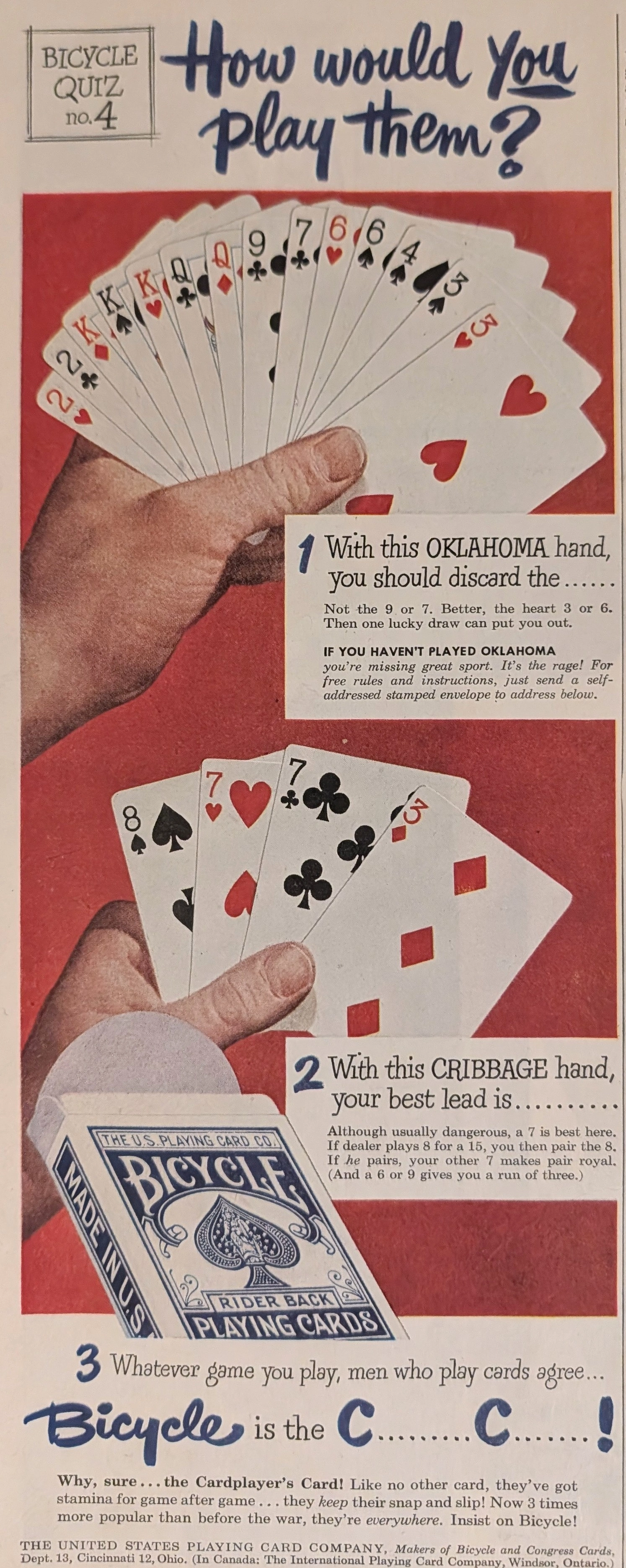
1948 Bicycle Playing Cards "Quiz No. 4" Vintage Advertisement The mid-20th century marked a golden age for tabletop and card gaming in the United States. This advertisement, framed as "Bicycle Quiz No. 4," represents a highly effective early form of interactive marketing—what modern strategists would call "gamification." Rather than simply listing the physical attributes of the cards, the ad challenges the reader's strategic acumen in specific games: Oklahoma (a popular mid-century rummy variant) and Cribbage. A critical historical marker within the copy is the phrase: "Now 3 times more popular than before the war, they're everywhere." During World War II, playing cards were standard issue for American GIs, serving as cheap, portable entertainment on the front lines. Upon returning home, these soldiers brought their ingrained card-playing habits back to civilian life, fueling a massive post-war boom for manufacturers like The United States Playing Card Company. Furthermore, the advertisement reinforces the physical superiority of the product. By labeling Bicycle the "Cardplayer's Card" and emphasizing their "stamina," "snap," and "slip," the company directly addressed the practical needs of serious players who demanded durability from their decks. The visual composition, featuring a dynamic hand of cards fanned out against a stark red background, immediately captures attention while guiding the eye down to the iconic Rider Back tuck case.

Paper & Print Condition

Printed on standard mid-century periodical stock. The piece demonstrates excellent ink retention, particularly the stark, high-contrast red background which serves to visually project the playing cards forward. Minor age-toning is present around the margins, consistent with acidic paper formulations of the late 1940s, but does not detract from the crispness of the typography or the central imagery.

Provenance & Rarity

Sourced from a mainstream American domestic publication. While advertisements for The United States Playing Card Company were widely distributed, interactive "Quiz" series variants are specifically sought after by playing card historians, magicians, and collectors of vintage gaming ephemera.

Rarity & Condition Summary

A vibrant, engaging, and well-preserved artifact. It brilliantly illustrates the gamification of mid-century print advertising and the massive cultural footprint of card playing in post-war America.
Share This Archive

From the Journal

Related Articles

The Time Traveller's Dossier : WWII War Bonds - Corporate Conscription — related article
Read Article

The Time Traveller's Dossier : WWII War Bonds - Corporate Conscription

A nation does not wage war with steel alone. It wages war with capital. It fights with belief. Before 1941, the American consumer was a creature of comfort, trained by an emerging advertising industry to desire soda, automobiles, and modern conveniences. Then came the sudden violence of global conflict. The factories pivoted. The supply chains froze. The consumer economy ground to a sudden, devastating halt. Yet, the advertising machinery did not sleep. It was conscripted. The artifacts presented here—fragments of print from 1943, embedded within the commercial messaging of companies like The Seven-Up Co. and Autocar Trucks—represent a monumental shift in human behavior. This was the moment the public was asked to purchase the future instead of the present. The strategy was unprecedented. Convert the civilian into a shareholder of the state. Transform the act of saving into the ultimate act of aggression against an unseen enemy. This is not merely a collection of vintage advertisements. It is the exact inflection point where corporate marketing was weaponized for national survival.

THE TINY TEXT THAT AUTHENTICATES HISTORY Why Fine Print in Magazine Advertisements Matters More Than You Think — related article
Read Article

THE TINY TEXT THAT AUTHENTICATES HISTORY Why Fine Print in Magazine Advertisements Matters More Than You Think

Tiny copyright notices in magazine ads originated from mandatory US copyright law (1909 Act) and sector-specific regulations (BATF for alcohol). They function as layered authentication evidence: typographic era-consistency, regulatory language accuracy, ink/paper forensics, and contextual integrity — paralleling vintage band tee authentication methods. Collaboration credits (Pierre Cardin × Tiffany & Co.) and creative credits (photography, calligraphy, fashion) document commercial relationships lost to no other record.

The Time Traveller's Dossier : 1980 The Architecture of Leisure and the Golden Age of the American Regional Department Store — related article
Read Article

The Time Traveller's Dossier : 1980 The Architecture of Leisure and the Golden Age of the American Regional Department Store

Before the algorithmic precision of digital feeds stripped the tactility from consumer longing, and long before the homogenization of global e-commerce, print media served as the grand architectural blueprint for the American lifestyle. Captured within the glossy confines of a late-20th-century publication—specifically indicated by the vertical marginalia of Playboy magazine—this Boston Traders advertisement stands as a pristine, museum-grade artifact. It masterfully encapsulates the ‘preppy-outdoor’ synthesis that dominated the sartorial landscape of the early 1980s. However, its true value extends far beyond its depiction of robust color-blocking and heritage-driven knitwear. This archival piece serves as a critical historical ledger of America’s evolving retail infrastructure. By permanently anchoring its brand legacy to iconic, and now profoundly defunct, regional department store giants, this document offers a rare, tightly datable window into the zenith of physical retail and the psychological marketing of the affluent weekend gentleman. It is a masterpiece of commercial archaeology.

The Time Traveller's Dossier: The Zenith of the American Living Room – Admiral Rectangular Color TV — related article
Read Article

The Time Traveller's Dossier: The Zenith of the American Living Room – Admiral Rectangular Color TV

The evolution of the American domestic interior during the mid-twentieth century was fundamentally redefined by the introduction and subsequent democratization of color television. The historical artifact elegantly and securely positioned upon the analytical table of The Record Institute today is a majestic, full-page print advertisement for Admiral Color TV, originating from the transitional technological era of the late 1960s. This document completely transcends the traditional boundaries of consumer electronics marketing. It operates as a highly sophisticated, multi-layered cultural and historical mirror, reflecting the exact moment when the magic of color broadcasting collided with the rigorous aesthetic demands of suburban domestic styling on a single printed page. This world-class, comprehensive dossier conducts a meticulous, unyielding, and exceptionally deep examination of the artifact, operating under the absolute most rigorous parameters of historical, sociological, and material science evaluation. With our analytical focus dedicated heavily to its historical gravity, we will decode the brilliant marketing psychology embedded within the "rectangular" tube innovation, analyze the space-age luxury of the "Sonar" remote control, and dissect the rich semiotics of disguised technology through "genuine walnut veneers". Furthermore, as we venture deeply into the chemical and physical foundations of this analog printed ephemera, we will reveal the precise mechanical fingerprints of the CMYK halftone rosettes and the graceful, natural oxidation of the paper substrate. This precise intersection of visual nostalgia, mid-century commercial artistry, and the immutable chemistry of time cultivates a serene wabi-sabi aesthetic—a natural, irreversible phenomenon that serves as the primary engine driving up its market value exponentially within the elite global spheres of Vintage Commercial Ephemera, Consumer Electronics Archives, and Mid-Century Lifestyle collecting.