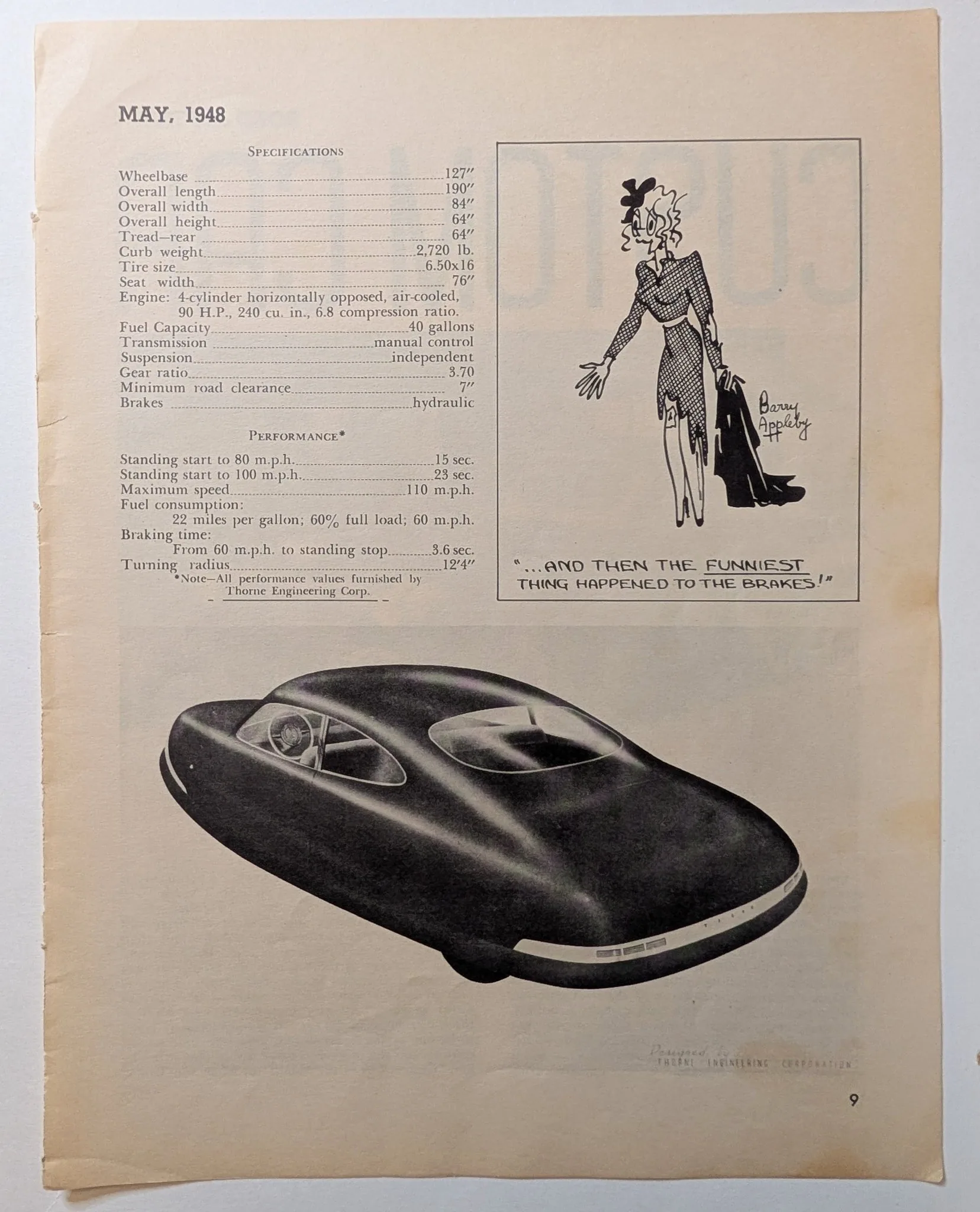
1948 Thorne Engineering Streamlined Concept Car Page
In May 1948, an unidentified magazine printed a single page that reads like a dispatch from the future. Page 9 carries a full specifications table for a streamlined automobile credited to the "Thorne Engineering Corporation": a teardrop body 190 inches long and 84 inches wide, riding on a 127-inch wheelbase, powered by an air-cooled, horizontally opposed four-cylinder engine of 240 cubic inches producing 90 horsepower. The page's performance section claims 0 to 80 mph in 15 seconds, a top speed of 110 mph, and 22 miles per gallon at cruising speed. Every figure is qualified by a single line of small type: all performance values were furnished by Thorne Engineering Corp. itself, not measured by the magazine. The Thorne name connects, provisionally, to a real and colorful figure of American motorsport. Joel Thorne (1914-1955) was a wealthy racing driver and engineer whose Burbank, California operation fielded Indianapolis race cars; the Thorne Engineering Special, driven by George Robson, won the 1946 Indianapolis 500. Whether the "Thorne Engineering Corporation" credited on this page is the same entity remains unconfirmed, and no corroborating record of a street-legal Thorne teardrop car has yet been established. The page alone cannot distinguish among a running prototype, a full-size styling mockup, or a paper project illustrated with a model. The page's upper-right corner carries its most human element: a cartoon signed "Barry Appleby." Appleby (1909-1996) was the British cartoonist who, with his wife Dorothy "Dobs" Appleby, created the long-running Daily Express strip The Gambols, which premiered in March 1950. This cartoon, printed in a May 1948 issue, predates that famous strip by nearly two years and shows Appleby already working in the motoring press. The signature is printed as part of the cartoon plate, a reproduced attribution mark rather than a hand-applied autograph. The caption reads: "...AND THEN THE FUNNIEST THING HAPPENED TO THE BRAKES!" The car itself belongs to the postwar moment when American designers treated streamlining as a near-moral imperative. The teardrop silhouette, the enclosed wheels, the aircraft-engine logic of an air-cooled flat four all echo the era's great might-have-beens: the Tucker 48, the Davis Divan, Norman Timbs's streamliner. This page should not be confused with any of them; the dimensions and drivetrain described here differ materially from each. It stands as its own document of the period's optimism, printed the same month that theatrical short films were promising audiences streamlined marvels on wheels for the roads of 1960. Read with a skeptical eye, the page rewards attention. A 90-horsepower engine moving 2,720 pounds to 110 mph strains credulity; a 12-foot-4-inch turning radius on a 127-inch wheelbase is implausibly tight; a 40-gallon fuel tank is extraordinarily large. These are manufacturer claims, printed as received. That is precisely what makes the artifact valuable: it preserves not the car, which may never have existed beyond this page, but the pitch, the numbers as their promoters wanted them read, and the visual language of an industry certain the future would be shaped like a raindrop.
Category: Cars
Year: 1948
Rarity Class: B