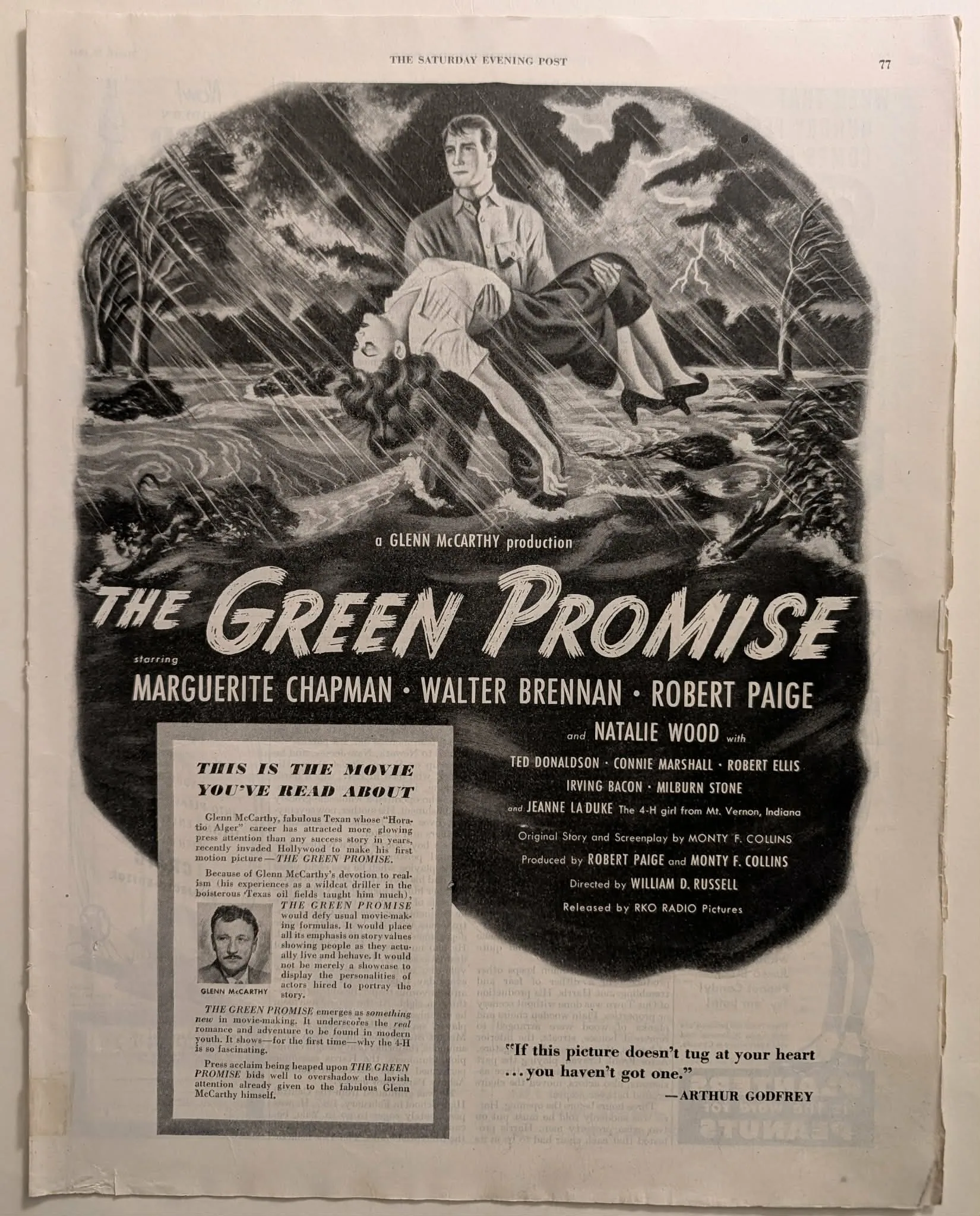
1949 RKO Radio Pictures The Green Promise Vintage Advertisement
The 1949 release of The Green Promise stands as a fascinating intersection of classic Hollywood studio distribution and fierce Texan independence. Produced by the flamboyant oil tycoon Glenn McCarthy, the film was a passion project intended to subvert standard industry formulas. As highlighted in the advertisement’s dedicated text block, McCarthy’s “Horatio Alger” career—rising from a wildcat driller to a millionaire—fueled his desire to create motion pictures grounded in realism and authentic human struggle. Instead of retreating to the pure escapism typical of the post-war era, McCarthy sought to portray characters who “actually live and behave,” explicitly avoiding the creation of a mere showcase for celebrity personalities. Visually, the advertisement immediately arrests the viewer with a dramatic, high-contrast illustration of turbulent survival. The central imagery features a stoic male figure carrying an unconscious woman through a treacherous, storm-swept flood. Rendered with deep, atmospheric shadowing and intense, driving rain, the artwork perfectly encapsulates the high-stakes melodrama that contemporary audiences craved. This stylistic choice leans heavily into the era’s penchant for sensationalist graphic design, utilizing stark monochrome tones to evoke raw emotion and natural peril. Beyond its gripping central artwork, the layout is a masterclass in mid-century promotional density. It balances the visual spectacle with extensive copy designed to establish the film's cultural importance. By explicitly calling attention to the 4-H club—a youth organization centered on agriculture and community—the campaign positions The Green Promise as a fundamentally American story. It elevates rural youth and agricultural life to the realm of cinematic heroism, a rarity in mainstream releases of the time. The strategic inclusion of an endorsement from prominent broadcaster Arthur Godfrey ("If this picture doesn't tug at your heart... you haven't got one") further anchors the film’s marketing in contemporary pop culture, promising audiences an undeniable emotional experience. As an archival document, this page offers profound insight into the shifting dynamics of late-1940s cinema. It represents the ambitions of independent financiers attempting to challenge the studio system by appealing directly to the traditional, hardworking values of the American public. Original story and screenplay by Monty F. Collins (as credited in the ad).
Category: Film & Entertainment
Year: 1949
Rarity Class: A
Paper & Print Condition
Printed on standard mid-century newsprint-grade magazine stock. The monochromatic halftone lithography retains remarkable deep black saturation and sharp tonal contrast, free from significant fading. Minor edge toning (foxing) is visible along the periphery, consistent with the natural aging of acidic paper from this era. A clean left-margin binding edge indicates careful, archival-standard removal from the original bound periodical, ensuring the structural integrity of the main visual field remains uncompromised.
Provenance & Rarity
Sourced directly from a verified 1949 national circulation of The Saturday Evening Post (page 77). While the publication itself was widely distributed during the post-war era, the intact survival of internal advertising pages—particularly those featuring independent, non-studio productions like Glenn McCarthy's The Green Promise—is increasingly uncommon. The piece is elevated in rarity due to its specific historical context, representing a brief, ambitious intersection of Texas oil wealth and Hollywood film distribution. High-contrast, text-heavy promotional lithographs of this specific motion picture are seldom found in such unblemished, archival-ready condition.
Rarity & Condition Summary
This exceptional archival piece is classified as a Class A artifact, denoting a high degree of scarcity for post-war independent cinema ephemera. While The Saturday Evening Post had a wide circulation, the survival rate of unbound, single-page promotional materials—especially those championing independent producers like Glenn McCarthy over major Hollywood studios—is remarkably low. The condition is graded as Very Good (VG); the mid-century newsprint stock has endured with excellent structural integrity. The monochromatic halftone lithography remains pristine, showcasing deep black saturation and sharp tonal contrasts without significant fading. Although minor peripheral foxing is present—a natural hallmark of acidic paper aging—it does not encroach upon the primary visual field. The clean left-margin extraction further confirms its careful preservation, making it a highly desirable, museum-grade acquisition for dedicated mid-century film history collections.