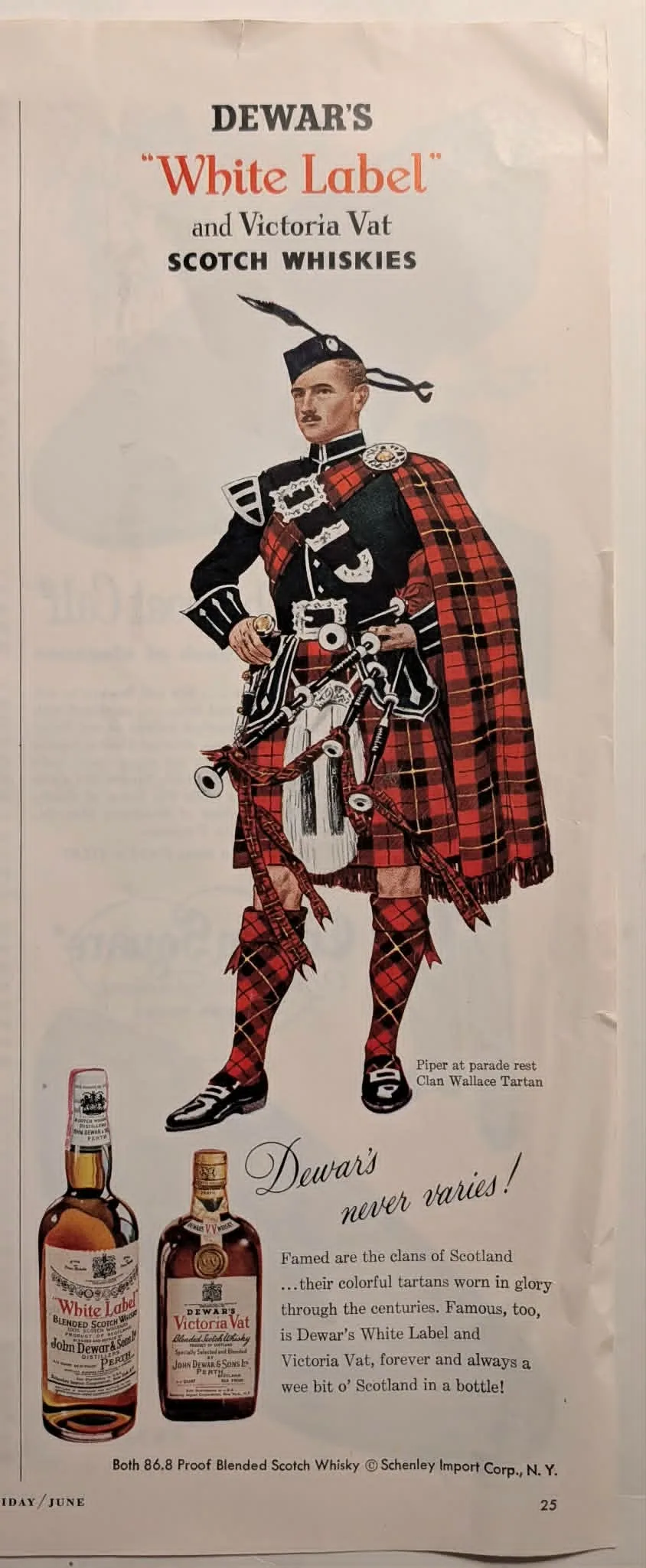
1950 Dewar's "White Label" & Victoria Vat Vintage Advertisement
In the mid-20th century, the global demand for blended Scotch whisky experienced a significant resurgence, particularly within the post-war American market. To capture this growing consumer base, John Dewar & Sons Ltd.—distributed in the United States by the Schenley Import Corporation of New York—launched a highly successful series of print campaigns celebrating Scottish heritage. This circa 1950 advertisement is a quintessential example of that strategic marketing era, prominently featuring a piper standing at "parade rest" adorned in the historic Clan Wallace tartan. By deeply intertwining their brand identity with the romanticized imagery of Scottish clans, Dewar’s sought to emphasize authenticity, deep-rooted tradition, and unwavering quality. The iconic slogan prominently displayed in graceful script—"Dewar's never varies!"—served as a steadfast guarantee of consistency to the American consumer. It assured the post-war buyer that every poured glass delivered the exact same refined flavor profile originally established by the master blenders in Perth, Scotland. From an archival and collector's perspective, this advertisement is particularly notable for featuring two distinct expressions of Dewar’s whisky side-by-side: the globally recognized "White Label" and the lesser-known "Victoria Vat." While "White Label," first created in 1899 by the company’s first Master Blender, A.J. Cameron, remains a cornerstone of the brand today, Victoria Vat represents a fascinating, finite chapter in the distillery's commercial history. Originally introduced in the late 19th century to commemorate Queen Victoria, the Victoria Vat was positioned as a premium, specially selected older blend. By 1954, Dewar’s officially discontinued the Victoria Vat nomenclature, replacing the label with "Dewar's Ancestor" to align with updated mid-century branding strategies. Consequently, print advertisements featuring the Victoria Vat bottle are relatively scarce and serve as critical visual markers of the brand's transitional era. The meticulous color lithography utilized in this print beautifully captures the intricate details of the traditional Scottish Highland dress, from the feathered bonnet to the silver-mounted bagpipes, elevating the perceived prestige of the 86.8 proof whiskies it promotes.
Category: Alcohol
Year: 1950
Rarity Class: A
Paper & Print Condition
Exceptional preservation of color fidelity within this vertical print layout. The authentic aged paper texture provides a warm, off-white foundation that contrasts beautifully with the rich reds and deep blacks of the Clan Wallace tartan. The original flat illustration styles and meticulous hand-drawn stroke qualities of the mid-century lithography remain remarkably crisp, particularly in the detailed rendering of the bagpiper's regalia. There is minimal edge-wear typical of historical periodical extraction, maintaining the structural integrity necessary for high-resolution archival reproduction.
Provenance & Rarity
Sourced directly from a premier mid-century American publication, this vertical layout artifact documents the post-war transatlantic distribution efforts managed by Schenley Import Corporation, New York. The extreme rarity of this specific print is anchored in the prominent display of Dewar's "Victoria Vat," a premium blend commemorating Queen Victoria that was permanently discontinued and rebranded by 1954. Surviving examples that retain such immaculate flat illustration styling and authentic aged paper textures are exceptionally scarce. This distinct combination of short-lived branding and perfectly preserved hand-drawn aesthetic elements elevates its status to a Class A archival asset, highly prized for both physical historical preservation and contemporary digital 2D animation studies.
Rarity & Condition Summary
As a Class A archival artifact, this piece stands out not only for its historical significance regarding the discontinued Victoria Vat but also for its immaculate physical condition. The vertical aspect ratio is perfectly preserved, making it an ideal candidate for high-fidelity digital preservation and dynamic 2D artwork adaptation. The authentic aged paper textures remain intact, free from significant degradation, thereby beautifully framing the original flat illustration styles. The meticulous hand-drawn stroke qualities of the mid-century lithography are exceptionally crisp, securing its status as a museum-grade specimen essential for both spirit historians and archival animators.