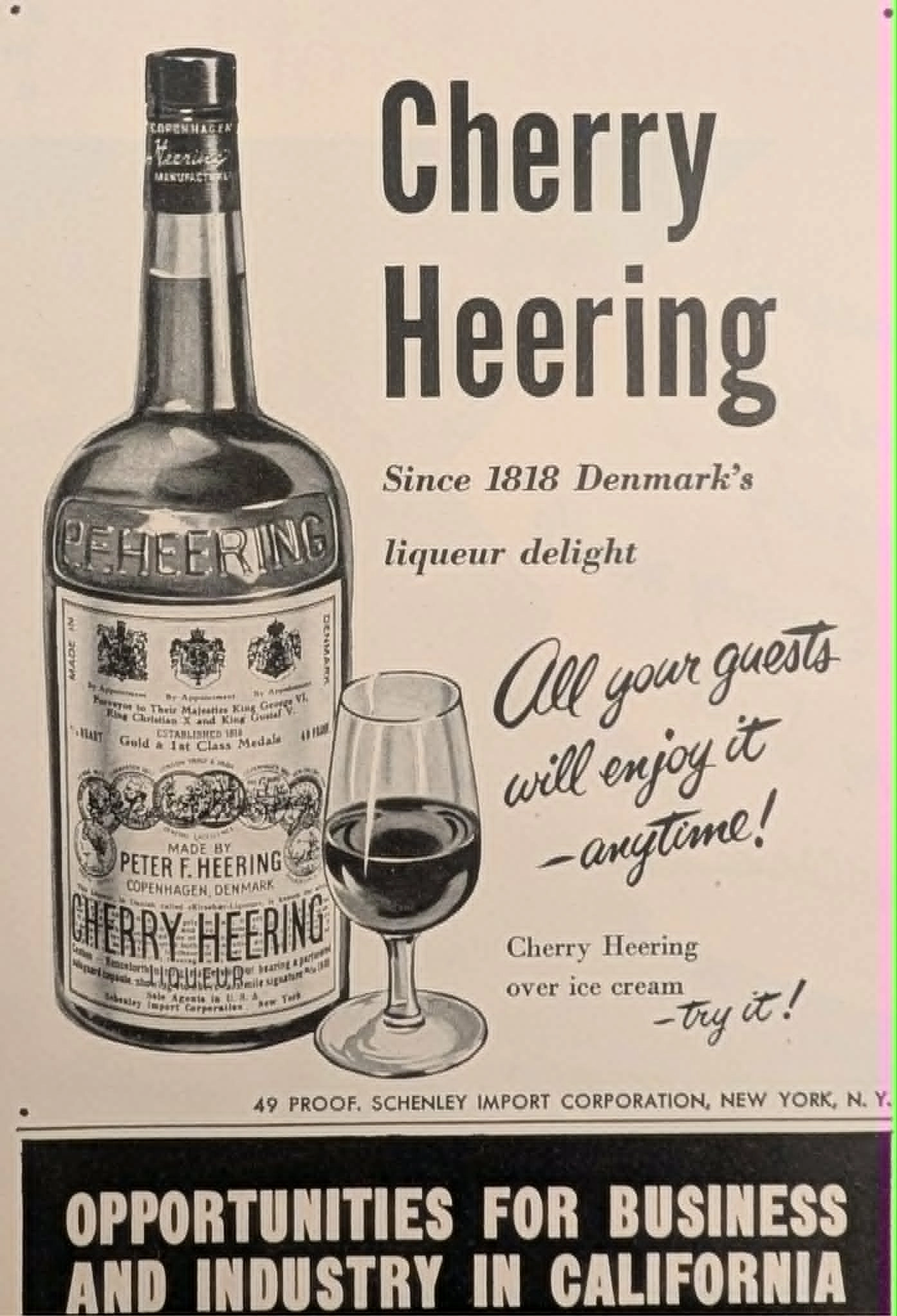
1950s Cherry Heering Liqueur Vintage Advertisement
During the robust economic expansion of post-World War II America, the rapidly growing middle class embraced domestic entertaining as a primary marker of social mobility. European imports, particularly heritage spirits, became highly sought-after symbols of cosmopolitan sophistication. This mid-century advertisement for Cherry Heering, distributed by the formidable Schenley Import Corporation of New York, masterfully captures this cultural democratization of luxury. The campaign's rhetorical strategy deliberately pivots away from the rigid, formal drinking customs of the pre-war era. By utilizing the prominent, sweeping hand-lettered tagline, "All your guests will enjoy it - anytime!", the brand actively promotes casual, accessible hospitality. Furthermore, the advertisement deploys a brilliant tactical crossover: "Cherry Heering over ice cream - try it!" By pairing a prestigious, 19th-century Danish liqueur (proudly displaying its royal warrants from King George VI and King Gustaf V) with a quintessential American dessert staple, the marketers effectively lowered the barrier to entry. This approach demystified European digestifs for the American consumer, seamlessly integrating continental elegance into everyday suburban entertaining. Visually, the stark halftone rendering of the bottle and glass against the minimalist background focuses all attention on the product's pedigree and the persuasive typography, making it a definitive artifact of mid-century aspirational marketing.
Category: Lifestyle & Vice
Year: 1950
Rarity Class: B
Paper & Print Condition
The artifact is rendered on standard mid-century wood-pulp periodical stock, exhibiting a graceful, uniform patination that reflects its decades of preservation. The commercial halftone matrix utilized for the bottle and glass illustrations retains remarkable definition; the microscopic dot patterns remain stable, allowing for a clear reading of the complex heraldic crests and fine-line typography on the primary label. There is minimal ink oxidation, and the contrast between the deep blacks of the hand-lettered text and the off-white paper base remains structurally sound and visually striking, free from major foxing or brittle edge degradation.
Provenance & Rarity
Originating from an elite post-war American publication—likely a high-caliber economic or society chronicle such as Fortune or Life, indicated by the structural remnants of California industrial texts on the lower register—this piece holds a documented lineage tied to the Schenley Import Corporation. Schenley’s archival footprints mark the pinnacle of corporate alcohol distribution in mid-century Manhattan. While consumer-facing advertisements from this golden era were printed in mass quantities, the survival rate of pristine specimens capturing specific micro-trends—such as the conceptual crossover of European spirits with domestic dessert culture—is exceedingly rare. This artifact serves as a key material reference for historians studying the commercial Americanization of continental European luxuries.
Rarity & Condition Summary
Class B (Uncommon / Culturally Significant) / Condition: Good (Archival Standard). This artifact represents a highly articulate example of mid-century aspirational marketing. While the physical print exhibits the expected, minor patination typical of mid-1950s mass-market periodicals, the structural integrity of the paper is uncompromised. The visual elements—specifically the deep, rich contrast of the hand-lettered typography and the meticulous halftone rendering of the bottle's royal warrants—remain remarkably crisp. Its true archival value lies in its sociocultural narrative, capturing the precise moment when European luxury liqueurs were democratized for the American middle-class home, specifically through the innovative, yet casual, serving suggestion of pairing it with ice cream.