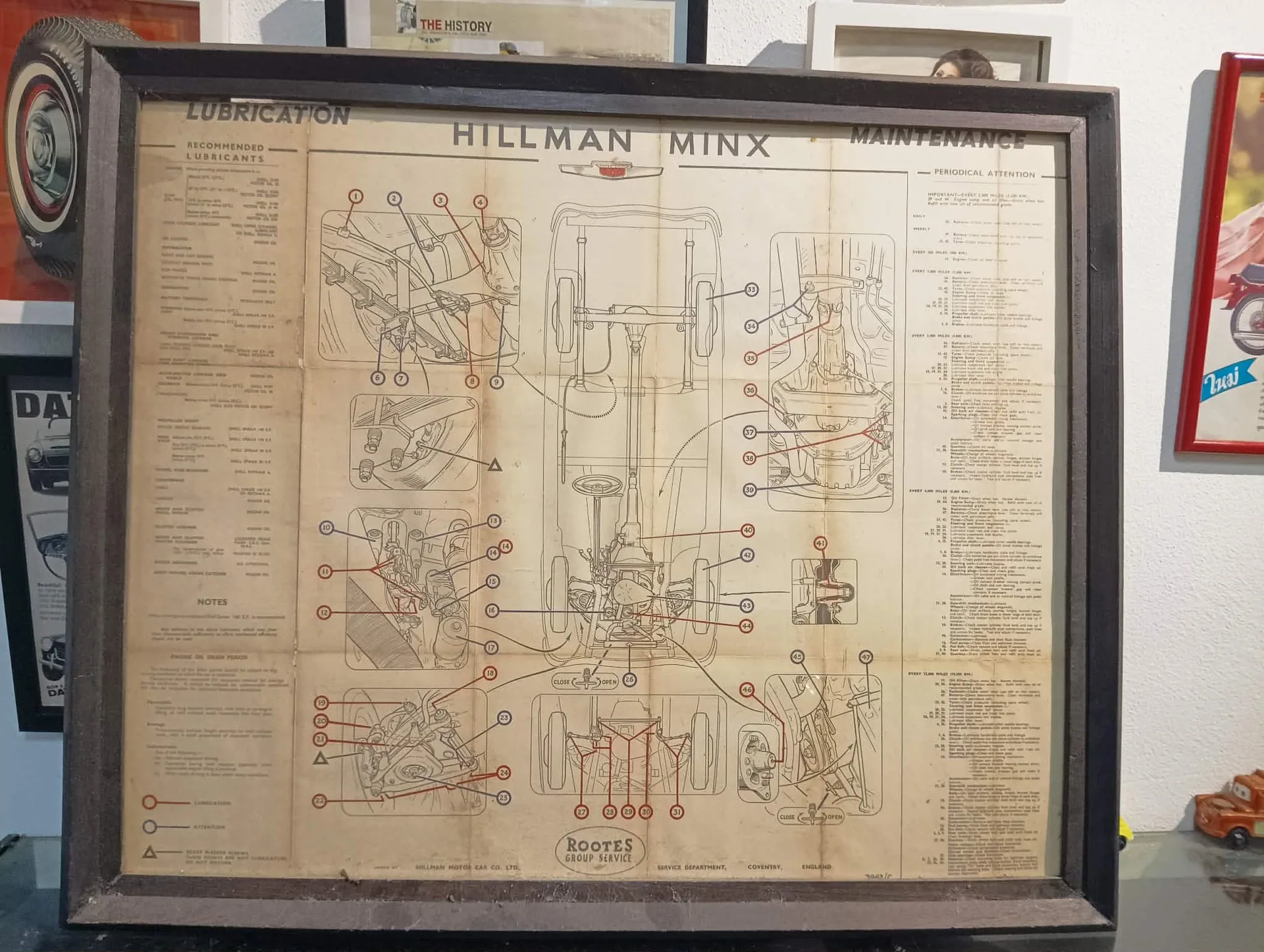
1950s Hillman Minx Rootes Group Lubrication and Maintenance Chart
This highly detailed mid-century maintenance and lubrication chart was issued by Rootes Group Service for the Hillman Minx. Featuring precise schematic illustrations of the chassis and mechanical components, the poster served as an essential operational guide for mechanics and dedicated owners, encapsulating the hands-on nature of classic British automotive care. The Hillman Minx, originally introduced in 1932 and continuously evolving through the post-war era, was the quintessential British family saloon. Produced by the Rootes Group—a major British automobile manufacturer headquartered in Coventry—the Minx was a symbol of accessible mobility for the burgeoning middle class. This highly intricate "Lubrication and Maintenance" chart, dating to the circa 1950s, offers a profound archival wi
Category: Automotive Parts
Year: 1950
Rarity Class: A
Paper & Print Condition
Printed on standard mid-century industrial paper stock, this document was engineered for practical workshop reference rather than archival preservation. The artifact displays a distinct grid of severe fold lines, indicating it was likely stored compactly within an owner's manual or a mechanic's toolbox. Despite its age and intended utilitarian environment, the vibrant red and blue spot-color inks remain remarkably distinct against the slightly oxidized, off-white background. Minor oil and moistu
Provenance & Rarity
Originating directly from the Rootes Group Service Department in Coventry, England, this chart is a piece of genuine British industrial history. Ephemera of this nature were highly utilitarian and were almost universally discarded once a vehicle model became obsolete, or they simply disintegrated from exposure to grease, oil, and continuous workshop wear. Finding a surviving example with entirely legible typography and intact technical schematics elevates its archival significance from a mere di
Rarity & Condition Summary
While these technical charts were mechanically reproduced in large volumes during the peak of the Hillman Minx's production run, their modern survival rate is exceedingly low. The moderate wear, deep creases, and faint workshop staining present on this specific piece are culturally significant—they do not detract from its value but rather enhance its narrative provenance as a genuine, hard-working tool of the trade. It is definitively rated Class A for its meticulous, intact documentation of his