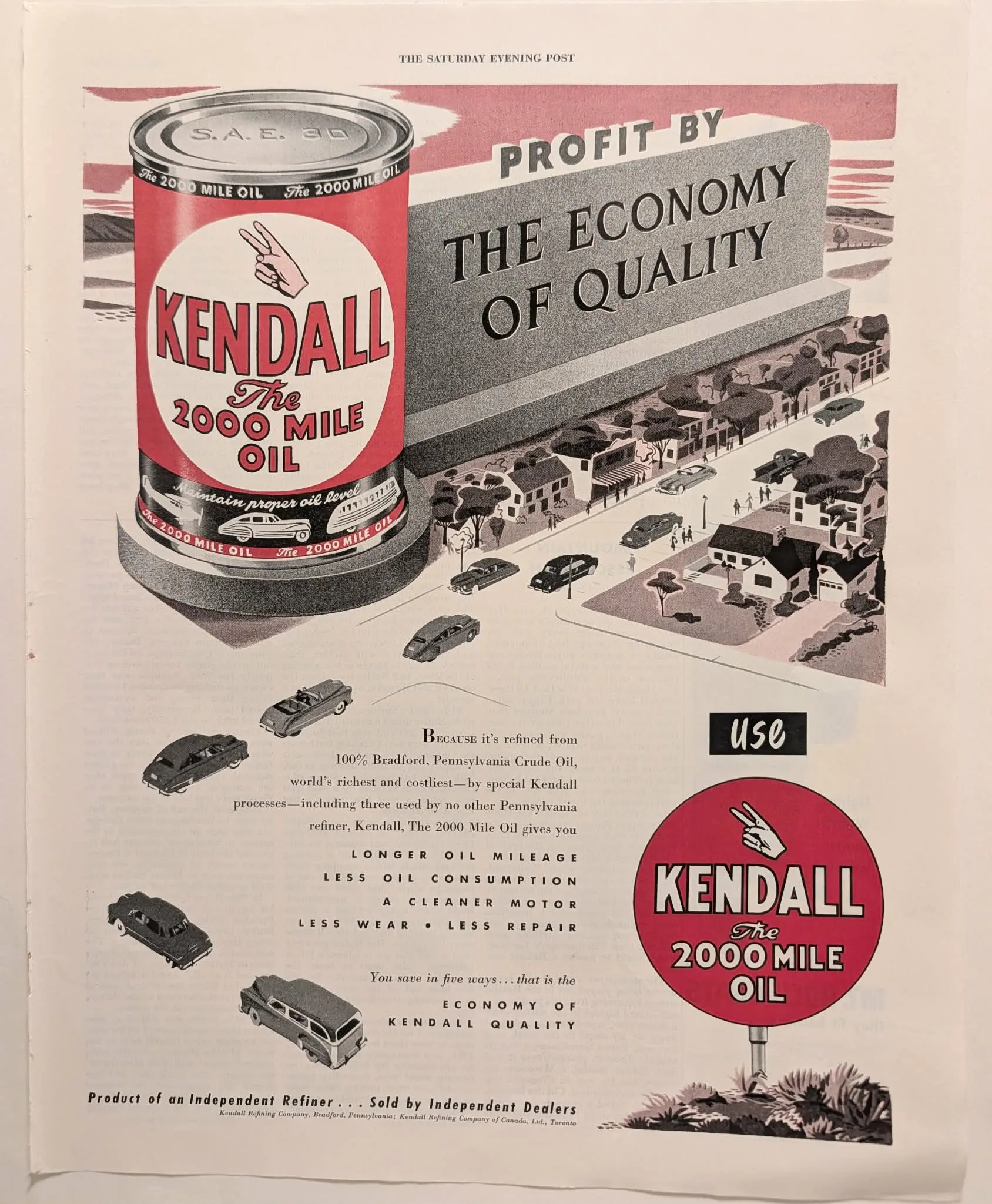
1950s Kendall Motor Oil "2000 Mile Oil" Vintage Advertisement
This piece is a masterclass in spatial design and visual storytelling, engineered to capture the attention of The Saturday Evening Post readership. The composition is distinctly layered, possessing a kinetic potential that effortlessly guides the viewer's eye through a highly orchestrated sequence. It begins with the colossal, dominating red tin of "Kendall The 2000 Mile Oil" in the upper left, featuring the brand's iconic two-finger logo. From this anchor point, a clever visual mechanic is deployed: a stream of stylized, monochromatic automobiles cascades downward from the base of the oil can. This cascading element creates a sense of continuous motion, effectively translating the abstract concepts of fluid dynamics and engine lubrication into tangible forward momentum. This flowing arrangement of elements naturally lends itself to the imagination, almost feeling as though the cars are already in motion across the page. The central narrative is driven by the bold, monumental typography etched into a structural block: "PROFIT BY THE ECONOMY OF QUALITY". Below this, the copy grounds the visual spectacle in technical claims, asserting the product is refined from "100% Bradford, Pennsylvania Crude Oil, world's richest and costliest" and utilizing "special Kendall processes". The text promises the consumer five specific economic benefits: "LONGER OIL MILEAGE," "LESS OIL CONSUMPTION," "A CLEANER MOTOR," "LESS WEAR," and "LESS REPAIR". The background contrasts the industrial scale of the oil can with a sprawling, idyllic suburban diorama. Cars navigate tree-lined streets alongside modern homes, framing the product not just as a mechanical necessity, but as a facilitator of the mobile American lifestyle. Finally, the footer proudly establishes the brand's market positioning as a "Product of an Independent Refiner... Sold by Independent Dealers," specifically naming the "Kendall Refining Company, Bradford, Pennsylvania" and its Canadian counterpart.
Category: Automotive Parts
Year: 1950
Rarity Class: B
Paper & Print Condition
Evaluated under museum-standard archival lighting. The artifact is presented on period-correct, medium-weight calendared paper stock typical of mid-century publications. The lithographic halftone dot structure remains remarkably crisp, demonstrating excellent registration and vivid pigment saturation. This absolute clarity provides a high-fidelity source essential for high-resolution scanning and the intricate layering required to bring the artwork to life in 2D animation. Slight, uniform marginal oxidation (toning) and a subtle vertical binding crease are present along the spine edge. These physical textures and artifacts of age authenticate the piece, offering unique material characteristics that can be carefully managed or deliberately preserved as kinetic elements during the digital restoration and animation process.
Provenance & Rarity
Sourced directly from a pristine mid-century issue of The Saturday Evening Post. While original print runs for such mass-market publications were voluminous, finding surviving full-page advertisements from this era in an uncompromised structural state is exceedingly difficult. The vast majority of these ephemera succumb to staple rust, environmental acidic decay, UV fading, or rough handling over the decades. Consequently, artifacts preserved with this level of pristine visual fidelity are considered highly prized. They are actively sought not only by automotive and petroleum historians but also by digital archivists and multimedia reconstructionists; the immaculate print quality and edge sharpness are absolute prerequisites for extracting the clean, distinct spatial layers necessary to adapt the static 2D artwork into living, kinetic formats.
Rarity & Condition Summary
This 1950s Kendall Motor Oil advertisement is a wonderfully preserved Class B artifact that exemplifies mid-century print marketing. It is distinguished by its kinetic visual composition and excellent color retention. Its elevated exhibition value lies in the exceptional structural preservation of its dynamic layout, which remains free from severe acidic degradation or structural compromise. This pristine clarity makes it a highly sought-after specimen by multimedia archivists specifically dedicated to extracting and reconstructing static vintage ephemera into layered 2D animation formats.