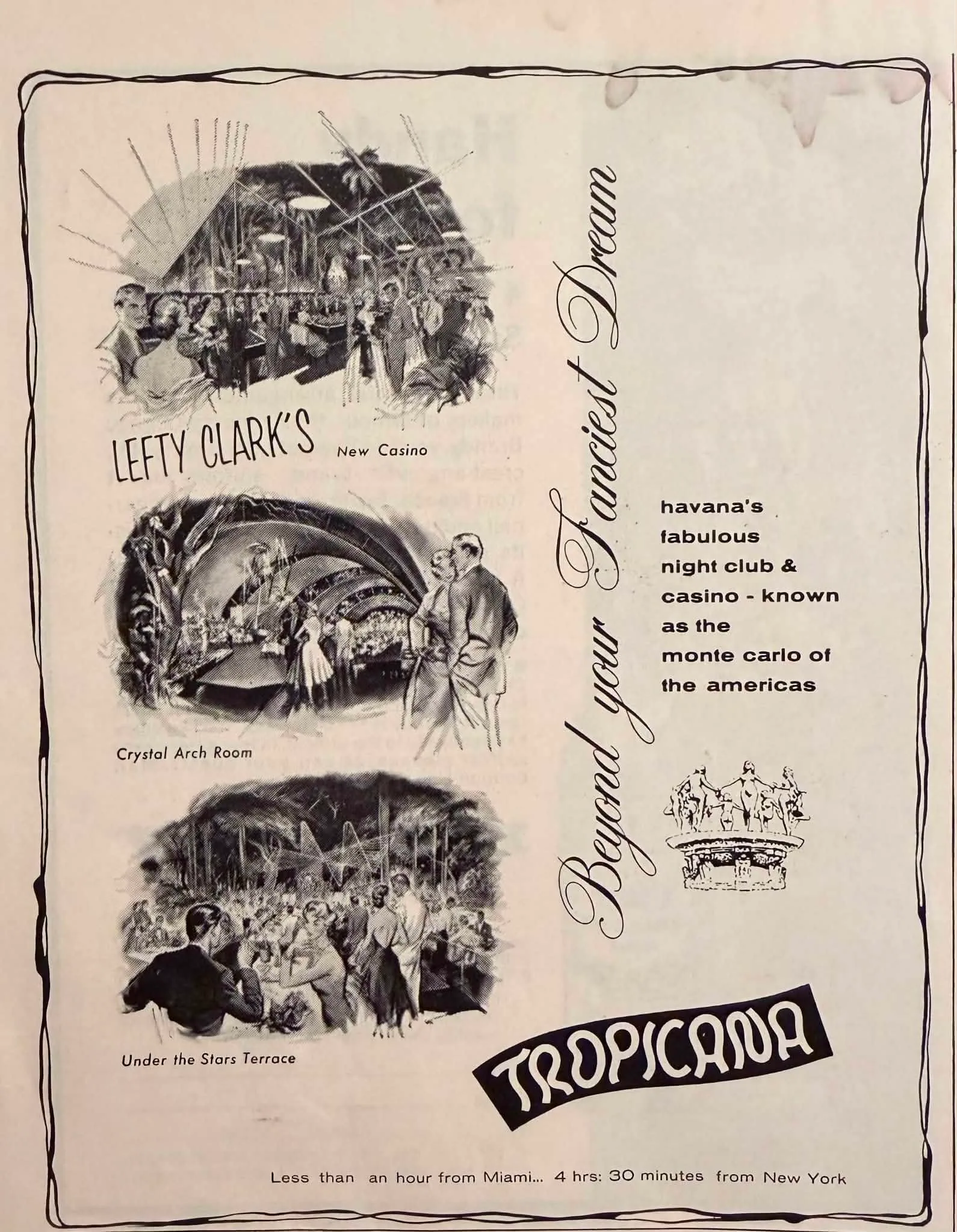
1950s Tropicana Havana Nightclub & Casino Vintage Advertisement
The 1950s represented a golden age for Cuban tourism, with Havana standing as a premier destination for American elites seeking exotic luxury. The Tropicana Club, famously billed in this document as "havana's fabulous night club & casino," was at the epicenter of this cultural and economic boom. This specific advertisement highlights the venue's architectural and atmospheric marvels, specifically promoting the "Crystal Arch Room," the "Under the Stars Terrace," and "Lefty Clark's New Casino". The strategic inclusion of travel times—"Less than an hour from Miami... 4 hrs: 30 minutes from New York"—underscores the aggressive, targeted marketing aimed at wealthy mainland tourists just a short flight away. Artistically, this document is a masterclass in mid-20th-century commercial illustration
Category: Travel & Hotels
Year: 1950
Rarity Class: A
Paper & Print Condition
The document exhibits an authentic, naturally aged paper texture with a subtle grain that provides a warm, tactile foundation. The monochromatic lithography beautifully retains the crisp, hand-drawn stroke quality characteristic of 1950s flat illustration. The ink has settled perfectly into the porous surface, preserving the fluid linework and precise cross-hatching without any significant bleeding or fading. This pristine preservation of period aesthetics—specifically the interplay between the
Provenance & Rarity
Sourced from premium American travel and lifestyle publications distributed during the late 1950s, this advertisement is a remarkably rare survivor of pre-revolution Cuban tourism ephemera. The specific inclusion of "Lefty Clark's New Casino" firmly anchors its publication timeline, tying it to a highly specific, fleeting era of Havana's nightclub history. While travel brochures and mass-market print ads of this period were originally produced for temporary use, locating surviving specimens that
Rarity & Condition Summary
A Class A artifact in Very Good condition. Its exceptional rarity stems not only from its status as pre-revolution Cuban ephemera but from the flawless preservation of its mid-century flat illustration style. The pristine retention of its authentic hand-drawn stroke quality against the naturally aged paper texture elevates it from a mere historical document to an invaluable reference for studying and recreating 2D commercial art techniques of the 1950s.