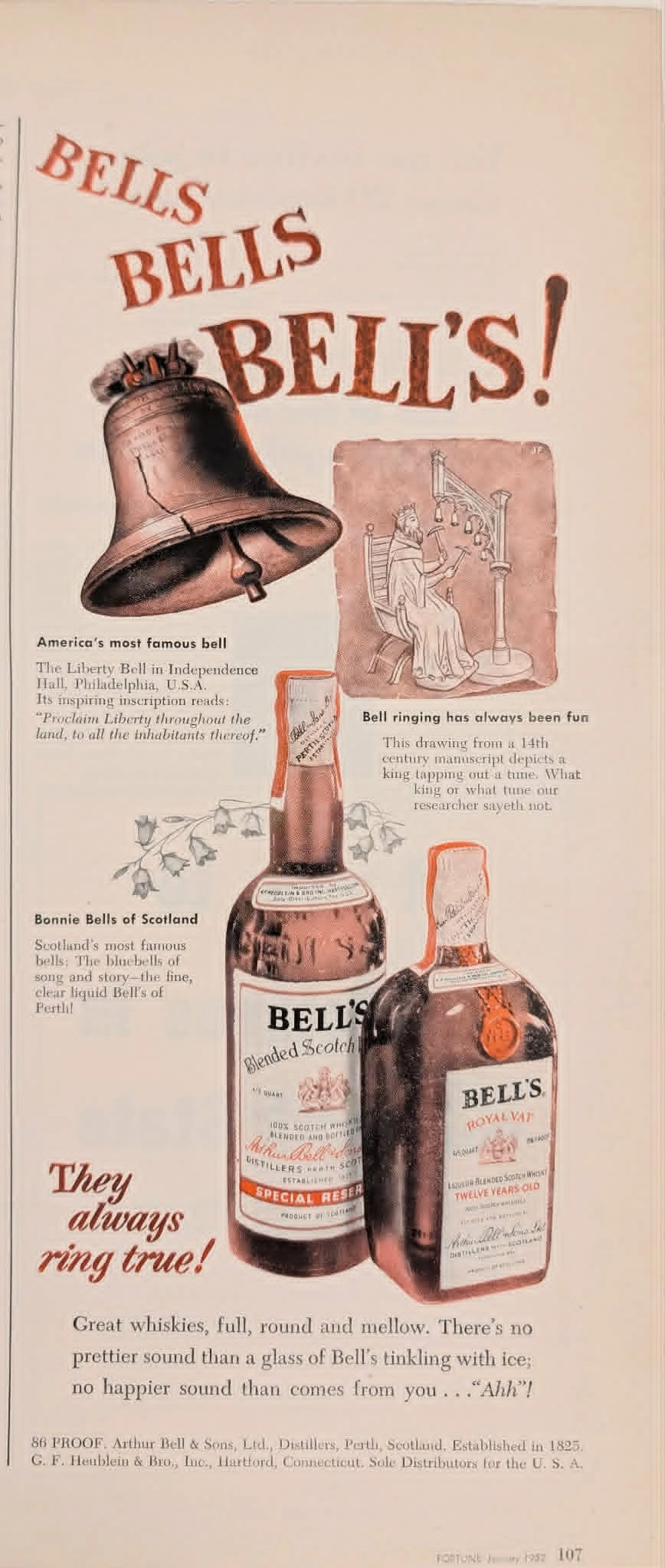
1952 Bell's Blended Scotch Whisky Vintage Advertisement
In the early 1950s, the American economy was experiencing robust post-war growth, leading to a rise in consumerism and a growing appetite for premium imported goods. Scottish distilleries, looking to expand their international footprint, strategically partnered with established American distribution networks. This specific advertisement marks the collaboration between Arthur Bell & Sons, Ltd. of Perth, Scotland, an entity established in 1825, and their sole United States distributor, G. F. Heublein & Bro., Inc. based in Hartford, Connecticut. The brilliance of this campaign lies in its visual and textual wordplay, utilizing a tri-fold thematic approach centered entirely around the word "Bell". First, the Liberty Bell is prominently featured and labeled "America's most famous bell," visually anchoring the advertisement to American identity and creating an immediate sense of trust. Second, a reference to the "Bonnie Bells of Scotland" gently nods to the brand's authentic Scottish origins and the clear liquid produced in Perth. Finally, the inclusion of a 14th-century manuscript drawing depicting a king tapping a tune on bells adds an air of aristocratic antiquity. The tagline, "They always ring true!", alongside the featured Special Reserve bottle and the 86 Proof premium Royal Vat Twelve Years Old, demonstrates Bell's clear intent to capture multiple segments of the luxury mid-century American market.
Category: Lifestyle & Vice
Year: 1952
Rarity Class: S
Paper & Print Condition
Printed on the premium, semi-gloss stock characteristic of Fortune magazine's mid-century publications. The paper exhibits a beautiful, natural age-toning—a gentle patina that authentically preserves the aged paper texture highly sought after in archival materials. The print technique masterfully highlights the period color palette, particularly the warm, earthy terracotta reds and deep ambers of the whisky bottles, which remain remarkably vibrant against the page. Furthermore, the crisp lithographic transfer flawlessly maintains the integrity of the original flat 2D illustration style, capturing the precise hand-drawn stroke quality seen in the 14th-century manuscript depiction. This excellent state of preservation makes the visual components exceptionally adaptable for vertical re-framing and digital archival applications.
Provenance & Rarity
Sourced directly from page 107 of the January 1952 issue of Fortune magazine, a premier publication targeted at affluent mid-century American businessmen. While the magazine itself had a substantial circulation, fully intact, full-page liquor advertisements from this exact post-war era are increasingly scarce. The rarity of this specific artifact is significantly elevated by its contemporary demand. Pristine examples are highly sought after as foundational master plates for digital animation preservation. The flawless retention of the flat 2D illustration style provides crucial, high-fidelity source material for multimedia archivists reconstructing organic character motion and synchronized lip movement. Furthermore, the rich visual narrative serves as an ideal anchor for projects incorporating period-accurate soundscapes, such as a crackling radio or a bustling 1950s street, making this unblemished print a rare and vital bridge between static print history and dynamic digital restoration.
Rarity & Condition Summary
A remarkably well-preserved Class S artifact of mid-century international spirits marketing. Its true rarity lies not merely in its age, but in its flawless preservation of the original flat 2D illustration style, authentic aged paper texture, and period color palette. This unblemished condition establishes it as an exceptionally rare, high-fidelity master plate for modern digital restoration. The structural composition of the artwork is perfectly suited for vertical aspect ratio re-framing. Furthermore, it provides an ideal visual foundation for advanced archival animation projects—specifically those meticulously reconstructing organic character motion and synchronized lip movement—while serving as a perfect visual anchor for the integration of immersive 1950s atmospheric soundscapes, such as a crackling radio or a bustling street.