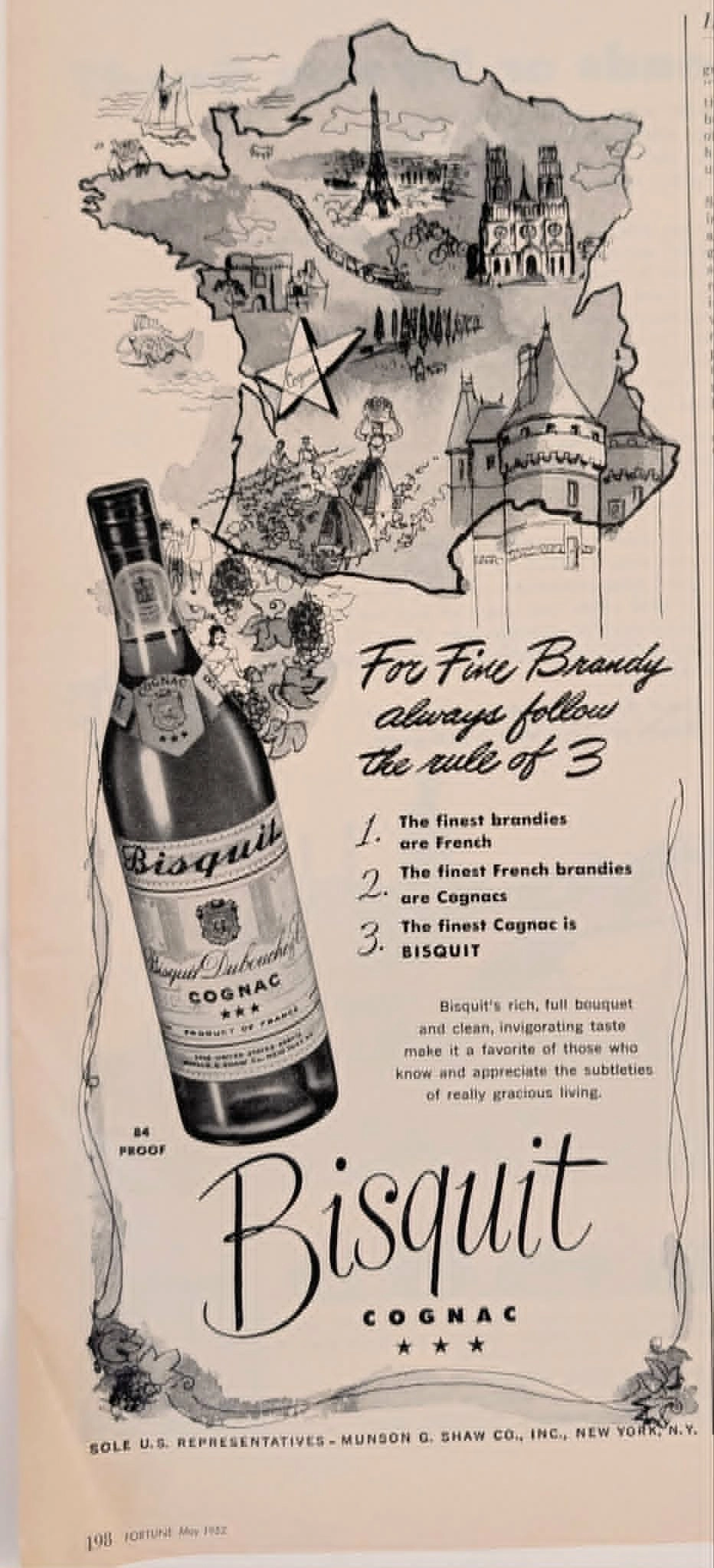
1952 Bisquit Cognac Vintage Advertisement
This 1952 Bisquit Cognac advertisement, published in the May issue of Fortune Magazine, transcends mere product promotion. It serves as a vital cultural artifact reflecting a pivotal transitional era in post-war global history. We can deconstruct its significance across four distinct dimensions: 1. The American Golden Age and the Export of French "Soft Power": During the early 1950s, the United States entered an era of unprecedented post-war economic prosperity. An increasingly affluent executive class began actively seeking imported European goods to signal upward social mobility and refined taste. Concurrently, a war-torn France urgently needed to rebuild its economy by leveraging its historical mastery in luxury exports—chiefly Cognac, Champagne, and high fashion. 2. The Legacy of the Bisquit Dubouché House: Founded in 1819 by Alexandre Bisquit, the brand holds a venerable position among the oldest Cognac houses. Historically favored by global figures such as King George VI and Sir Winston Churchill, the "Three Star" (***) designation served as a strategic, accessible entry point into the world of heritage European luxury for the burgeoning American market. 3. Marketing Psychology and the "Rule of 3": The American importer, Munson G. Shaw Co., faced a consumer base that largely could not differentiate between domestic "brandy" and authentic French "Cognac." The copywriters ingeniously employed a deductive logical framework: 1. The finest brandies are French. 2. The finest French brandies are Cognacs. 3. The finest Cognac is BISQUIT. This strategy effectively educated the consumer and positioned Bisquit at the apex of quality. 4. The Aesthetics of Terroir and Visual Pedagogy: Visually, the piece relies on a romanticized, line-and-wash illustration of a map of France, blending historical monuments with vignettes of rustic vineyard labor. A large star pinpoints the Cognac region, subliminally reinforcing the concept of terroir—the unique convergence of soil, climate, and tradition that makes genuine Cognac impossible to replicate.
Category: Lifestyle & Vice
Year: 1952
Rarity Class: B
Paper & Print Condition
Printed on medium-weight, uncoated magazine stock typical of mid-century premium business periodicals. The paper exhibits a natural, mild patina indicating authentic archival aging. The printing technique utilizes black-and-white offset lithography with a high-resolution halftone screen. This method effectively balances the soft, varied tonal washes of the hand-drawn map illustration with the crisp, high-contrast typography of the 'Bisquit' logotype and the classic serif body copy. The ink remains remarkably rich, showing minimal fading, which preserves the intricate line work of the regional vignettes and the detailed bottle etching.
Provenance & Rarity
Sourced directly from the May 1952 issue of Fortune Magazine (Page 198), a premier American business publication renowned for its lavish production value, oversized format, and affluent readership. The provenance of this piece highlights a strategic demographic targeting: placing a premium imported spirit before a sophisticated audience of post-war corporate executives and high-net-worth investors. Classified as a Class B archival artifact (Standard archive, specialized publication), this advertisement is relatively scarce today due to the low survival rate of mid-century commercial periodicals in unclipped, untorn condition. While Fortune had a smaller circulation compared to mass-market weeklies, its issues were frequently preserved in corporate libraries, allowing this specific specimen to survive with its exceptional structural integrity intact.
Rarity & Condition Summary
This 1952 Bisquit Cognac advertisement stands as an exceptionally well-preserved mid-century artifact, representing a critical intersection of luxury beverage marketing, consumer pedagogy, and cross-cultural prestige. Earning a Class B Rarity designation, the specimen is notable not only for its survival but for its outstanding structural and visual integrity. The uncoated paper retains a uniform, authentic aging without significant foxing, moisture damage, or acidic deterioration often seen in periodicals of this era. The lithographic ink remains vivid, ensuring the cartographic illustrations and typographical nuances are easily legible. Ultimately, it is a superior archival example that successfully encapsulates the post-war American appetite for European refinement.