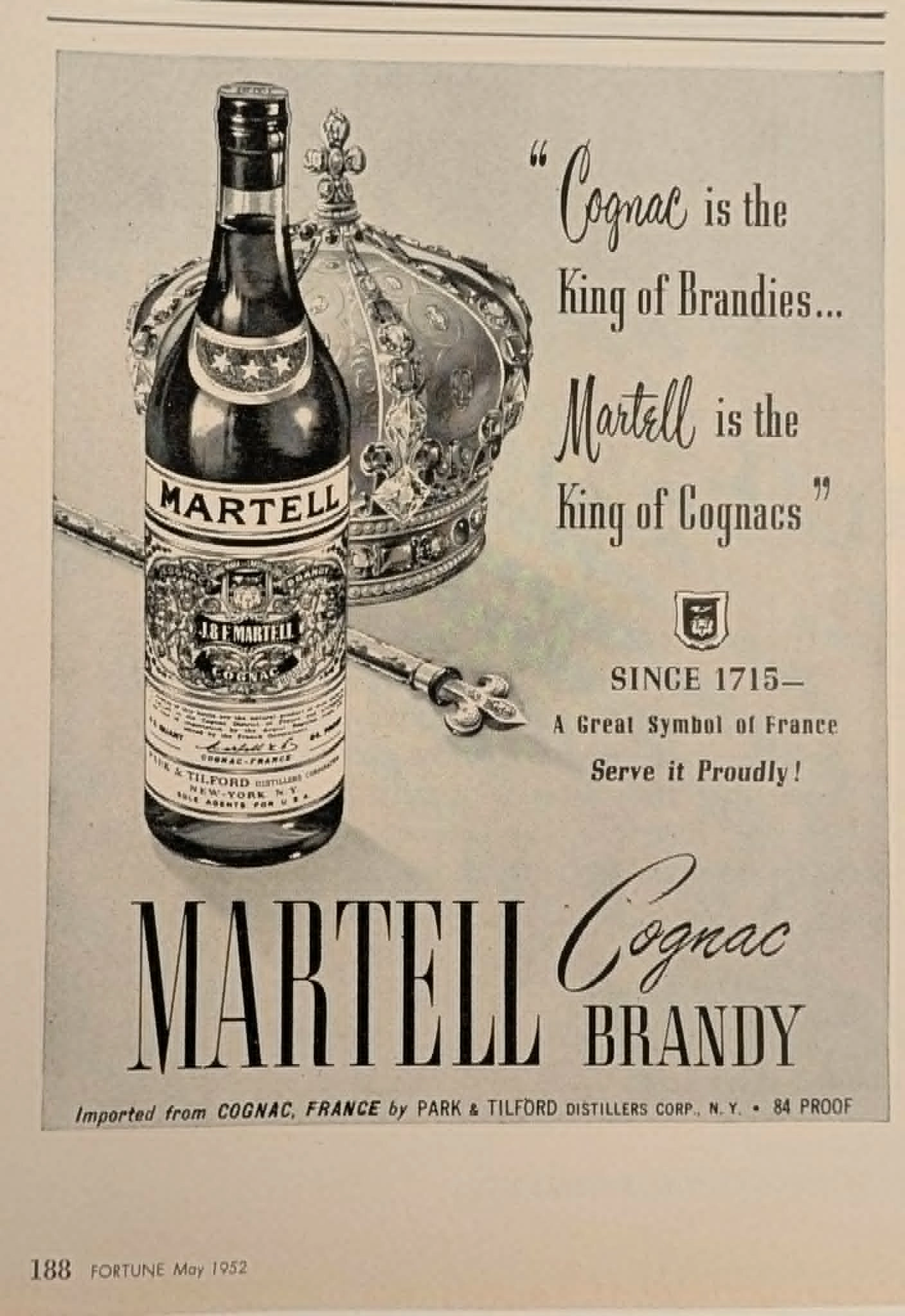
1952 Martell 3-Star Cognac Vintage Advertisement: "The King of Cognacs"
The post-World War II era in the United States marked a profound shift in consumer culture. As the American economy expanded, a newly affluent executive class began to emerge, possessing both the disposable income and the desire for sophisticated, European luxury goods. This 1952 Martell advertisement, deliberately placed in Fortune magazine—the premier publication for American business leaders—serves as a masterclass in targeted demographic marketing. Visually, the advertisement leverages the power of association. The Martell 3-Star bottle stands tall beside a meticulously illustrated royal crown and scepter. This is not merely decorative; it is a visual translation of the ad’s bold typographic claim: "Cognac is the King of Brandies... Martell is the King of Cognacs." By utilizing this royal imagery, Martell bypassed the need to explain the complex distillation processes of cognac, instead instantly communicating ideas of hierarchy, supremacy, and luxury. Furthermore, the inclusion of the text "SINCE 1715 – A Great Symbol of France" grounds the product in centuries of tradition. In an era where American brands were rapidly innovating and modernizing, European heritage brands like Martell leaned heavily on their antiquity to justify premium positioning. The 1715 date reminds the consumer that this is a product that has survived revolutions, wars, and the passage of time, further cementing its status as an enduring symbol of refinement. The advertisement also highlights the mechanical aspects of mid-century international trade. The explicit mention of the importer, Park & Tilford Distillers Corp., N.Y., reveals the distribution networks required to bring European luxury to American shores. Park & Tilford was a historic and highly influential importer, and their stamp on the advertisement assured retailers and consumers alike of the product's authenticity and legal importation (a still-relevant reassurance in the decades following Prohibition). Operating at 84 proof, this specific export iteration of Martell represents the precise intersection of French craftsmanship and mid-century American palate preferences.
Category: Lifestyle & Vice
Year: 1952
Rarity Class: B
Paper & Print Condition
Extracted from the original May 1952 issue of Fortune magazine (page 188), the paper exhibits the standard, mild tonal aging expected of mid-century publication stock. The black-and-white halftone dot structures of the photographic and illustrative elements remain remarkably sharp, and the typographic overlay is crisp, showing no significant ink bleed.
Provenance & Rarity
Authenticated as an original page-run from the May 1952 issue of Fortune magazine, a premier American business publication of the mid-20th century. The presence of the Park & Tilford Distillers Corp. corporate credit establishes clear institutional provenance, linking the artifact directly to the authorized post-war luxury import networks of New York. Assigned a Rarity Class B (Uncommon), this print advertisement is highly collectible due to its pristine state of survival and its specific appeal to specialized collectors of premium beverage ephemera, mid-century advertising design, and social history archives documenting the evolution of corporate luxury taste.
Rarity & Condition Summary
Rarity Class: Class B (Uncommon) Archival Assessment: This 1952 Martell 3-Star Cognac advertisement is a exceptionally well-preserved example of post-war corporate luxury print media. Extracted cleanly from a high-grade cultural repository (Fortune magazine), it has avoided the typical structural decay—such as heavy foxing, water staining, or edge fraying—common to loose paper ephemera of this vintage. While not classified as a mythical or unique artifact (Class S/Omega), its scarcity is driven by its pristine graphic integrity and the specific cultural cross-section it documents: the direct intersection of historic French distillation excellence and mid-century American elite consumption. It remains a premier, gallery-grade piece for corporate, spirit-historical, or design-focused archives.