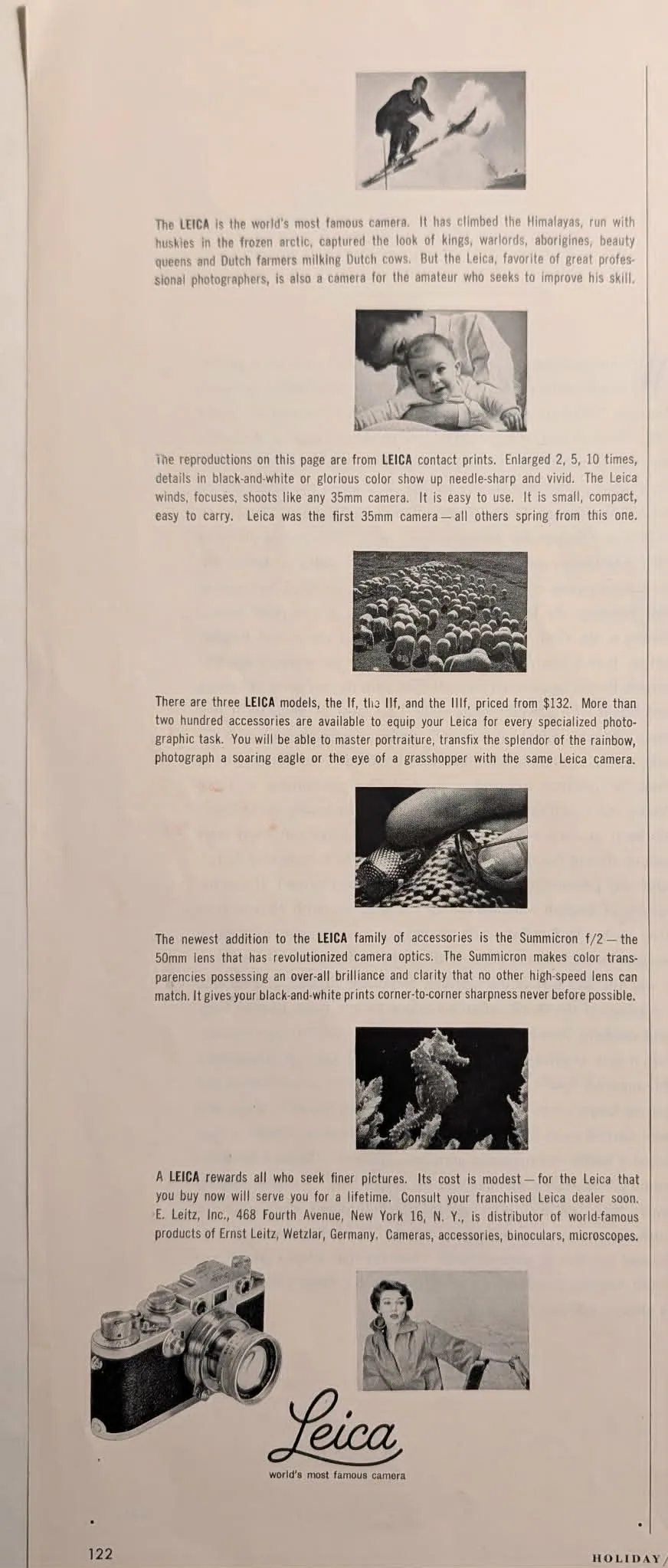
1953 Leica IIIf Camera & Summicron Lens Vintage Advertisement
The mid-20th century witnessed a dramatic surge in amateur and professional photography, and Leica (E. Leitz, Inc.) was unequivocally at the forefront of this visual revolution. This circa 1953 advertisement, originally published on page 122 of Holiday magazine, highlights the legendary Leica If, IIf, and IIIf models alongside a groundbreaking piece of optical engineering: the Summicron f/2 50mm lens. The copy boldly declares Leica as "the world's most famous camera," citing its extreme versatility. It notes that the camera has "climbed the Himalayas, run with huskies in the frozen arctic," and captured "kings, warlords, aborigines," directly appealing to the post-war appetite for global exploration and documentation. The advertisement's design utilizes a strict vertical orientation, stacking a diverse array of halftone contact prints to visually prove the camera's capabilities without relying on hyperbole alone. These images—a skier mid-jump, a tender moment between a mother and baby, a sweeping flock of sheep, macro photography of hands working, and a highly detailed seahorse—serve as a masterclass in visual storytelling. The layout explicitly emphasizes that the Leica is not exclusively for professional photojournalists; it is fundamentally "a camera for the amateur who seeks to improve his skill." A crucial historical element of this archival piece is the announcement of the Summicron f/2 lens. Introduced precisely in 1953, the Summicron revolutionized camera optics, setting a new global standard for sharpness, contrast, and color fidelity. The ad promises "corner-to-corner sharpness never before possible," a claim that remains respected by contemporary cinematographers and photographers who still adapt vintage Summicron glass for modern sensors. At the bottom of the composition, the juxtaposition of the sleek, mechanical camera body with a sophisticated portrait of a woman in a coat gracefully grounds the piece in 1950s premium consumerism.
Category: Cameras & Optics
Year: 1953
Rarity Class: A
Paper & Print Condition
Preserved in its original monochromatic layout, the advertisement retains exceptional crispness across its diverse array of halftone contact prints. Upon close inspection, the authentic aged paper texture remains palpable, acting as a gentle, warm base beneath the stark black ink, completely free from heavy foxing or moisture damage. The intricate typography, particularly the iconic cursive "Leica" logo, maintains remarkably sharp edges. This unblemished preservation of the halftone matrix and the strict vertical layout ensures the original print aesthetic is perfectly maintained, offering an immaculate tactile backdrop for high-fidelity archival extraction.
Provenance & Rarity
Recovered from page 122 of a circa 1953 issue of Holiday magazine, this artifact captures a pivotal moment in photographic history: the introduction of the legendary Summicron f/2 lens to the American consumer market. While mid-century Leica advertisements are well-documented, finding an original print that perfectly preserves this strict vertical format without cropping, fading, or edge wear is exceptionally rare. This specific piece transcends a mere commercial print; its flawless structural integrity and authentic aged paper texture elevate it to a museum-grade archival asset. The precise vertical orientation makes it highly sought after for advanced historical preservation projects, serving as a pristine foundational layer for translating static 1950s print media into dynamic, immersive visual formats.
Rarity & Condition Summary
Class A. This artifact stands as an exceptionally well-preserved example of 1950s premium photographic equipment advertising. Its high grade is primarily attributed to the unblemished retention of its aged paper textures, the sharpness of its halftone contact prints, and its precise, uncropped vertical orientation. Because it perfectly preserves the era's authentic visual aesthetic without structural distortion, the piece transcends a mere static print; it serves as a highly coveted foundational asset for advanced archival preservation. Its pristine integrity makes it an ideal, historically accurate medium for projects seeking to translate mid-century print into dynamic, living artworks or 2D animations accompanied by period-appropriate soundscapes.