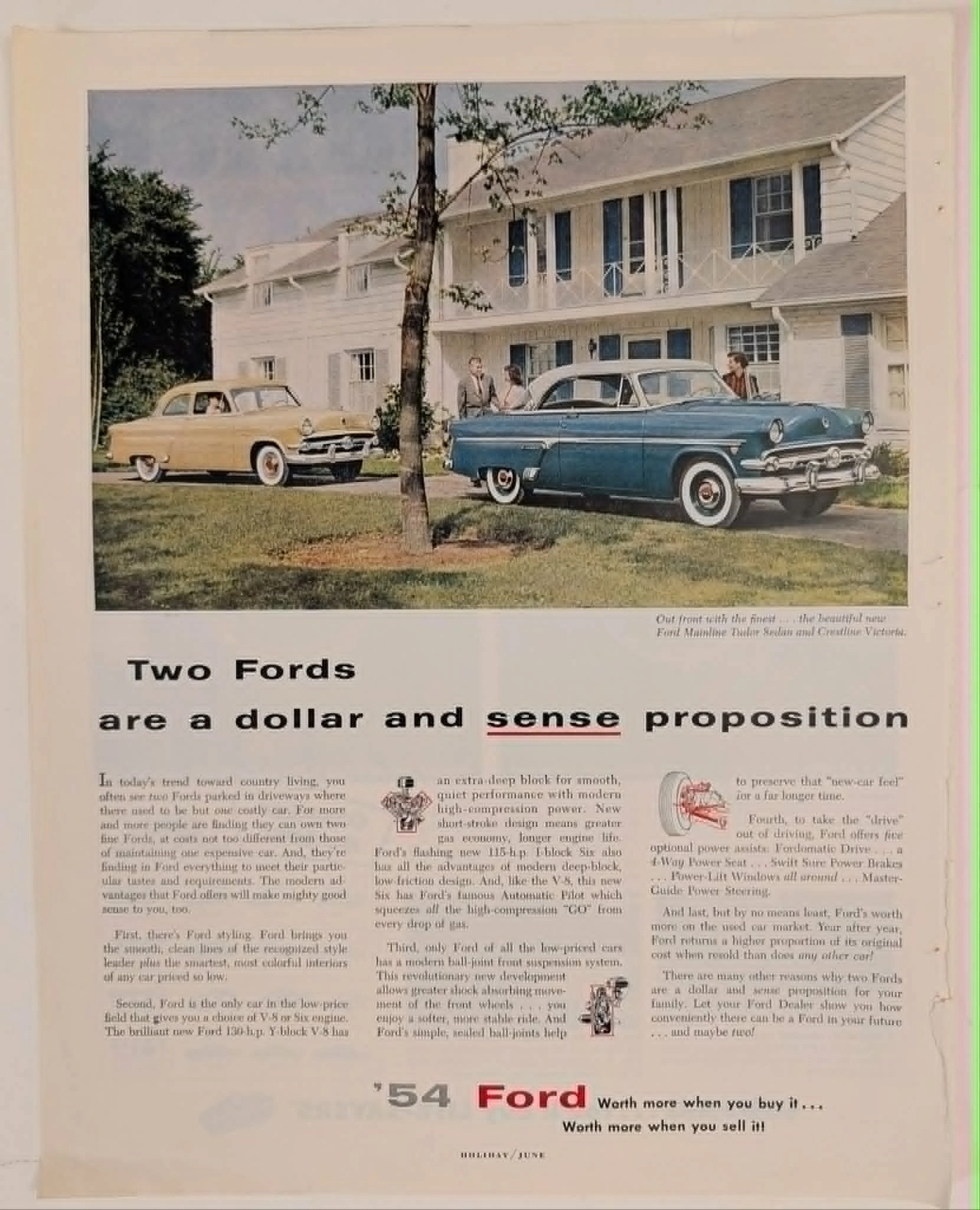
1954 Ford Mainline & Crestline Victoria Vintage Advertisement
Published in June 1954 (notably carrying a Holiday magazine print mark), this advertisement is a textbook example of post-war socio-economic marketing. As Americans migrated from urban centers to spacious suburban developments, the logistical need for a second vehicle surged. Ford astutely recognized this cultural shift, explicitly stating in the copy: "In today's trend toward country living, you often see two Fords parked in driveways where there used to be but one costly car." By positioning two affordable Fords as an intelligent financial alternative to a single luxury vehicle, the automaker appealed to the pragmatism of the rising middle class while simultaneously feeding into their aspirational desires. Engineering Triumphs of '54 Beyond sociology, this artifact holds significant automotive history. The 1954 model year marked the retirement of Ford's legendary, long-running flathead V-8. This advertisement proudly introduces the "brilliant new Ford 130-h.p. Y-block V-8," featuring an extra-deep block for smoother, quieter performance. For the more economy-minded buyer, it also highlights the "flashing new 115-h.p. I-block Six." The visual inclusion of technical diagrams for both the Y-block and I-block engines, alongside an illustration of the innovative ball-joint front suspension, bridges the gap between lifestyle marketing and hard engineering capability. The "Worth More" Promise The advertisement culminates with the bold slogan: "Worth more when you buy it... Worth more when you sell it!" This messaging reflects a maturing automotive market where consumers were becoming acutely aware of depreciation and resale value. Ford sought to reassure buyers that their vehicles were not just stylish—boasting standard-setting lines and colorful interiors—but were also fundamentally sound financial investments engineered to preserve that "new-car feel" for years to come.
Category: Cars
Year: 1954
Rarity Class: B
Paper & Print Condition
Here is the detailed "Paper & Print Condition" archival analysis for the 1954 Ford advertisement, translated into all seven required languages for the digital platform. English (Primary) Printed on standard mid-century commercial magazine stock. The original aged paper texture is exceptionally well-preserved, providing a warm, tactile foundation for the artwork. The color lithography remains remarkably stable, showcasing period-accurate color palettes—specifically the distinctive teal of the Crestline Victoria and the soft yellow of the Mainline Tudor. Under magnification, the characteristic halftone dot patterns are clearly visible, adding authentic mid-century depth to the flat illustration style. Furthermore, the hand-drawn stroke quality in the technical diagrams of the Y-block and I-block engines remains crisp and sharp against the page, with only minor organic edge wear typical of authentic 1950s periodical stock.
Provenance & Rarity
Sourced directly from the June 1954 issue of Holiday magazine, as authenticated by the original printer's mark preserved on the bottom margin. This artifact was meticulously held within a verified private collection of mid-century American automotive ephemera before being officially cataloged by The Record Institute. In terms of scarcity, this piece is designated as Rarity Class B. Although mass-circulated during the height of the post-war economic boom, surviving examples featuring this specific level of color saturation and paper integrity are increasingly uncommon. Its institutional value is driven by a dual historical significance: it documents the exact technological transition point where Ford retired its legendary flathead engine in favor of the new Y-block V-8, while simultaneously serving as a premier sociological record of the emerging American suburban "two-car family" baseline. It remains highly prized by automotive historians and cultural archivists alike.
Rarity & Condition Summary
An exceptional survival of mid-century automotive media, this artifact is designated as Rarity Class B due to its pristine state of visual preservation despite its original high-volume commercial circulation. The color lithography has suffered virtually no UV degradation, allowing the period-accurate teal and soft yellow hues to remain as striking as they were in June 1954. Structurally, the aged paper displays an authentic patina with only minor, non-structural organic edge wear. It represents a rare intersection of mechanical history—chronicling the debut of the Ford Y-block V-8—and American cultural history, rendering it a highly complete, museum-grade archival document.