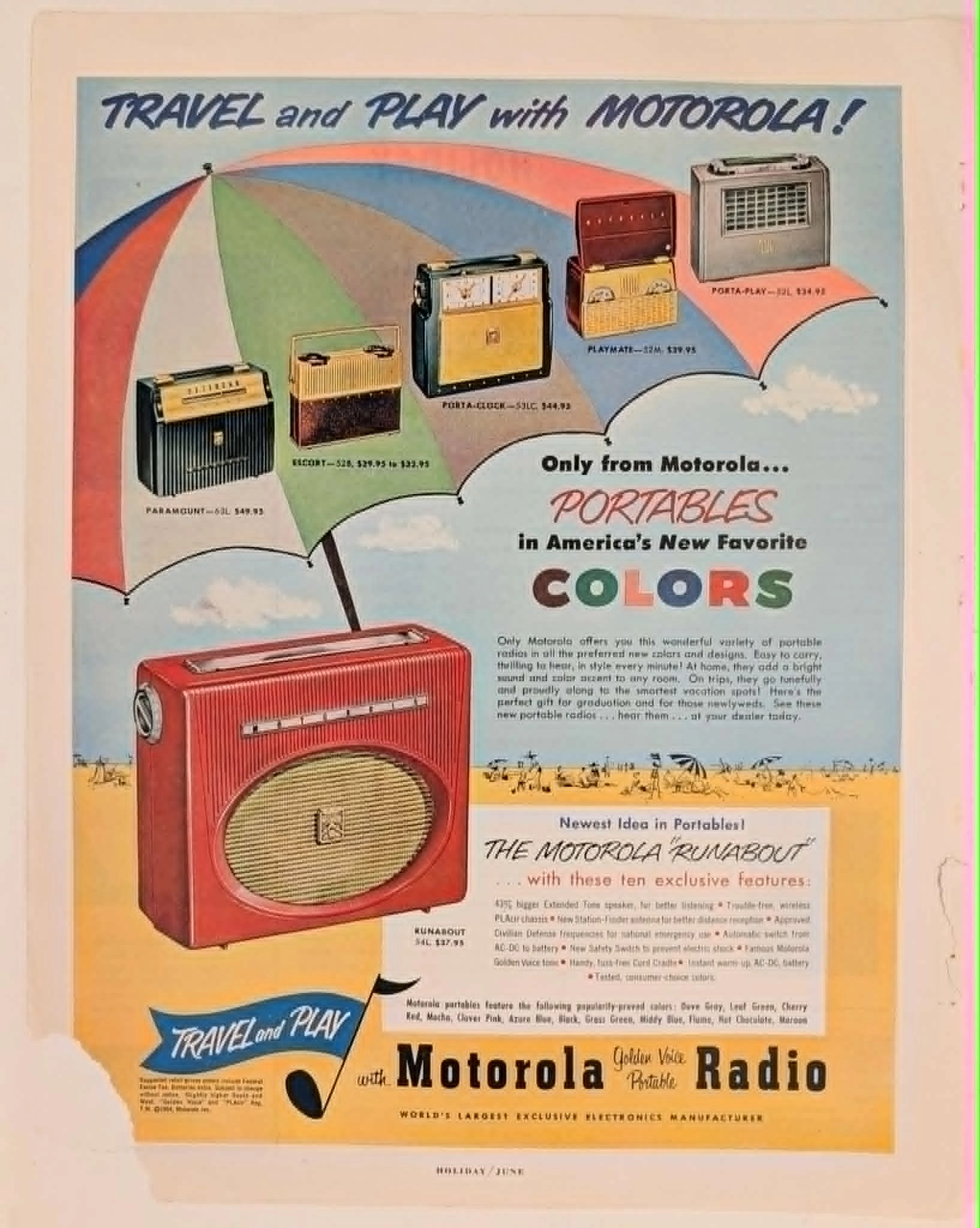
1954 Motorola Portable Radios Vintage Advertisement
By the mid-1950s, the American cultural landscape was defined by mass suburbanization, the rise of the automobile vacation, and the democratization of personal electronics. This 1954 Motorola campaign, leading with the imperative to "Travel and Play," signals a crucial transition in industrial design. The bulky, wood-veneered parlor radios of the pre-war era had been entirely supplanted by lightweight, personal devices meant to accompany the consumer to "the smartest vacation spots." Technologically, this advertisement highlights several landmark shifts in manufacturing. The promotion of the "trouble-free, wireless PLAcir chassis" represents the early commercial adoption of printed circuit boards—a military technology developed during World War II that Motorola was now scaling for civilian use. This innovation allowed for the dramatic reduction in chassis weight and complexity, enabling the array of compact form factors seen in the "Escort" and "Playmate" models. Furthermore, the emphasis on "America's New Favorite Colors" (such as Dove Gray, Cherry Red, and Clover Pink) underscores the chemical industry's post-war perfection of mass-producible, colorfast plastics, transforming utilitarian electronics into fashion accessories. Yet, beneath the sunny, beach-umbrella leisure of the illustration lies the inescapable shadow of the Cold War. The advertisement proudly lists "Civilian Defense frequencies for national emergency use" as an exclusive feature. This is a direct reference to CONELRAD (Control of Electromagnetic Radiation), a public warning system instituted by the U.S. government in 1951. Radios manufactured in this era were legally required to have the frequencies 640 and 1240 kHz marked on their dials (often with small triangles, visible in the high-resolution crop of the "Paramount" model), ensuring civilians could tune in to emergency broadcasts in the event of a Soviet bomber attack. This single sheet of ephemera stands as a masterclass in mid-century contradictions: it is simultaneously an invitation to carefree, colorful beach vacations and a survival tool for a nuclear emergency.
Category: Electronics
Year: 1954
Rarity Class: B
Paper & Print Condition
The artifact is in Good condition. The four-color registration remains remarkably vibrant, faithfully preserving the period-accurate manufacturer colorways against the natural, tactile grain of the aged paper stock. The substrate exhibits moderate, even toning characteristic of mid-1950s high-acid magazine printing. A rough, uneven tear is present along the lower left margin where the page was extracted from its original binding, resulting in a slight loss to the bottom border but leaving the primary flat illustrations and text fields entirely uncompromised.
Provenance & Rarity
Record: Notable. The artifact provides an excellent documentary record of the post-war transition to portable consumer plastics, early printed circuit technology (PLAcir), and the integration of Cold War survival infrastructure (CONELRAD) into everyday leisure goods. Rarity: Low. This advertisement was extracted from the June 1954 issue of Holiday magazine, a widely circulated national publication. Millions of copies were printed, and a substantial population of complete issues and individual pages survives in the secondary market today.
Rarity & Condition Summary
Rarity: B (Common) — While the historical significance (Record) of this advertisement is notable due to its rich cross-section of cultural and technical data, its sheer physical availability (Rarity) dictates the final grade. It is a mass-produced artifact with a high survival rate, keeping it firmly in the common tier. Condition: Good — A structurally sound example with vibrant ink retention, downgraded slightly due to the rough binding extraction on the left margin and natural high-acid paper toning.