1955 Movado Luxury Timepieces Vintage Advertisement (1955) — Class B vintage Luxury Brands
CLASS B
1 of 5

1955 Movado Luxury Timepieces Vintage Advertisement

Category|Luxury Brands
Subcategory|Watches
Year|1955
Rarity Class|CLASS B
Archive Views|10
Theme/SubjectLuxuryWatches
Heritage AdvertisementsLuxury & LifestyleWatch
Ad Content TypeProduct Showcase

Last updated: 14 Apr 2026

Historical Context

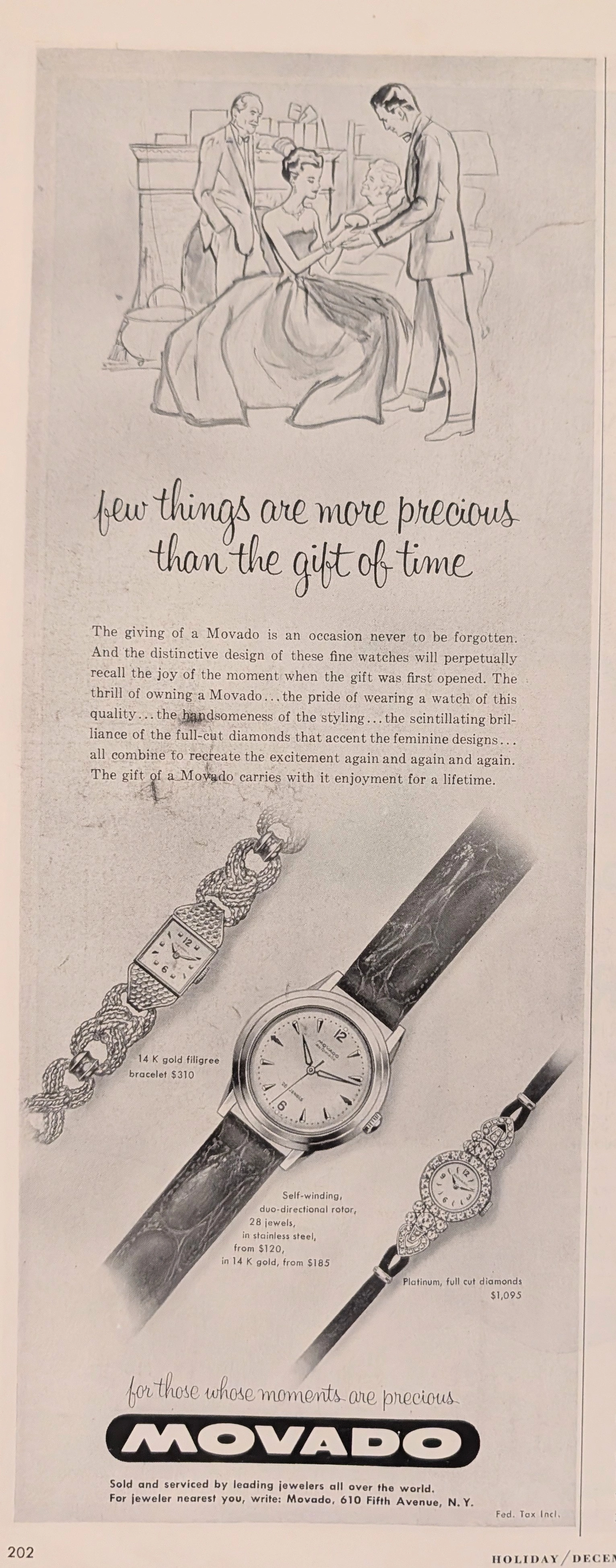
1955 Movado Luxury Timepieces Vintage Advertisement During the mid-twentieth century, the Swiss watchmaking industry was enjoying a golden age of both technical innovation and high-society glamour. This 1955 Movado advertisement perfectly encapsulates the brand's dual commitment to mechanical excellence and haute joaillerie. Targeted specifically at the affluent holiday shopper, the campaign utilizes a classic upper-class vignette—an elegant woman in a sweeping gown receiving a gift in a refined, domestic setting—to establish a tone of exclusivity. The central focal point of the advertisement is the varied product lineup, which highlights significant technological and material achievements of the era. The men's watch featured is a "Self-winding, duo-directional rotor" with 28 jewels. In the 1950s, the widespread commercialization of reliable automatic movements was a major selling point, and the 28-jewel count indicates a premium, highly refined caliber designed to reduce friction and increase longevity. Equally fascinating is the economic data preserved within the copy. The timepieces range from a relatively accessible $120 for the stainless steel automatic to an astounding $1,095 for the women's platinum watch set with full-cut diamonds. Adjusted for inflation, that $1,095 price tag represents a staggering luxury investment equivalent to over $12,000 today. The inclusion of a 14K gold filigree bracelet watch at $310 further demonstrates Movado's strategy of capturing multiple tiers of the high-end market. The overarching tagline, "few things are more precious than the gift of time," remains one of the most enduring and effective psychological appeals in luxury horology.

Paper & Print Condition

The artifact exhibits expected marginal toning, minor foxing, and subtle edge wear characteristic of mid-1950s premium magazine stock. The contrasting elements—the soft, sketch-like illustration at the top and the high-contrast halftone photography of the watches below—remain exceptionally clear. The delicate details of the watch dials and the filigree bracelet are preserved without significant ink spread.

Provenance & Rarity

Sourced from a December holiday publication printed in the mid-1950s (circa 1955). Advertisements detailing the specific jewel counts, movement types, and exact retail pricing of multiple models are highly prized by horological archivists for dating and verifying vintage timepieces.

Rarity & Condition Summary

A beautifully preserved example of mid-century horological marketing, offering invaluable reference data for watch collectors and serving as a pristine artifact of 1950s luxury consumerism.
Share This Archive

From the Journal

Related Articles

The Time Traveller's Dossier: The Anatomy of Autonomy – The 1966 Bulova Commander Collection and the American System of Watchmaking — related article
Read Article

The Time Traveller's Dossier: The Anatomy of Autonomy – The 1966 Bulova Commander Collection and the American System of Watchmaking

The evolution of the mid-twentieth-century luxury consumer market was fundamentally propelled by an intense post-war desire for unwavering reliability and transparent corporate accountability. The historical artifact elegantly and securely positioned upon the analytical table of The Record Institute today is a striking, full-page print advertisement for the 1966 Bulova Commander Collection, originating from a highly transformative era in global horology. This document completely transcends the standard, utilitarian boundaries of jewelry marketing. It operates as a highly sophisticated, multi-layered cultural mirror, reflecting the precise era when American industrial might directly challenged the fragmented traditions of European watchmaking, explicitly packaging and selling the concept of total mechanical autonomy to the American middle-class consumer. This world-class, comprehensive dossier conducts a meticulous, unyielding, and exceptionally exhaustive examination of the artifact, operating under the absolute most rigorous parameters of historical, sociological, and material science evaluation. With the vast majority of our analytical focus dedicated to its immense historical gravity, we will decode the brilliant marketing psychology embedded within the "If you want something done right, do it yourself" campaign, analyze the sociopolitical impact of the "American System of Watchmaking," and dissect the profound visual semiotics of the exploded mechanical view. Furthermore, as we venture deeply into the chemical and physical foundations of this analog printed ephemera, we will reveal the precise mechanical fingerprints of the CMYK halftone rosettes captured in the macro imagery of the watch dial and alligator strap. Finally, we will assess its archival rarity, exploring how the graceful, natural oxidation of the paper substrate cultivates a serene wabi-sabi aesthetic—a natural, irreversible phenomenon that serves as the primary engine driving up its market value exponentially within the elite global spheres of Vintage Commercial Ephemera and Horological Archives.

Ahead of Its Time: The 1978 Heuer Chronosplit Manhattan GMT — related article
Read Article

Ahead of Its Time: The 1978 Heuer Chronosplit Manhattan GMT

Rediscover the ultimate analog-digital hybrid timepiece through a rare 1978 vintage magazine advertisement, meticulously preserved as a single sheet cut-out.

Rolex "Perpetually Yours" — related article
Read Article

Rolex "Perpetually Yours"

This rare mid-century Rolex "Perpetually Yours" advertisement captures the genesis of the modern Rolex empire. Featuring the legendary Oyster Perpetual, it celebrates the historic union of the world's first waterproof 'Oyster' case (1926) and the revolutionary self-winding 'Perpetual' rotor (1931). A true museum-grade horological archive, this piece represents the ultimate mechanical blueprint that defined Rolex's eternal supremacy.

The Time Traveller's Dossier: The Ultimate Horological Supremacy – A Museum-Grade Forensic Deconstruction of the 1968 Longines Ultra-Chron — related article
Read Article

The Time Traveller's Dossier: The Ultimate Horological Supremacy – A Museum-Grade Forensic Deconstruction of the 1968 Longines Ultra-Chron

The evolution of human timekeeping is not merely a passive record of hands rotating in concentric circles; it is a brutal, centuries-long engineering war waged against the absolute, unforgiving laws of physics—specifically gravity, temperature fluctuation, and physical friction. The historical artifact placed upon The Record Institute’s forensic examination table today is a monumental full-page print advertisement for the 1968 Longines Ultra-Chron, extracted from a mid-twentieth-century publication. Released precisely on the precipice of the "Quartz Crisis"—a technological tsunami that would soon decimate the traditional Swiss watch industry—this document represents the absolute pinnacle, the zenith, and the glorious final, defiant stand of analog mechanical engineering. This exhaustive, world-class academic archival dossier will ruthlessly dissect the artifact with microscopic precision, operating under the most rigorous parameters of historical and physical evaluation. We will decode the arrogant yet mathematically backed copywriting that boldly claims "A Minute A Month" accuracy, the profound mechanical significance of the 36,000 vibrations per hour (vph) high-beat movement, and the five specific medallions of honor that permanently anchor the brand’s bloodline to legendary aviation pioneers such as Charles Lindbergh and Howard Hughes. Furthermore, we will subject the heavy, dark-field offset lithography to a rigorous material science analysis, exposing the mechanical fingerprints of the analog halftone rosettes and the inevitable, profoundly beautiful wabi-sabi oxidation of the paper substrate. It is this exact intersection of horological mastery and chemical degradation that acts as the primary engine driving the artifact's market value exponentially upward among serious global collectors.