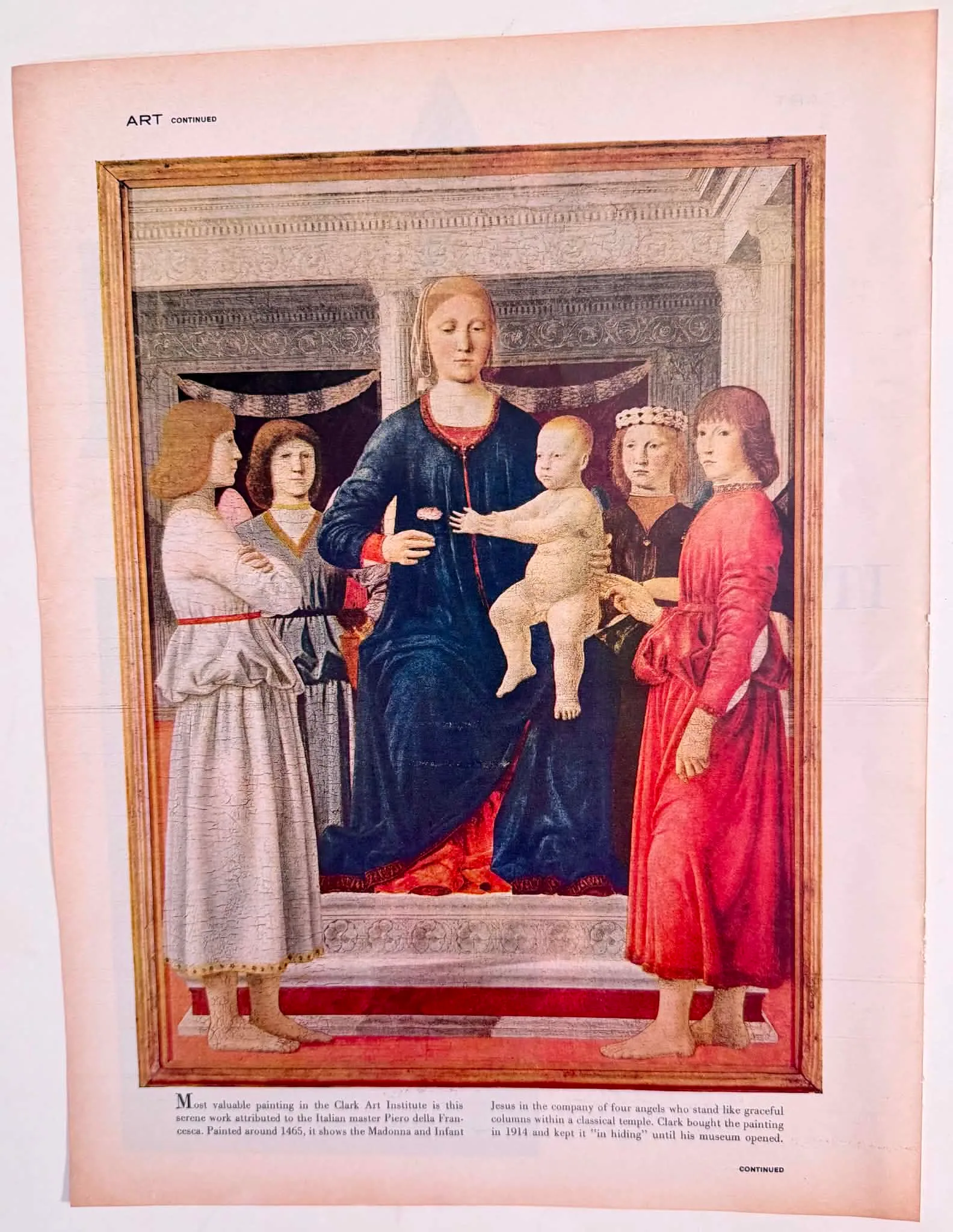
Circa 1955 Piero della Francesca Clark Art Institute Vintage Editorial Print
This mid-century editorial clipping serves as a captivating intersection between American institutional history and Early Italian Renaissance art. The featured painting itself is a hallmark of Piero della Francesca's mastery of perspective, geometry, and serene architectural balance. The publication explicitly notes the work is the "Most valuable painting in the Clark Art Institute" and was painted around 1465. The composition features the Madonna and Infant Jesus. The accompanying text describes the four flanking figures as angels who stand "like graceful columns within a classical temple," highlighting the structural harmony characteristic of the artist's mature style. Beyond the art historical analysis, the clipping reveals the fascinating provenance of the piece. The text states that the collector, Clark, purchased the painting in 1914. Most notably, the publication highlights that Clark kept this masterpiece "in hiding" until his museum was opened. This narrative perfectly encapsulates the mid-20th-century phenomenon of elite American collectors—like Robert Sterling Clark—transitioning their private, fiercely guarded European masterpieces into public cultural trusts. The clipping's header, "ART CONTINUED," indicates that this specific page was part of a larger, multi-page cultural spread. Such features in popular mid-century American magazines were instrumental in democratizing high art. By publishing high-quality color reproductions with accessible historical narratives, these periodicals offered the general public access to cultural treasures that had previously been locked away in private estates for decades.
Category: Art & Museums
Year: 1955
Rarity Class: B
Paper & Print Condition
The source document exhibits characteristics typical of high-quality mid-century periodical publishing. The paper stock, while showing the natural, uniform oxidation (patina) expected of wood-pulp blends from the 1950s, remains structurally sound without severe embrittlement. A slight yellowing is visible primarily along the outer margins, softly framing the central image. Notably, the four-color halftone lithographic process utilized by the publication has remarkably preserved the delicate color grading of Piero della Francesca's original 15th-century painting technique. The deep lapis lazuli blues of the Madonna's robe, the vibrant reds of the flanking angel's garment, and the subtle, luminous skin tones of the infant Jesus maintain a striking saturation and contrast, avoiding the severe fading often seen in mass-market prints of this era. Furthermore, the black typography of the accompanying editorial text remains crisp and highly legible, demonstrating excellent ink registration.
Provenance & Rarity
The source material is an excised page from a mid-century American mass-market periodical, likely dating to the public inauguration of the Clark Art Institute around 1955. While publications of this era were printed in high volume and are not inherently rare as a medium, sourcing complete, tear-free editorial pages that document specific, high-value institutional acquisitions is increasingly challenging. This particular clipping acts as vital documentary evidence for museology historians, illustrating how elite private collections—such as that of Robert Sterling Clark, who purchased the piece in 1914—were unveiled to the general public during the post-war cultural boom.
Rarity & Condition Summary
A well-preserved mid-century editorial document that provides both visual pleasure and historical insight into the mid-20th-century American art world and the establishment of the Clark Art Institute. As a Class B archival piece, it represents a high-quality mass-market publication that, while originally produced in large quantities, is becoming increasingly scarce in this complete, unblemished condition, serving as a vital record of institutional provenance.