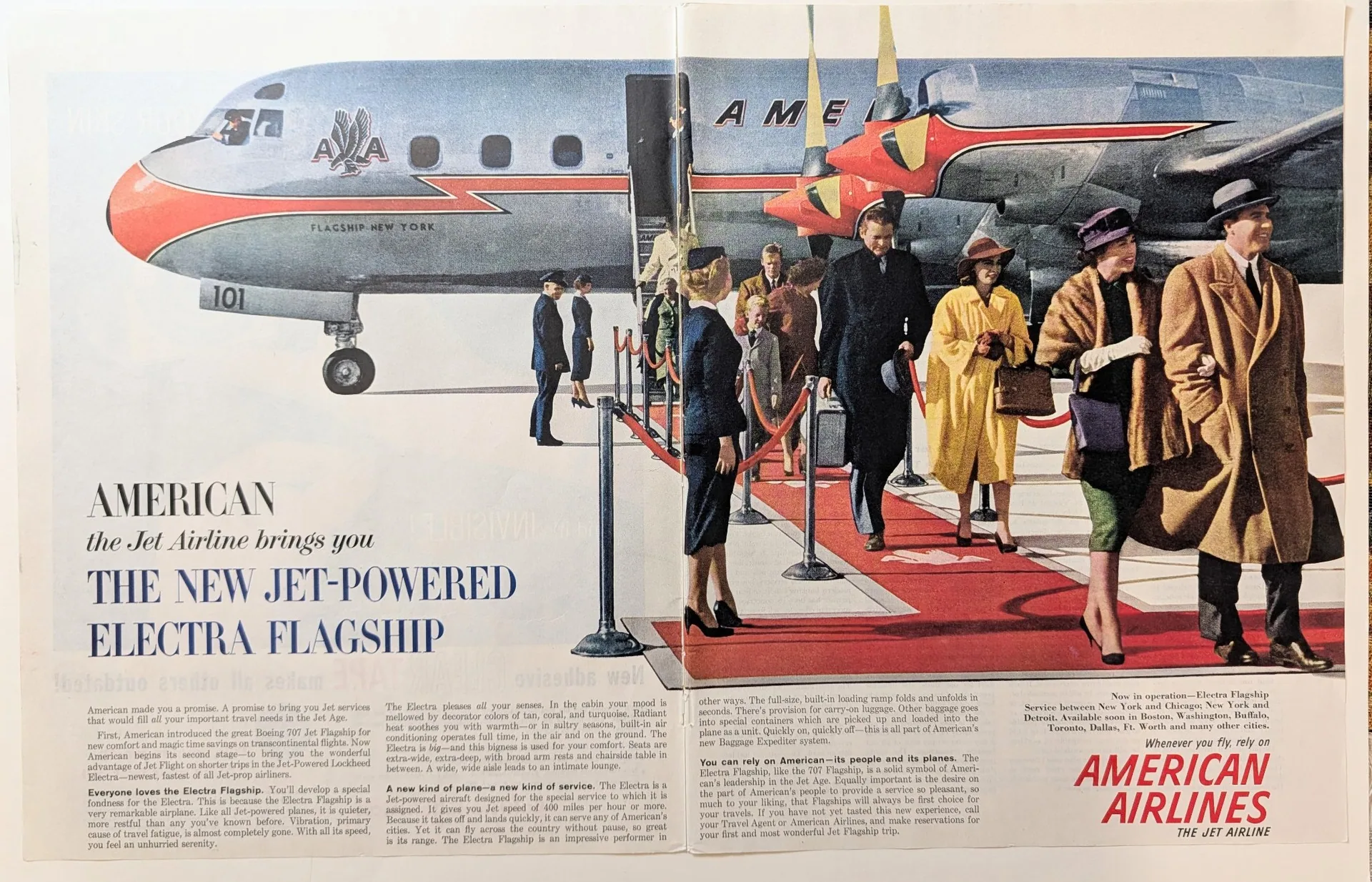
American Airlines — "The New Jet-Powered Electra Flagship"
1. The Artifact A two-page magazine spread advertisement for American Airlines, headlined "THE NEW JET-POWERED ELECTRA FLAGSHIP." The advertisement promotes the Lockheed L-188 Electra in American Airlines service, depicting the aircraft in flight above a stylized cloud field, with the American Airlines eagle emblem, the name "FLAGSHIP NEW YORK," and nose number "101" visible on the fuselage. The copy announces: "Now in operation — Electra Flagship Service between New York and Chicago; New York and Detroit. Available soon in Boston, Washington, Buffalo, Toronto, Dallas, Ft. Worth and many other cities." The spread is documented through six photographs: the full two-page opening, a macro of the American Airlines eagle emblem, a halftone detail showing the cockpit and pilot, a close view of the emblem with "FLAGSHIP NEW YORK" lettering, the "AMERICAN AIRLINES / THE JET AIRLINE" logotype block, and a macro of the headline typography. 2. The Aircraft The Lockheed L-188 Electra was the first large turboprop airliner built in the United States. First flown on December 6, 1957, it was powered by four Allison 501-D13 turboprop engines. American Airlines had ordered 35 Electras in June 1955, straight from the drawing board, making it the launch customer alongside Eastern Air Lines, which ordered 40. The Electra occupied a transitional moment in commercial aviation. Piston airliners such as the Douglas DC-7 and Lockheed's own Constellation series were reaching their technological limits, while pure-jet airliners had not yet achieved commercial maturity. The turboprop — a gas-turbine engine driving a propeller — offered a compromise: greater speed and economy than piston engines, with better short-field performance than early jets. A total of 170 Electras were built between 1957 and 1961. 3. The "Jet-Powered" Claim American promoted the Electra as "jet-powered," emphasizing its gas-turbine engines. It was nevertheless a turboprop: its four Allison engines drove propellers, rather than providing propulsion principally through jet exhaust. The phrase was not an entirely baseless technical claim — turboprops belong to the gas-turbine engine family — but in passenger advertising it could blur a meaningful distinction between a propeller-driven turbine aircraft and aircraft propelled principally by jet exhaust. The broader branding, "AMERICAN AIRLINES / THE JET AIRLINE," was a fleet-wide claim that was literally becoming true. American Airlines launched Boeing 707 pure-jet service on January 25, 1959 — just two days after its first Electra revenue flight on January 23, 1959, between New York and Chicago. (Eastern Air Lines had put the Electra into service first, on January 12, 1959.) The advertisement belongs to a coordinated two-aircraft "jet age" launch campaign. 4. Dating The advertisement's copy — "now in operation" on New York–Chicago and New York–Detroit routes, with other cities "available soon" — is consistent with American's January 1959 service introduction. The date is assessed as probably 1959. The specific magazine, issue, and page numbers are unconfirmed; identifying the source publication would resolve the dating and strengthen provenance. 5. A Note on "Flagship New York" The advertisement depicts an Electra bearing the name "Flagship New York" and nose number 101. These markings suggest an association with N6101A, the aircraft lost as American Airlines Flight 320 on February 3, 1959, when it crashed on approach to LaGuardia Airport with 65 fatalities — the first Electra hull loss. Confirmation requires comparison with contemporary fleet and photographic records. The advertisement is not described as "pre-crash" without an issue date, as post-accident appearance through advertising production lead times remains possible. Flight 320's cause, as determined by the Civil Aeronautics Board, was crew error during approach — not the whirl-mode structural failure implicated in the later Braniff Flight 542 (September 1959) and Northwest Flight 710 (March 1960) accidents. These events should not be conflated. 6. Historical Significance The Electra's frontline career with major United States carriers was short — displaced by pure jets within a decade — but the type flew for decades in cargo, charter, and firefighting roles, and its airframe became the basis for the Lockheed P-3 Orion maritime patrol aircraft, one of the longest-serving military aircraft in history. As a printed artifact, the advertisement is useful evidence of how airlines marketed turbine-powered propeller aircraft during the jet-age transition, when the word "jet" carried prestige that transcended strict technical taxonomy.
Category: Airlines
Year: 1959
Rarity Class: B
Paper & Print Condition
American Airlines "The New Jet-Powered Electra Flagship" — two-page magazine advertisement, probably 1959. The Lockheed L-188 Electra was the first large turboprop airliner built in the United States, ordered by American in 1955 and entering service in January 1959. Though the advertisement calls it "jet-powered," the Electra's four Allison engines drove propellers — a turboprop marketed with jet-age language at the dawn of the jet era. The depicted aircraft bears the name "Flagship New York."
Provenance & Rarity
Two-page magazine spread; source publication and issue unconfirmed. Six documentary photographs: full spread, eagle emblem macro, halftone cockpit detail, "Flagship New York" lettering, logotype block, headline macro. Consistent with period printing; original-versus-facsimile determination requires physical inspection. American Airlines and associated marks are property of their owners; TRI is not affiliated with or endorsed by American Airlines.
Rarity & Condition Summary
This advertisement captures a transitional moment in commercial aviation. In January 1959, American Airlines introduced two new aircraft types within days of each other: the Lockheed Electra turboprop (January 23) and the Boeing 707 pure jet (January 25). The "jet-powered" language applied to the Electra was technically defensible — its engines were gas turbines — but commercially ambiguous, borrowing prestige from the jet age for a propeller-driven aircraft. The ad's route list ("now in operation" New York–Chicago and New York–Detroit) places it at the very start of Electra service. The "Flagship New York" name and nose number 101 suggest a possible association with N6101A, lost as Flight 320 on February 3, 1959, though this identification remains unconfirmed.