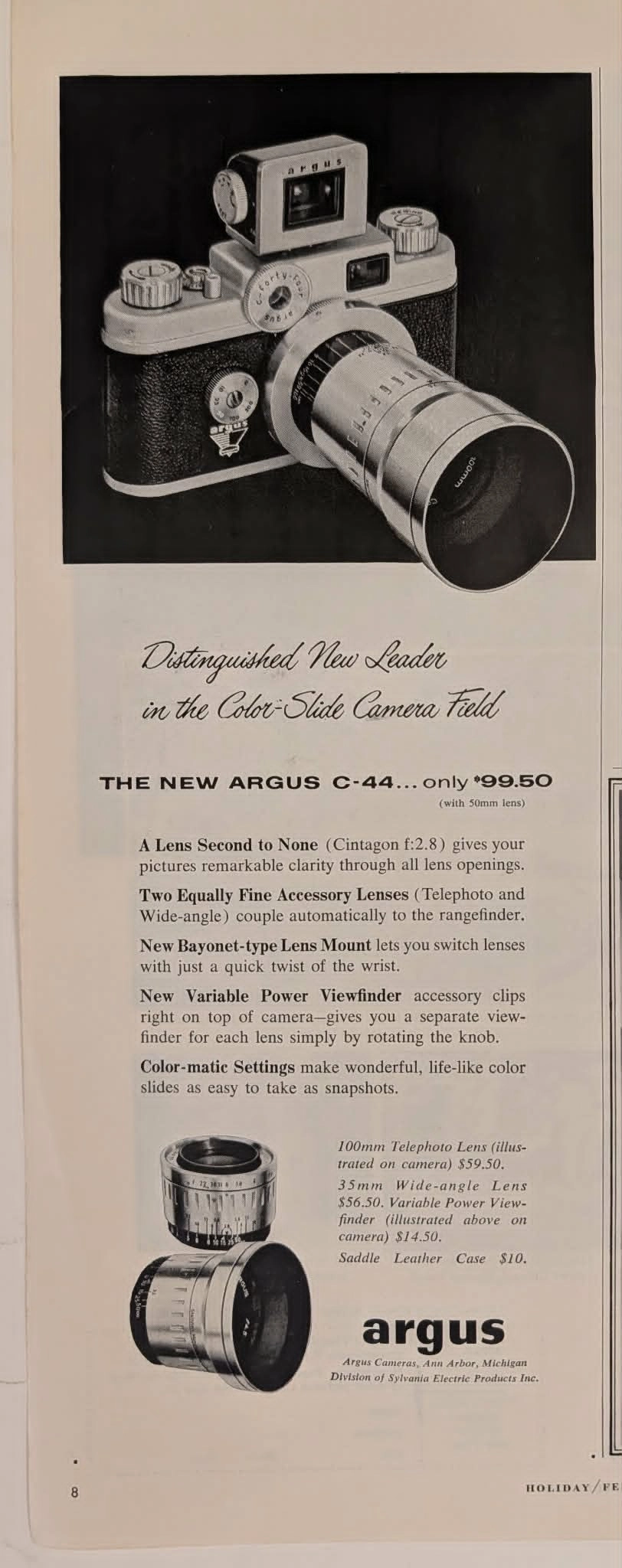
1959 Argus C-44 Color-Slide Camera Vintage Advertisement
Following the massive commercial success of the utilitarian Argus C-3 (affectionately known as "The Brick"), Argus sought to elevate its brand prestige to compete with high-end German and rapidly advancing Japanese imports. The introduction of the Argus C-44 was a direct response to this market pressure, offering an elegant, feature-rich 35mm rangefinder camera designed specifically to capitalize on the soaring popularity of Kodachrome and other color-slide films. This specific advertisement is a prime example of mid-century technical marketing. It emphasizes modularity and precision, highlighting the "New Bayonet-type Lens Mount" which allowed photographers to switch lenses with a "quick twist of the wrist"—a significant upgrade from the cumbersome threaded mounts of earlier eras. The ad prominently features the standard Cintagon f:2.8 lens, asserting it as "Second to None," while also upselling the avid hobbyist on essential accessories: a 100mm Telephoto lens ($59.50), a 35mm Wide-angle lens ($56.50), and an innovative Variable Power Viewfinder (
Category: Cameras & Optics
Year: 1959
Rarity Class: B
Paper & Print Condition
The artifact demonstrates standard characteristics of late 1950s periodical stock, exhibiting mild edge toning consistent with its age. The monochrome halftone reproduction of the metallic camera body retains deep contrast, sharp delineations, and excellent typographic clarity, effectively showcasing the industrial design of the Argus C-44. The lightly textured paper surface and the authentic, microscopic printing anomalies inherent to mid-century commercial lithography remain beautifully preserved, offering a tactile glimpse into the era's mass-media production.
Provenance & Rarity
Extracted from a February issue of Holiday magazine, a premier American travel and lifestyle publication of the late 1950s. This artifact is particularly notable for its transitional corporate branding. Advertisements from this exact period—bearing the Sylvania corporate signature alongside the original Ann Arbor manufacturing location—are vital historical documents of post-war American corporate consolidation. Classified as Class B (Moderately Rare), it survives as a scarce and remarkably pristine testament to the peak of domestic rangefinder manufacturing, captured just before the market dominance of imported single-lens reflex (SLR) cameras.
Rarity & Condition Summary
A remarkably well-preserved document of late 1950s American photographic history (Class B). It stands as a testament to post-war consumer marketing, highlighting the peak of domestic rangefinder manufacturing prior to the dominance of imported SLR cameras.