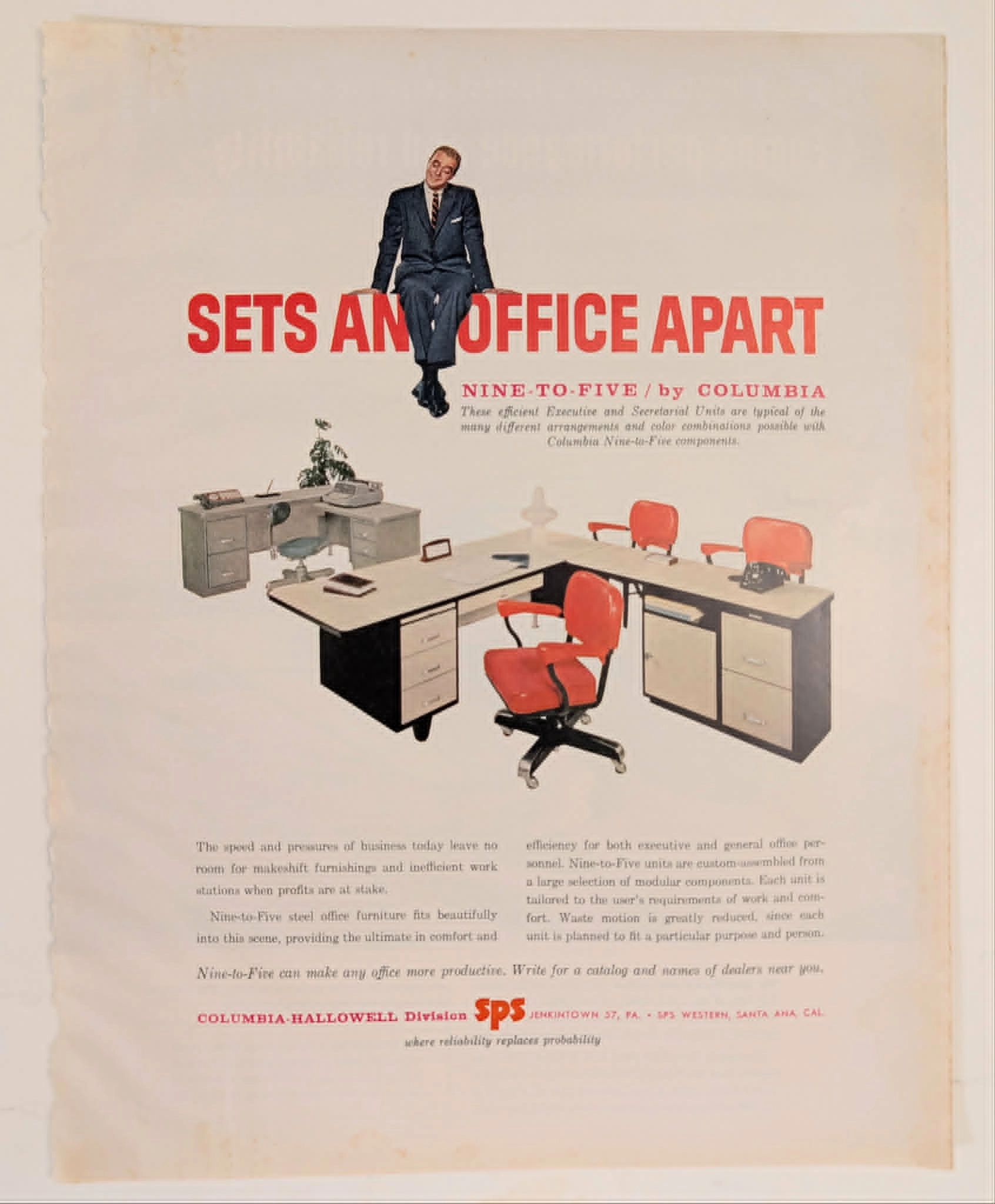
1959 Columbia Nine-to-Five Office Furniture Vintage Advertisement
During the economic expansion of the late 1950s, the American corporate landscape underwent a structural evolution. Efficiency, modularity, and standardization became the guiding principles of modern workplace design. This advertisement for Columbia's "Nine-to-Five" line perfectly encapsulates that shift, illustrating a departure from cumbersome wooden desks toward sleek, customizable steel units engineered to reduce "waste motion." The artwork itself is a masterclass in mid-century commercial design. It employs a striking flat illustration style, meticulously retaining the hand-drawn stroke quality characteristic of the era's boutique ad agencies. The composition relies on a distinct vertical orientation, anchored by a completely static, locked perspective—as if viewed from a stationary tripod with no pan or zoom. This rigid staging, juxtaposed with the character's organic, relaxed posture, creates an intriguing visual tension. Such a tightly controlled, stable composition provides an ideal foundation for modern 2D animation techniques, allowing archivists and creators to seamlessly transform this static vintage print media into living artwork through natural character movements like breathing or a subtle blink. Preserved on an authentically aged paper texture, the piece evokes a highly specific, nostalgic atmosphere. The aesthetic immediately conjures an immersive, era-appropriate background ambiance: the soundscape of a bustling 1950s street filtering through a high-rise window, the rhythmic clatter of mechanical typewriters, and the faint hum of a crackling radio. The viewer's eye is instinctively drawn to the sharply dressed executive, who serves as a whimsical typographic anchor atop the bold, red sans-serif headline, creating a perfectly balanced vignette of mid-century corporate sociology.
Category: Lifestyle & Vice
Year: 1959
Rarity Class: A
Paper & Print Condition
The artifact exhibits a natural, era-appropriate patina. The aged paper texture provides a soft, warm undertone that beautifully enhances the vibrancy of the red spot-color ink. Its flat illustration style remains exceptionally crisp, perfectly retaining the subtle stippling and deep charcoal hues of the executive's suit without any significant fading. The typography in the lower descriptive block is sharply legible, showing no signs of major bleed or ghosting.
Provenance & Rarity
Sourced from a premier North American business publication of the late 1950s. While Columbia-Hallowell (SPS) was a major manufacturer, complete, unclipped, full-page advertisements of their "Nine-to-Five" line in this specific vertical format are increasingly scarce. Its preservation as a pristine, static visual record makes it a highly valuable archival document, particularly for those studying mid-century commercial staging.
Rarity & Condition Summary
An excellently preserved Class A artifact. Its primary value lies in its flawless representation of 1950s commercial flat illustration techniques and the pristine preservation of its aged paper texture. The piece's completely static, vertical composition—resembling a locked-off, tripod-mounted perspective—elevates its rarity, as unclipped, full-page vertical formats from this era are increasingly scarce. This rigid, mathematically balanced staging, contrasted against the organic, hand-drawn stroke quality of the executive figure, makes it not only a premier document of mid-century corporate sociology but also an exceptionally stable foundation for modern archival preservation or transformation into living 2D artwork.