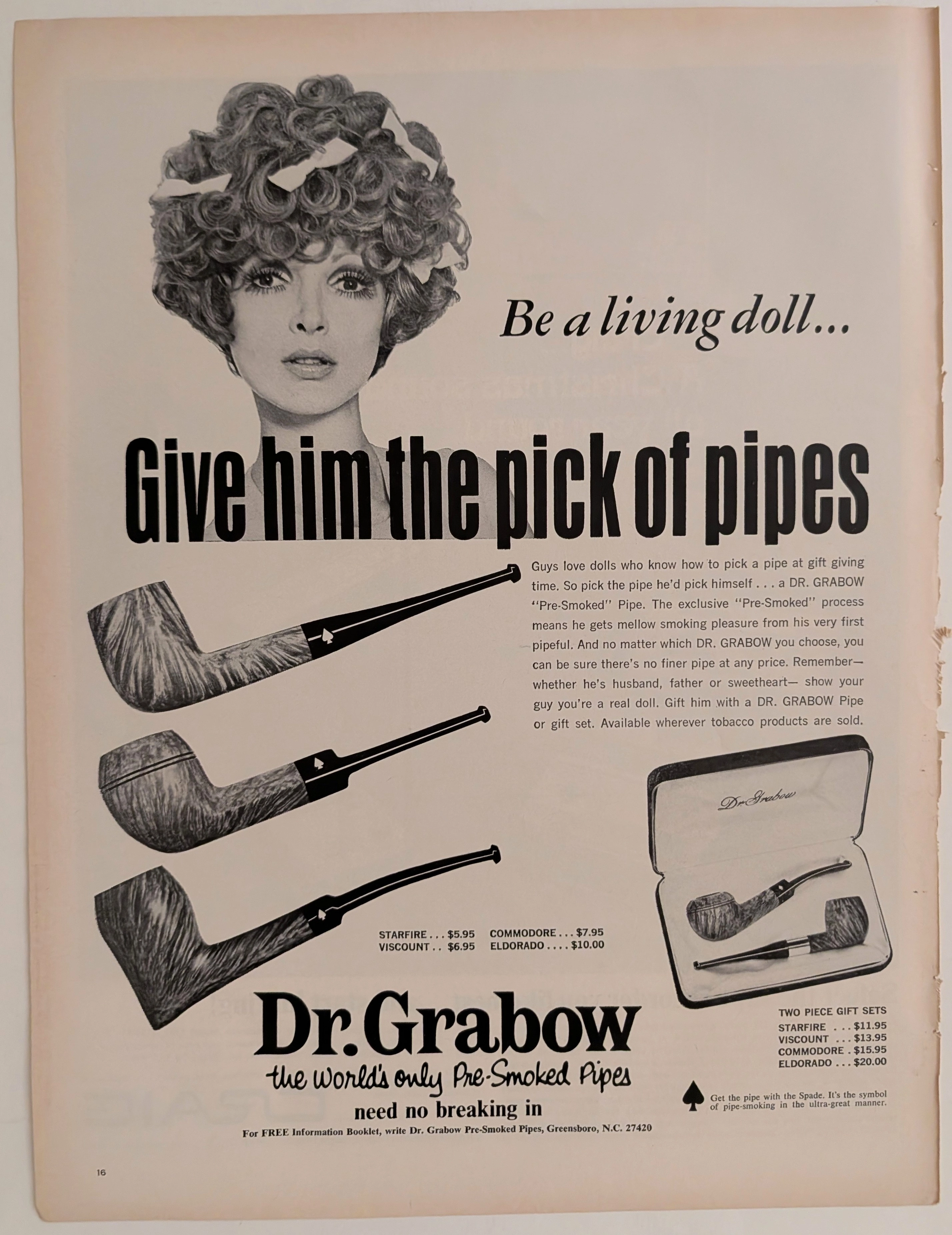
1960s Dr. Grabow Pre-Smoked Pipes Vintage Advertisement
Late 1960s Dr. Grabow "Be a living doll" Pre-Smoked Pipes Vintage Advertisement
Category: Tobacco
Year: 1960
Rarity Class: B
Paper & Print Condition
This artifact serves as an exemplary specimen of high-contrast monochromatic offset lithography from the late 1960s. The printing process demonstrates a sophisticated use of halftone dot patterns to achieve a range of grey tones, particularly effective in rendering the organic grain of the briar wood pipes and the intricate, high-fashion shading of the model's hair. The ink remains deeply saturated, maintaining a sharp, crisp edge on the bold "Dr. Grabow" typography. The paper is a standard, mid-century wood-pulp magazine stock, which exhibits a natural and uniform age-toning—a warm, pale yellow patina that is most evident in the expansive negative space. Despite the inherent acidity of paper from this era, the structural integrity is remarkably sound; it is free from significant foxing, moisture staining, or structural brittleness. The margins are clean, and the overall contrast between the deep black inks and the aged paper remains striking, preserving the original visual impact intended by the advertising agency decades ago.
Provenance & Rarity
The provenance of this specific artifact traces back to the golden age of American print advertising in the late 1960s, having been carefully extracted from a high-circulation, mainstream general-interest or men's lifestyle publication. During this era, print magazines were the undisputed cultural arbiters, dictating trends, consumer behaviors, and gift-giving etiquette to the rapidly expanding middle class. As a piece of commercial ephemera, this advertisement was originally produced in the millions with the explicit expectation of a fleeting lifespan; it was designed to be consumed, acted upon, and promptly discarded. Consequently, the contemporary rarity of this piece does not stem from a limited initial print run, but rather from an exceptionally high rate of historical attrition. The mid-century wood-pulp paper on which it was printed is inherently highly acidic, making it profoundly susceptible to rapid deterioration, embrittlement, and severe discoloration over the decades. To discover a full-page specimen that has miraculously escaped the common ravages of time—such as staple hole tears, rough spine extractions, destructive foxing, or moisture damage—is becoming increasingly uncommon. What makes this particular artifact highly coveted among historians and archive collectors is not merely its flawless physical preservation, but its function as a pristine time capsule. It perfectly preserves the intersection of mid-century mechanical innovation (Dr. Grabow's patented "Pre-Smoked" process) and the highly stylized, gender-normative visual culture of the 1960s, elevating it from a disposable commercial ad to a rare and valuable sociological document.
Rarity & Condition Summary
This artifact represents an exceptional convergence of commercial mass-media ephemera and museum-grade physical preservation. While originally distributed by the millions across mid-century American periodicals, the survival of this Dr. Grabow advertisement in such an immaculate, structurally sound state is remarkably rare. Its pristine monochromatic contrast, free from the severe degradation typically afflicting acidic wood-pulp paper of the 1960s, provides an uncompromised view of the era’s sophisticated offset lithography. Beyond its exceptional physical condition, the piece endures as a highly coveted sociological document, brilliantly encapsulating both the technological marketing of the "Pre-Smoked" process and the highly stylized, gender-normative visual culture of the period. Ultimately, it stands as a chronological benchmark, elevating a once-disposable consumer advertisement to a vital, highly desirable artifact for historians of tobacciana and mid-century American consumerism.