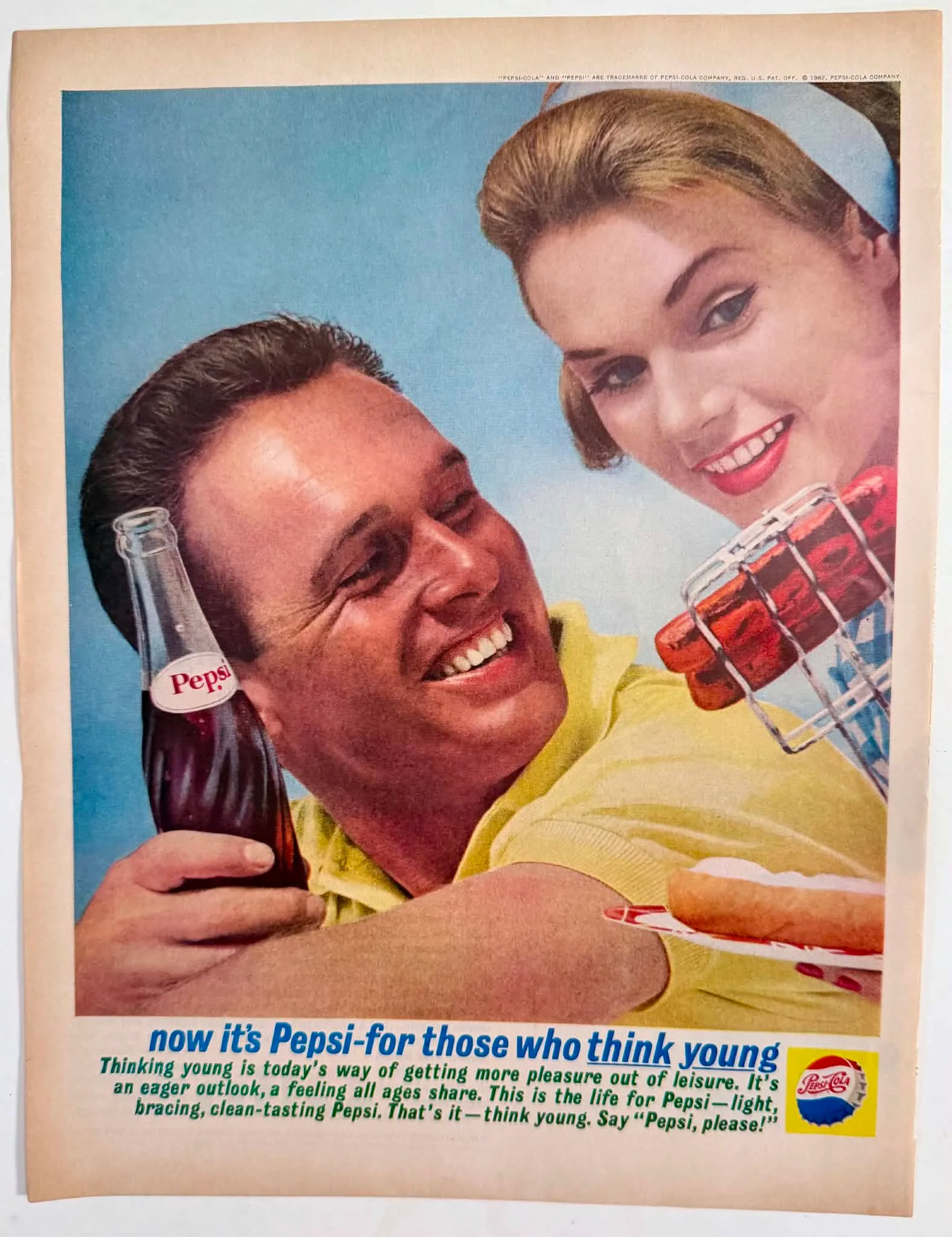
1962 Pepsi-Cola "Think Young" Vintage Advertisement
In 1961, the Pepsi-Cola Company, working with the legendary advertising agency BBDO (Batten, Barton, Durstine & Osborn), launched the "Now it's Pepsi - for those who think young" campaign. This 1962 print exemplifies the core strategy of that initiative. Rather than competing directly with Coca-Cola on heritage or tradition, Pepsi positioned itself as the beverage of the future. By targeting the psychological concept of "thinking young"—an "eager outlook" shared across demographics, though undeniably influenced by the coming-of-age Baby Boomer generation—Pepsi actively shaped the cultural zeitgeist. Visually, the advertisement is a masterclass in mid-century aspirational marketing. The composition focuses entirely on a moment of casual, outdoor leisure. A smiling couple is depicted enjoying a backyard barbecue, complete with grilled hot dogs, capturing the idealized postwar American suburban dream. The product itself, the iconic swirl-glass Pepsi bottle with its oval label, is held casually by the man, seamlessly integrated into the lifestyle rather than standing as a sterile focal point. The accompanying copy reinforces this lifestyle association: "Thinking young is today's way of getting more pleasure out of leisure... This is the life for Pepsi—light, bracing, clean-tasting Pepsi." Furthermore, the classic red, white, and blue crown cap logo anchors the bottom right corner, serving as a powerful visual signifier alongside the enduring call to action: "Say 'Pepsi, please!'" This campaign was wildly successful, shifting market share and laying the vital psychological groundwork for the famous "Pepsi Generation" campaign that would dominate the remainder of the 1960s.
Category: Food & Beverage
Year: 1962
Rarity Class: C
Paper & Print Condition
The source document exhibits the quintessential characteristics of high-volume, early 1960s periodical publishing. The paper stock reveals a very mild, natural oxidation (patina) typical of mid-century wood-pulp blends, yet it maintains excellent structural integrity without signs of embrittlement. Most notably, the four-color halftone lithographic process has remained remarkably vibrant over the decades. The crisp cyan skies, the bold primary reds of the Pepsi-Cola crown cap and grilled hot dogs, and the warm, nuanced flesh tones of the models have successfully avoided the severe fading or chromatic shifting commonly associated with mass-market printing of this era. The ink registration is precise, allowing the intricate details of the iconic swirl-glass bottle and typography to stand out with exceptional clarity.
Provenance & Rarity
Heavily syndicated in prominent American mass-market magazines such as Life, Look, and The Saturday Evening Post throughout 1962, this piece is not inherently rare in its sheer existence. Millions of these periodicals were printed and distributed. However, the true rarity lies in its pristine survival. Securing complete, tear-free pages that maintain this exceptional level of chromatic fidelity—free from the common degradations of water damage, severe yellowing, or edge fraying—is increasingly challenging. For historians and archivists studying the evolution of demographic marketing, this flawlessly preserved artifact provides vital documentary evidence of BBDO's groundbreaking "Think Young" campaign and the dawn of modern lifestyle advertising.
Rarity & Condition Summary
A vibrant mid-century advertising artifact that perfectly captures the socio-demographic shift of 1960s America and the dawn of lifestyle marketing. As a Class C archival piece, it is widely recognized by historians; while the print run was vast, locating this piece in such pristine, unyellowed condition makes it a highly desirable addition to any collection focused on postwar consumer culture.