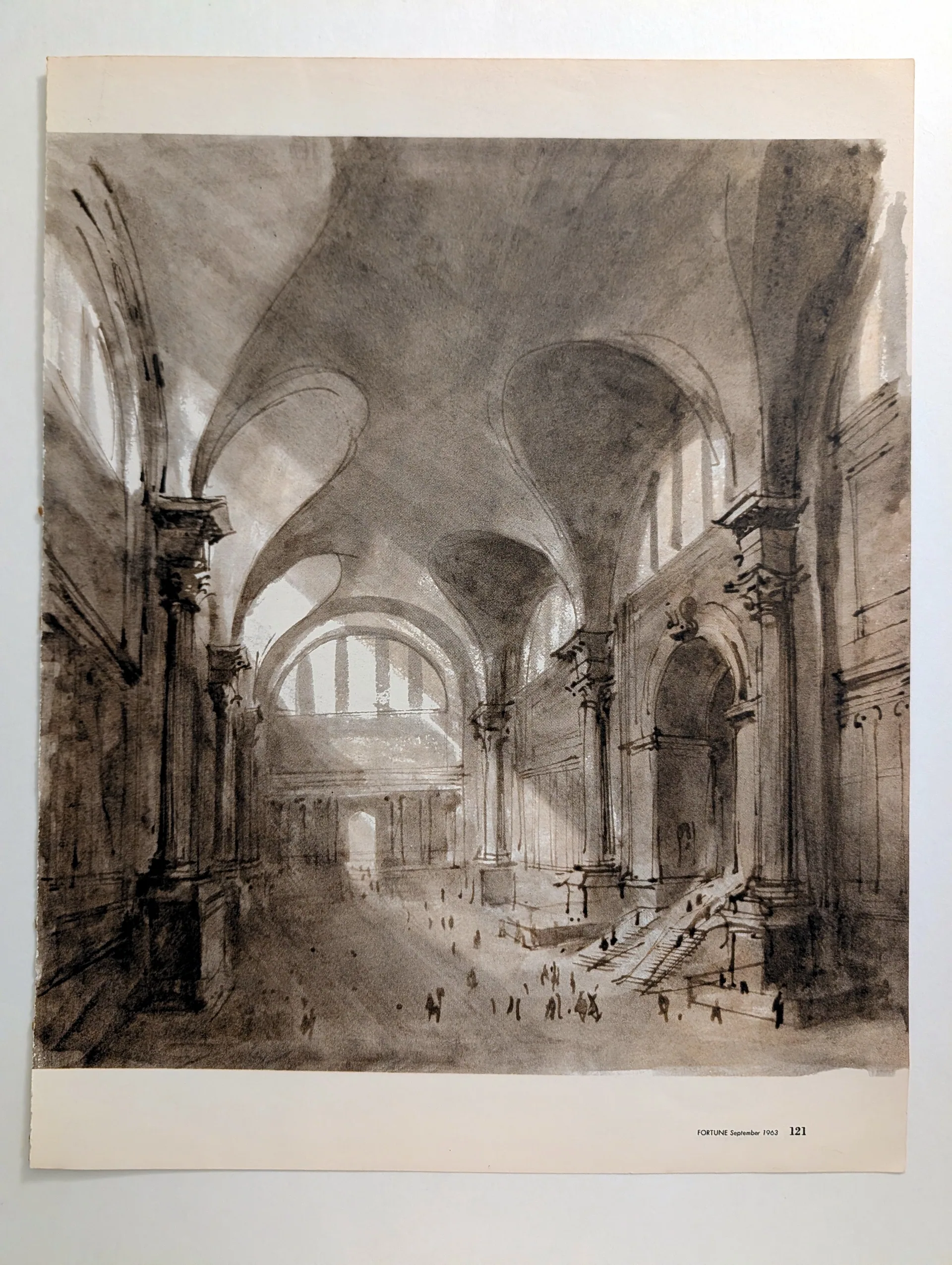
1963 Fortune Magazine Vaulted Interior Illustration, Page 121
*Paragraph 1 — Visual Description:* The supplied images show a single portrait magazine leaf photographed rotated 90 degrees; it is described here in reading orientation. The page carries a full-page sepia/umber wash illustration of a grand vaulted interior: rows of massive fluted columns on tall pedestals, round arches, and barrel vaults receding toward a bright arched opening at the rear. Tiny human figures are scattered across the floor, dwarfed by the architecture and giving the hall its scale. The handling is loose and painterly — broad washes with visible brushwork and inked structural lines, the darkest accents reserved for column bases, capitals, and the foreground figures. The wash image fills the page to the head and side edges; the foot carries a plain unprinted margin with the issue imprint. The paper reads as a cream or off-white coated magazine stock with an even, light age-toning. No artist signature is resolvable anywhere on the page at the supplied image resolution. *Paragraph 2 — Printed Text & Marks:* The foot margin carries the imprint "FORTUNE September 1963" and the page numeral "121", both verified from the detail photograph. The printed numeral identifies this as page 121. No headline, caption, article text, or artist credit appears on the supplied page at the supplied resolution. No illustrator signature is visible at the supplied image resolution; this is a limit of the reproduction, not evidence that none was printed. *Paragraph 3 — Maker Context:* The illustrator is unidentified and the sheet is unsigned at the supplied resolution. The publishing context is Fortune magazine, the American monthly business magazine founded by Henry Luce and first published in 1930 (Time Inc.). In this era Fortune was noted for commissioning leading illustrators, designers, and fine artists for its covers and editorial illustrations, and for printing them on heavy coated stock. The specific article this illustration accompanied, and the artist commissioned for it, could not be verified: no accessible scan of the September 1963 issue was found during research, and the page itself carries no credit. *Paragraph 4 — Geographic & Audience Context:* The imprint places production with Fortune magazine, a New York monthly addressed to an American business and professional readership. The interior depicted is not identified: it is a grand vaulted hall — basilica-like in its columns, arches, and scale — but no specific building can be determined from the image alone, and without the accompanying article no subject identification is attempted here. The page therefore documents the object as found: a detached editorial illustration whose original editorial context awaits recovery from a complete copy of the issue. *Paragraph 5 — Visual Language Analysis:* The visual language is the commissioned editorial illustration of the early-1960s American quality press: a monochrome wash that reads as both reportage and fine art, economical in reproduction yet painterly in effect. The composition works by scale contrast — minute figures against overwhelming architecture — a device that lets a business magazine render institutions (corporate, civic, or sacred) as vast and impersonal without naming them. The sepia palette unifies the page and keeps the image subordinate to the magazine's typographic system: this is illustration as atmosphere and emphasis, not as documentation. The full-bleed treatment at head and sides marks the page as a feature illustration — given visual weight within the issue's layout — rather than a spot drawing. *Paragraph 6 — Function & Archival Significance:* The sheet likely functioned as a full-page editorial illustration inside a feature article — a visual pause or opener giving the article's subject architectural and emotional scale. Its archival significance is as a specimen of Fortune's early-1960s art program, the period when the magazine routinely set fine-art illustration beside business journalism. Because the article and artist are unverified, no claim is advanced about the illustration's original editorial meaning; the honest record is a well-preserved example of the era's magazine illustration craft, detached from its issue.
Category: Art & Museums
Year: 1963
Rarity Class: C
Paper & Print Condition
The image is carried in umber and black wash tones over a cream coated magazine stock; linework and wash edges appear visually crisp at the supplied resolution, with tonal gradation from pale wash to near-black accents. The paper shows an even, light age-toning across the unprinted foot margin; no foxing, tears, or creases are observed in the supplied images. The leaf is photographed as a loose sheet with clean-cut edges. Likely process: offset lithography on coated stock (physical examination required for confirmation). Confidence: Moderate. No handling or storage history is inferred from the observed toning.
Provenance & Rarity
Source media observed: a single magazine leaf identified by its own imprint as page 121 of Fortune magazine, September 1963, photographed as a loose sheet. The original acquisition record, prior ownership, and the circumstances under which this leaf left its issue are undocumented in the supplied material. Rarity: C. Fortune was a mass-circulation monthly; this is an editorial illustration leaf detached from its issue, with no visible artist signature and no identifiable article to lend it campaign significance. No comparative survival claim is advanced beyond this general assessment.
Rarity & Condition Summary
The leaf presents as an intact single sheet with legible image and crisp wash tones; the unprinted foot margin carries an even, light age-toning, and the imprint "FORTUNE September 1963" with page numeral "121" remains fully legible. Rarity class C: a mass-market monthly's editorial illustration page, detached, with no visible signature. Nothing in the observed condition is used here to imply scarcity or to grade the object.