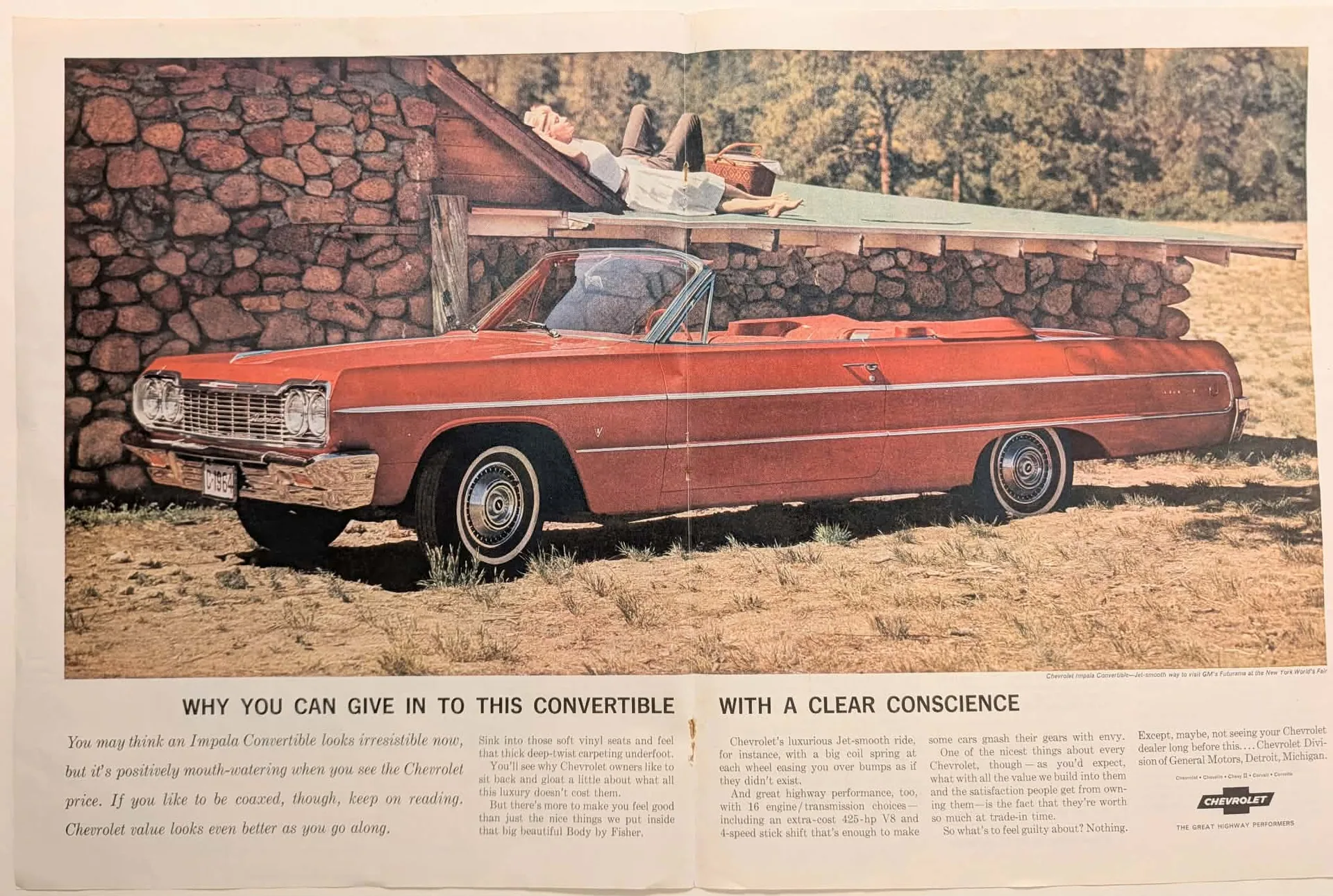
1964 Chevrolet Impala Convertible Vintage Advertisement
Released during a pinnacle era of American automotive dominance, this 1964 Chevrolet Impala Convertible advertisement serves as a masterclass in aspirational mid-century marketing. The primary visual composition immediately establishes a juxtaposition between rugged, leisurely domesticity and highly refined industrial design. By positioning a relaxed couple atop a rustic stone-and-timber structure, the agency crafts a narrative of effortless affluence. The vibrant red Impala commands the foreground, its sweeping profile and subtle rear styling details acting as a testament to General Motors' design prowess. The copywriting strategy is particularly notable for its psychological approach. Leading with the headline, "Why you can give in to this convertible with a clear conscience," the text anticipates and neutralizes buyer hesitation regarding luxury indulgences. It pivots smoothly from the tactile pleasures of "soft vinyl seats" and "deep-twist carpeting" into a robust defense of Chevrolet’s inherent value. This dual messaging perfectly encapsulates the 1960s consumer mindset, where prestige had to be justified by practicality and tangible return on investment. Beneath the luxurious exterior lay formidable engineering. The advertisement highlights "16 engine/transmission choices," explicitly noting the availability of an "extra-cost 425-hp V8 and 4-speed stick shift." This specific reference points to the legendary 409 cubic-inch V8, an engine that achieved mythical status in American car culture. The detailed view of the front fascia and the distinct 1964 license plate, alongside the pristine whitewall tire and hubcap assembly, underscore a vehicle built for both commanding presence and raw power. Culturally, this document captures a moment of intense corporate optimism. The footer copy explicitly ties the vehicle to the "Jet-smooth way to visit GM's Futurama at the New York World's Fair," a landmark exhibition that presented a utopian vision of the future shaped by advanced transportation. By associating the Impala with the Futurama exhibit, Chevrolet elevated the car from a mere consumer product to an active participant in American progress. Furthermore, the inclusion of the corporate bowtie emblem and the branding of its diverse lineup—Chevelle, Chevy II, Corvair, and Corvette—as "The Great Highway Performers" solidifies Chevrolet’s absolute market dominance during the 1964 model year.
Category: Cars
Year: 1964
Rarity Class: A
Paper & Print Condition
Evaluated from a two-page center spread. A noticeable vertical crease aligns with the original magazine's binding spine, a standard characteristic for period ephemera of this format. Halftone dot patterns remain exceptionally crisp under magnification, maintaining the high vibrancy of the signature Chevrolet red pigment and the earthy, natural background tones. Minor marginal oxidation is present along the extreme edges, but it does not intrude upon the primary lithographic plate or compromise the visual integrity of the advertisement.
Provenance & Rarity
Sourced from a premier, high-circulation American lifestyle periodical published in the spring of 1964. While the original publication volume was substantial, surviving centerfolds depicting the highly sought-after 425-hp Impala Convertible in such unblemished, structurally sound condition are increasingly scarce. Many center-spreads from this era suffer from severe staple rust, page separation, or environmental degradation. Consequently, this remarkably preserved piece is highly sought after by automotive historians, mid-century advertising purists, and archivists dedicated to preserving the visual legacy of the American muscle car’s golden era.
Rarity & Condition Summary
This 1964 Chevrolet Impala Convertible center-spread is a remarkably well-preserved Class A artifact that exhibits authentic, acceptable period wear consistent with its medium. Its high exhibition value is anchored not only in its visual and structural integrity but also in its direct textual and cultural ties to the landmark 1964 New York World's Fair (GM's Futurama) and its exact representation of the zenith of the American automotive golden era.