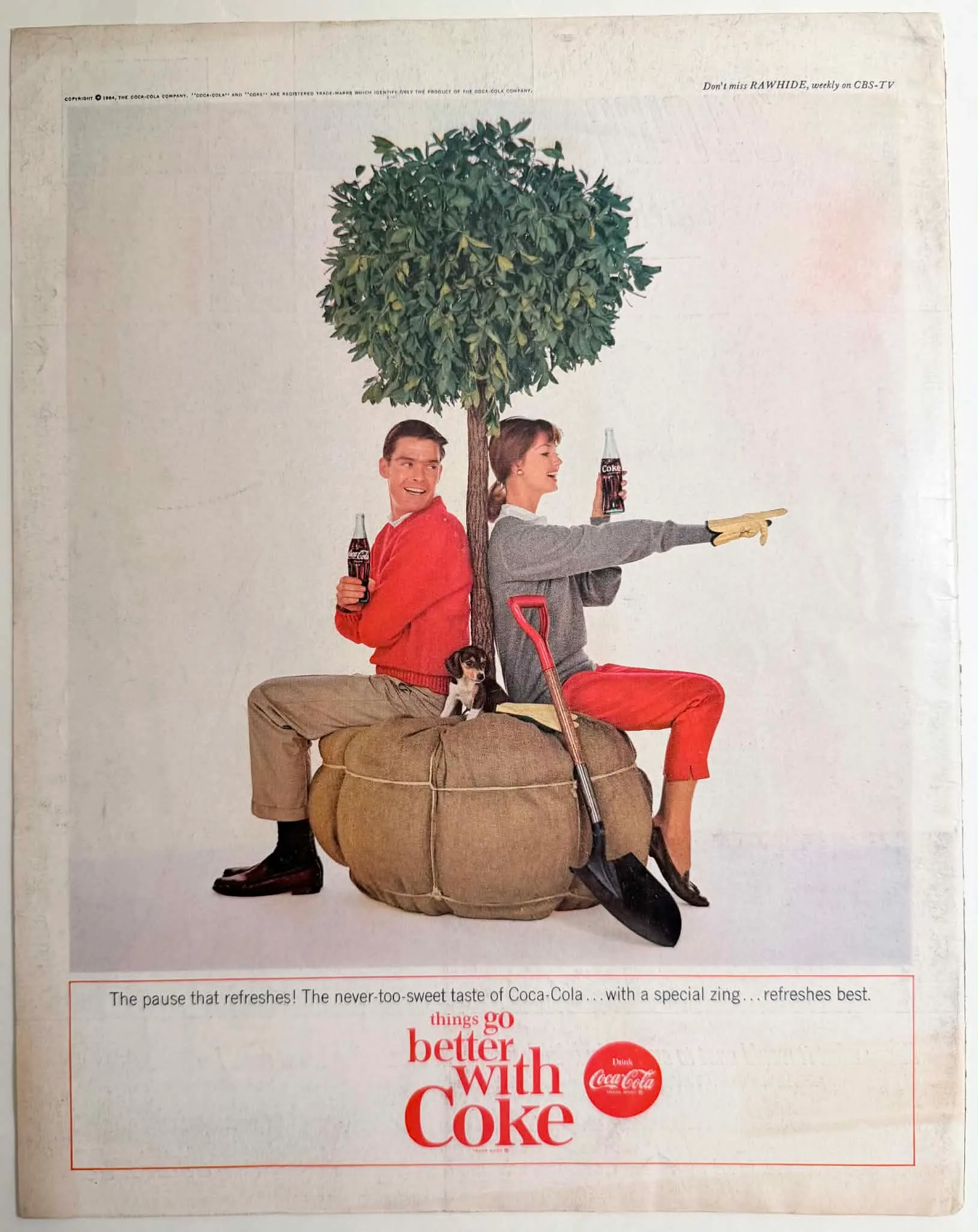
1964 Coca-Cola Contour Bottle Vintage Advertisement
The 1964 Coca-Cola print advertisement encapsulates a pivotal era in mid-century American advertising, dominated by the highly successful "Things Go Better With Coke" campaign. Launched in 1963 by the McCann-Erickson agency, this initiative represented a paradigm shift for the brand. It moved the narrative away from simple refreshment and integrated the beverage directly into active, modern lifestyles, associating the brand intimately with youth culture, suburban leisure, and dynamic energy. In this specific execution (f4a335fb-150a-419d-8f4f-51885e5e9c64.jpg), the compositional strategy utilizes a stark, unprinted white background to isolate the central subjects—a smartly dressed couple taking a break from gardening, flanked by a beagle puppy resting on a burlap-wrapped root ball. This staging effectively funnels the viewer's immediate attention toward the product and the casual interaction between the models. For contemporary creatives and digital archivists looking to translate static commercial art into 2D motion graphics, this piece serves as an exceptional structural reference. The advertisement isolates the figures into distinct, almost flat visual planes, separating the foreground action from the negative space. Combined with a highly constrained period color palette—characterized by muted khakis, soft greys, and the vibrant, contrasting "Coca-Cola red"—the design provides perfectly defined layers for kinetic animation. Furthermore, the authentic aged paper textures inherent in the surviving print add a degree of organic, tactile depth that modern digital reproductions often struggle to emulate. A fascinating cultural artifact of its time, the top right margin features a subtle cross-promotional banner for the CBS-TV Western series Rawhide, highlighting the synergistic media strategies utilized during the television boom of the early 1960s. The inclusion of the legacy slogan, "The pause that refreshes," at the bottom of the page strategically bridges the gap between Coca-Cola's pre-war identity and its bold, modern mid-century direction.
Category: Food & Beverage
Year: 1964
Rarity Class: B
Paper & Print Condition
The artifact exhibits the classic physical characteristics of high-volume 1960s magazine lithography. Close examination of the serif typography and the iconic red trade-mark disc reveals slight, natural ink bleed typical of the porous, uncoated aged paper stock used in mid-century periodicals. Most notably, a macro analysis of the contour bottle clearly exposes the CMYK halftone rosette structure—a striking visual testament to the analog color separation printing processes of the era. The distinct separation of these flat ink layers, combined with the inherent organic textures of the paper, provides a meticulously authentic foundation for translating this period aesthetic into layered 2D motion graphics while strictly preserving the original mid-century color palette.
Provenance & Rarity
Sourced from a widely circulated American mass-market publication in 1964, this document serves as a common yet highly desirable example of the "Things Go Better With Coke" visual identity. The detailed photographic captures of both the female and male models demonstrate exceptional ink retention and minimal fading, indicating that the source material was carefully preserved away from direct ultraviolet light exposure. This level of pristine color fidelity and sharp edge definition is particularly valuable for archivists and creators looking to isolate elements for retro 2D motion graphics, as it requires minimal digital restoration to extract authentic, high-quality mid-century assets.
Rarity & Condition Summary
Assigned a Rarity Class B. While the initial print run for this national 1964 campaign was extensive, sourcing surviving examples with such vibrant color fidelity, crisp halftone registration, and minimal page-edge oxidation is increasingly uncommon. The remarkably preserved period color palette, authentic aged paper textures, and distinct flat visual layers make this piece not only a stellar artifact of 1960s commercial visual culture but also an exceptionally stable foundation for adaptation into 2D motion graphics.