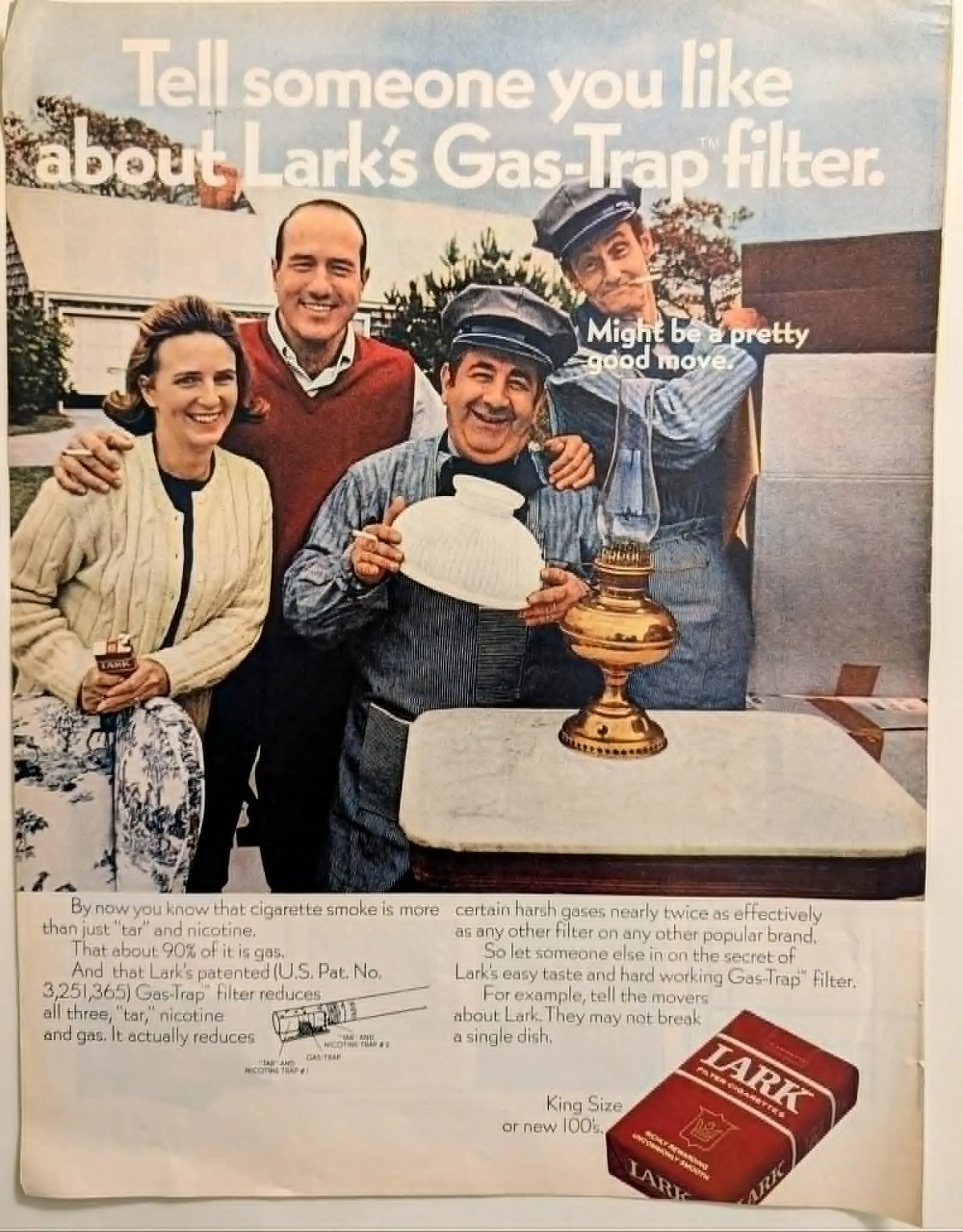
1968 Lark Gas-Trap Filter Cigarettes Vintage Advertisement
The late 1960s saw a dramatic pivot in tobacco marketing as public health awareness regarding smoking began to steadily rise. In response, brands introduced highly engineered, visually complex filtration systems to reassure consumers. Lark introduced the "Gas-Trap" filter, prominently displaying U.S. Patent No. 3,251,365 in their print media to lend an authoritative, scientific weight to their claims of reducing both tar and "certain harsh gases." Visually, the advertisement brilliantly juxtaposes this clinical, diagrammatic approach with a highly relatable domestic scene. A casually dressed couple shares a friendly moment with two uniformed movers, establishing a warm, nostalgic atmosphere of suburban American life. The period color palette—characterized by muted denim blues, earthy brown
Category: Tobacco
Year: 1968
Rarity Class: B
Paper & Print Condition
This specimen exhibits an authentic aged paper texture that adds significant tactile depth and historical grounding to the piece. Minor edge wear is present, consistent with its extraction from a bound 1960s periodical. The halftone color reproduction remains impressively sharp, seamlessly preserving the warm period color palette—particularly the muted denim blues and the striking deep crimson of the product packaging—without severe UV fading. Crucially, the fine line work in the technical filte
Provenance & Rarity
Originating from a widely circulated American mass-market periodical of the late 1960s, this piece represents a highly specific era of tobacco marketing. While Lark was a ubiquitous brand, finding intact ephemera featuring this detailed Gas-Trap cross-sectional diagram alongside such a stable, slice-of-life photographic tableau is increasingly rare. The superior preservation of this print elevates its archival value. Notably, its structurally sound, inherently static layout makes it an exception
Rarity & Condition Summary
Rarity & Condition Summary: Class B. A remarkably preserved artifact exhibiting standard environmental aging characteristic of 1960s ephemeral media. Its pristine compositional structure and the stark contrast between the warm photographic elements and the cold, precise technical diagram make it an exceptional foundational asset. The inherent visual stability of the layout makes it an ideal candidate for continuous, synchronized 2D animation within a fixed, static framework, allowing the era's u