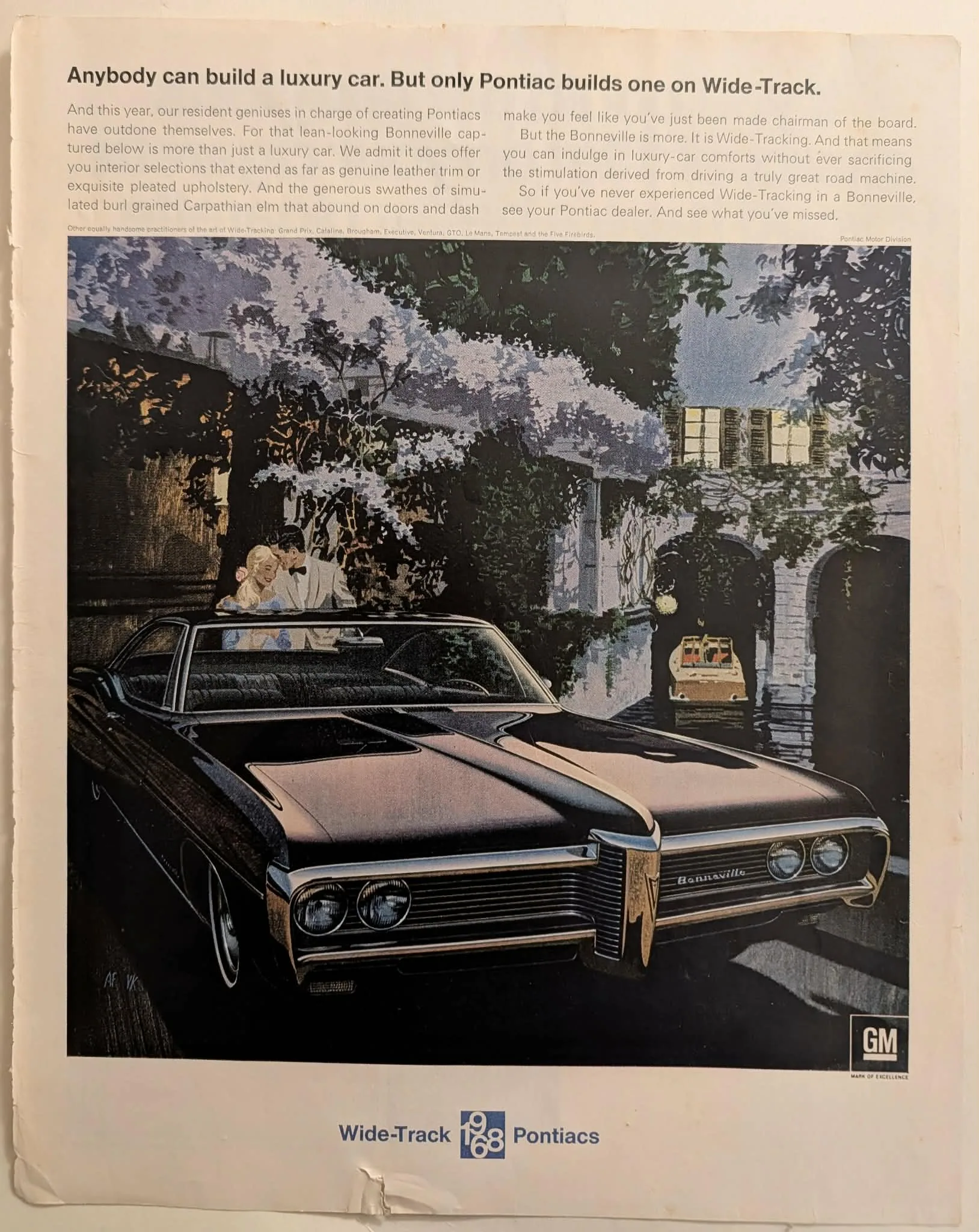
1968 Pontiac Bonneville Vintage Advertisement
During the 1960s, Pontiac solidified its position as the performance and styling division of General Motors, largely driven by its brilliant "Wide-Track" marketing campaign. This 1968 Pontiac Bonneville vintage advertisement serves as a quintessential artifact of that golden era. The core philosophy of Wide-Tracking—pushing the wheels further apart to lower the center of gravity and improve handling—was transformed by Pontiac’s advertising agency, MacManus, John & Adams, into a lifestyle statement. It wasn't just about physics; it was about presence. The visual power of this classic car print ad rests entirely in the hands of "AF VK"—the iconic signature of illustrators Art Fitzpatrick and Van Kaufman. Fitzpatrick (AF) was responsible for the vehicle itself, employing forced perspectives and dramatic lighting to make the Bonneville appear wider, longer, and more imposing than it was in reality. Kaufman (VK) painted the atmospheric backgrounds and figures, placing the car in exclusive, romantic, and often exotic locales. In this specific piece, the deep, lustrous black paint of the Bonneville is contrasted against a lush, moonlit estate featuring classical masonry and an elegant couple in evening wear, complete with a beautifully rendered wooden boat in the background waterway. The scene whispers of old money, yet the car promises modern, aggressive performance. The copywriting is equally strategic. The headline, "Anybody can build a luxury car. But only Pontiac builds one on Wide-Track," directly challenges traditional luxury competitors. It acknowledges the Bonneville’s opulent interior features—such as genuine leather trim, exquisite pleated upholstery, and simulated burl grained Carpathian elm—but pivots sharply to remind the reader of the "stimulation derived from driving a truly great road machine." This dual appeal to both luxury and performance was the cornerstone of Pontiac's success in automotive history. By proudly listing its siblings at the bottom of the page—the Grand Prix, Catalina, Brougham, Executive, Ventura, GTO, Le Mans, Tempest, and the Firebirds—this advertisement doesn't just sell the Bonneville; it reinforces the entire 1968 Pontiac lineup as the ultimate practitioners of the art of Wide-Tracking.
Category: Cars
Year: 1968
Rarity Class: A
Paper & Print Condition
The artifact displays typical characteristics of mid-century magazine stock. There is a slight, uniform patina (yellowing) visible along the extreme margins, which firmly affirms its age and authenticity. Minor edge wear is present on the lower border, but the central image area retains exceptional ink saturation. The deep blacks and intricate halftone patterns of the original AF VK illustration remain remarkably crisp, highlighting the high-quality commercial offset lithography indicative of the era's premium publications.
Provenance & Rarity
Originally circulated in premium high-gloss periodicals of the late 1960s, such as Life or The Saturday Evening Post, this piece represents the pinnacle of General Motors' marketing dominance. While millions of these magazines were printed, surviving examples that retain such immaculate color fidelity, structural integrity, and absence of center-crease distortion are exceedingly rare today. The presence of the authentic GM "Mark of Excellence" and the distinct 1968 Wide-Track emblem significantly elevate its archival cataloging value. Furthermore, the pristine separation of the AF VK illustration—where Art Fitzpatrick's hyper-realistic, forced-perspective vehicle distinctively pops against Van Kaufman's atmospheric, impressionistic background—makes this specific artifact highly sought after by modern studios as a foundational reference piece for animating vintage print advertisements into 2D artwork. It serves as an unblemished masterclass in mid-century visual layering, lighting, and spatial composition.
Rarity & Condition Summary
This 1968 Pontiac Bonneville advertisement is a beautifully preserved, highly representative example of peak 1960s commercial automotive illustration. Classified as a Class A artifact, it maintains a deep visual impact despite the minor organic aging typical of mid-century magazine stock. Its immaculate preservation of the AF VK illustration's distinct visual layers—separating foreground subject from atmospheric background—makes it not only a critical piece of American automotive history but also an exceptionally valuable foundational asset for modern digital restoration and 2D motion design projects.