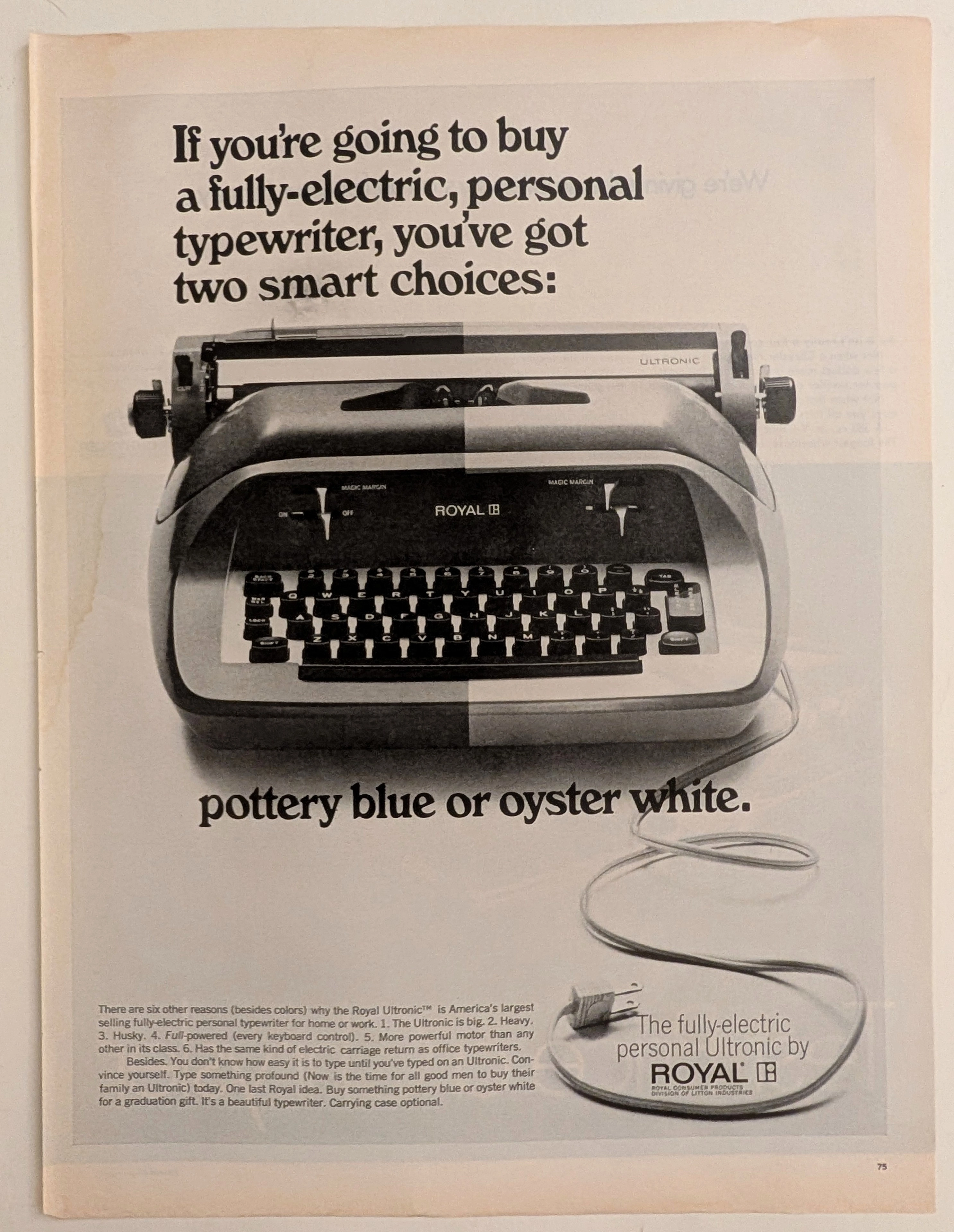
1968 Royal Ultronic Typewriter Vintage Advertisement
The 1968 Royal Ultronic advertisement serves as a masterclass in mid-century consumer psychology and industrial design. During this era, typewriters were undergoing a profound technological shift where manual machines were being eclipsed by "fully-electric" models that promised a more uniform type-bar strike and reduced physical fatigue. Royal, a venerable name in the industry since the early 20th century, utilized its acquisition by the conglomerate Litton Industries to aggressively market these high-powered personal machines. The core message of the campaign, "two smart choices: pottery blue or oyster white," reflects a marketing pivot where technical specifications were paired with lifestyle aesthetics. By 1968, the color palette of the American office was expanding beyond traditional "industrial grey," and Royal offered these machines as "personal" tools intended for students and home-based professionals. Notably, the advertisement emphasizes that the Ultronic was "America’s largest selling fully-electric personal typewriter," highlighting its dominance in the home market. Technologically, the Ultronic boasted features usually reserved for heavy-duty office units. The copy lists six definitive reasons for its success, including that it is "big," "heavy," and "husky"—terms that, in 1960s engineering, equated to durability and a "more powerful motor" than any other in its class
Category: Pens & Writing
Year: 1968
Rarity Class: B
Paper & Print Condition
The artifact is printed on mid-weight, uncoated magazine stock typical of late-1960s mass-market periodicals. High-resolution macro-analysis reveals a well-defined halftone screen and a sophisticated ink distribution that preserves the deep blacks of the typewriter’s body while maintaining clarity in the white serif typography. The paper exhibits a natural age-toning and subtle oxidation (foxing) along the upper margins, yet remains structurally sound with minimal brittleness. The grayscale graduation in the "split-tone" visual remains sharp, showcasing the technical proficiency of the original offset lithographic production.
Provenance & Rarity
The artifact is printed on mid-weight, uncoated magazine stock typical of late-1960s mass-market periodicals. High-resolution macro-analysis reveals a well-defined halftone screen and a sophisticated ink distribution that preserves the deep blacks of the typewriter’s body while maintaining clarity in the white serif typography. The paper exhibits a natural age-toning and subtle oxidation (foxing) along the upper margins, yet remains structurally sound with minimal brittleness. The grayscale graduation in the "split-tone" visual remains sharp, showcasing the technical proficiency of the original offset lithographic production.
Rarity & Condition Summary
In summary, this 1968 Royal Ultronic advertisement serves as a pristine archival witness to the zenith of the personal electric typewriter era. Although originally part of a high-circulation periodical, the extreme fragility of mid-century magazine stock—subject to decades of environmental attrition—renders a surviving specimen in this condition notably uncommon. The piece maintains excellent grayscale depth and sharp typographic clarity, representing a stable, museum-quality example of Litton-era marketing design and monochrome commercial photography.