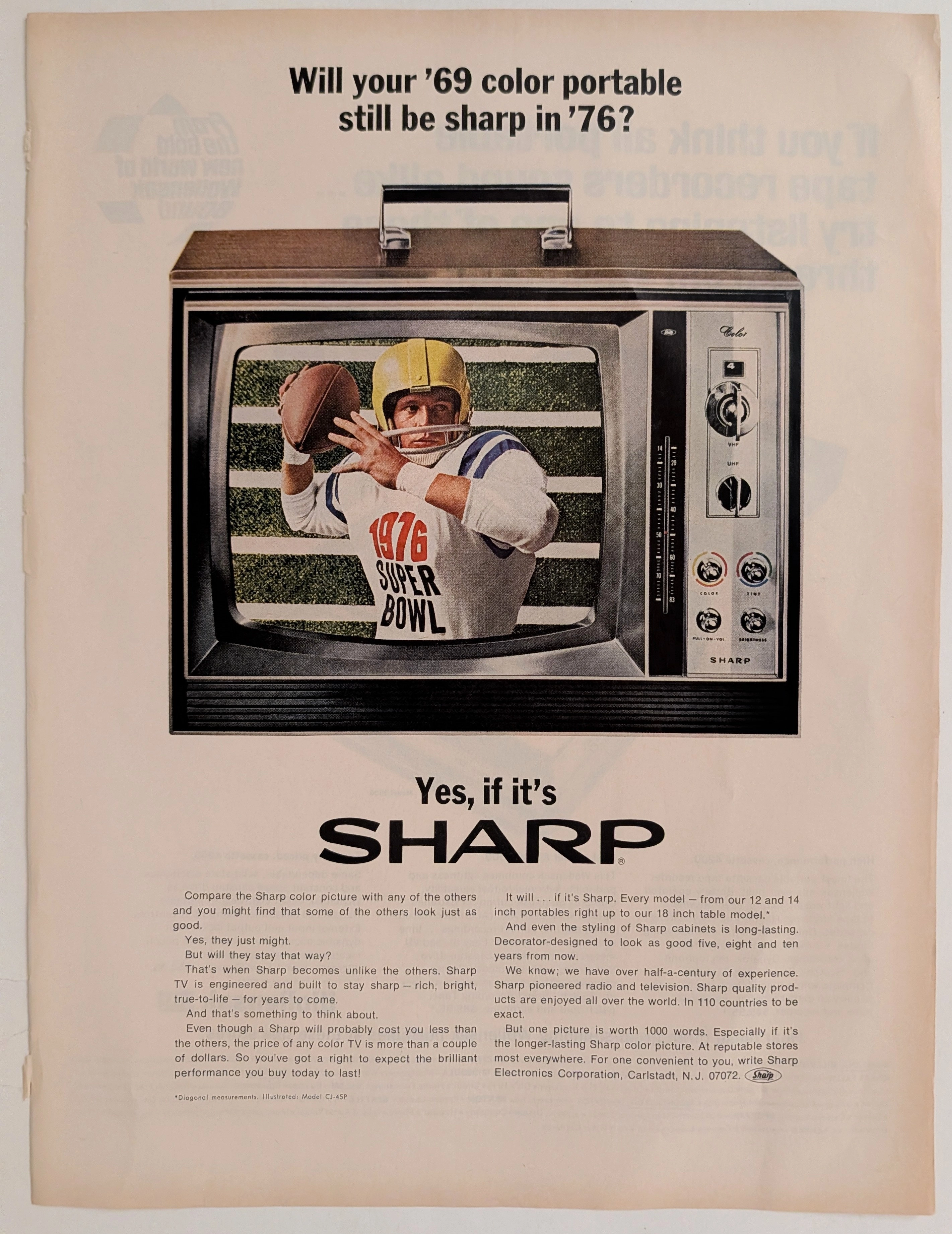
1969 Sharp CJ-45P Color Portable TV Vintage Advertisement
1969 Sharp CJ-45P "Still be sharp in '76?" Color Portable TV Vintage Advertisement The late 1960s represented a massive paradigm shift in consumer electronics, marking the period when color television sales finally overtook black-and-white sets in the United States. However, color televisions were still a significant financial investment for the average American family. A major consumer apprehension at the time was technological obsolescence—the fear that an expensive color set would quickly degrade in picture quality or break down entirely. Sharp Electronics Corporation, a pioneering Japanese manufacturer expanding its footprint in the American market, directly addressed this anxiety. By promising a television engineered to last at least seven years without losing its "true-to-life" brilliance, Sharp positioned itself as the rational, durable choice in a crowded marketplace. The use of the "1976 Super Bowl" imagery is a brilliant piece of cultural anchoring. In 1969, the Super Bowl was still a relatively new phenomenon (Super Bowl III, famous for Joe Namath's guarantee, took place in January 1969). By forecasting ahead to 1976—which was also the highly anticipated American Bicentennial—the advertisement creates a tangible, futuristic timeline for the consumer. It subtly suggests that sports, the primary driver for color TV adoption among many households, will be best experienced on a Sharp television for the better part of the next decade. The visual focus on the intricate tuning dials (Color, Tint, VHF, UHF) further reassures the buyer of the television's advanced, customizable technical capabilities.
Category: Electronics
Year: 1969
Rarity Class: B
Paper & Print Condition
This artifact is printed on standard commercial, lightweight magazine stock typical of mass-circulation American periodicals from the late 1960s. The printing technique utilizes four-color (CMYK) offset lithography. Archival inspection, specifically of the television screen showing the football player and the control dials, reveals the tight, distinct halftone rosette patterns. The ink registration is precise, successfully delineating the sharp black casing of the television against the muted background, thereby drawing the viewer's eye directly to the product. The paper shows expected minor edge wear and a uniform, very mild natural toning due to the oxidation of the paper fibers, but it is free of severe creasing, moisture damage, or disruptive foxing.
Provenance & Rarity
This advertisement was highly likely sourced from a major, general-interest weekly or monthly American publication (such as LIFE, Time, or Look) circulating during the fall of 1969 to coincide with the beginning of the football season. Advertisements from this era were printed on highly acidic paper meant for ephemeral, temporary consumption. While the initial print run of the magazine would have been in the millions, the survival rate of single, intact pages in exhibition quality is low. Time, environmental exposure, and disposal have destroyed the vast majority of these documents. Finding a clean example that documents the specific intersection of mid-century home entertainment technology and the rising cultural dominance of the NFL Super Bowl makes it a moderately rare and highly interesting archival piece.
Rarity & Condition Summary
An excellently preserved example of late-1960s consumer electronics advertising. This artifact transcends its original ephemeral purpose, standing today as a museum-grade record of Sharp's early expansion into the US market and the historical consumer shift towards color broadcasting. Its condition is highly stable, requiring no advanced conservation, making it a valuable asset for archivists studying the intersection of 20th-century technology and sports media marketing.