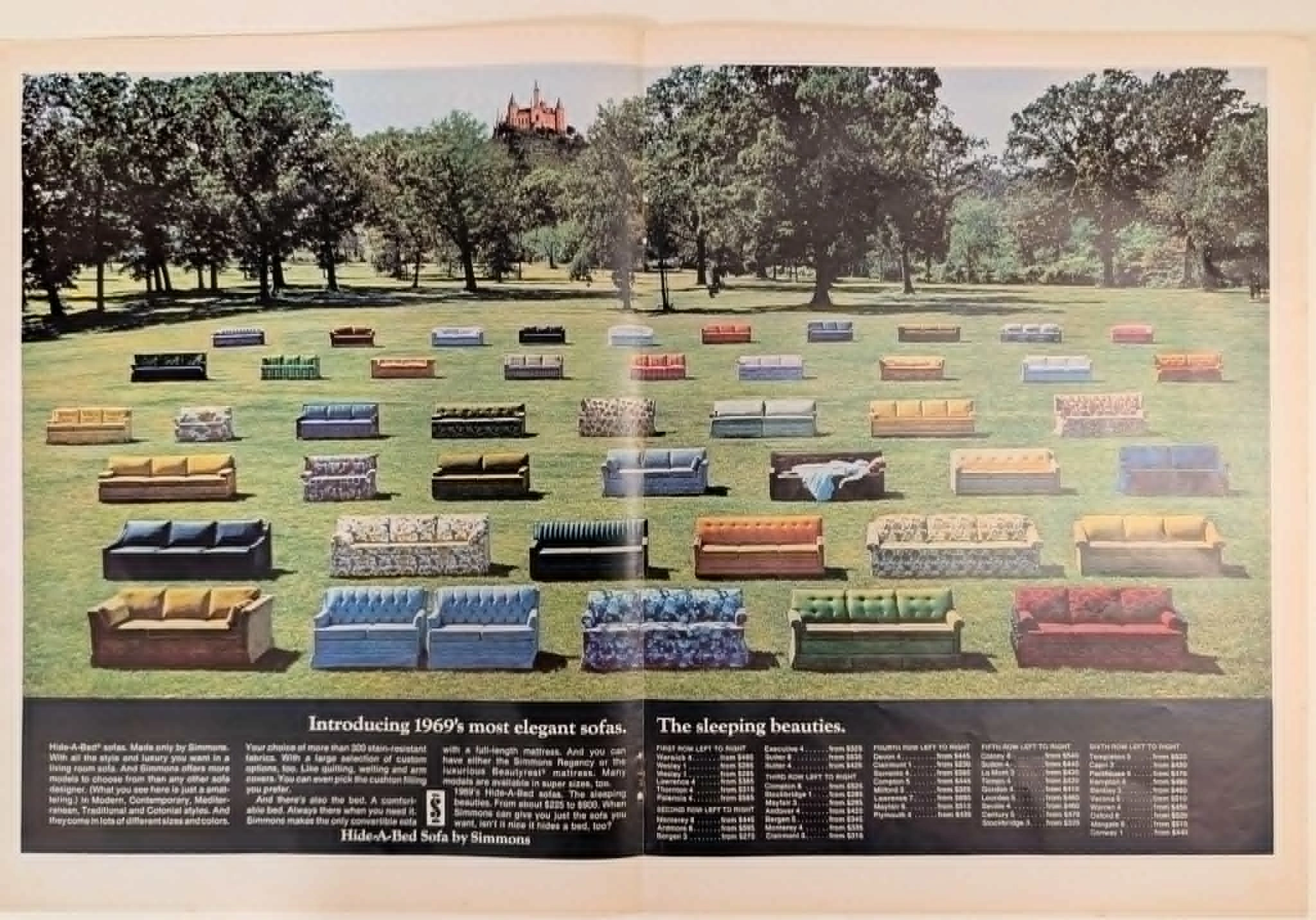
1969 Simmons Hide-A-Bed Sofa: "The Sleeping Beauties" Vintage Advertisement
The 1969 model year for Simmons was characterized by a massive expansion of consumer choice, beautifully documented in this promotional fold-out poster. Functioning as a piece of dealer display ephemera rather than a standard consumer magazine page, this large-scale lithograph presents a surreal, expansive landscape to showcase the sheer volume of the brand's offerings. Dozens of varied couches are meticulously arranged in a grid across a vast, sunlit green lawn. Anchoring the composition is a European-style fairy-tale castle perched on a distant, forested hill. This architectural element visually reinforces the campaign's core motif: "The sleeping beauties". At the physical center of the sheet, resting on a dark brown tufted Hide-A-Bed, a woman in a flowing light blue gown sleeps gracefully, directly echoing the fairy-tale narrative. For digital archivists focused on translating mid-century ephemera into "living" 2D artwork, this specific piece provides a compelling canvas. The wide, locked visual perspective and flat layout require precise preservation of the aged paper texture, while the resting subject invites organic, synchronized animation—such as the subtle rise and fall of breathing or era-appropriate ambient soundscapes—without violating the structural integrity of the original 1960s lithograph. The sheet's lower text block provides a comprehensive index of "1969's most elegant sofas," detailing a "choice of more than 300 stain-resistant fabrics". Simmons emphasizes the concealed utility of the furniture, highlighting the inclusion of "either the Simmons Regency or the luxurious Beautyrest mattress". With retail prices listed "From about $225 to $900," this document served as a vital, all-in-one visual catalog for showroom floors before being discarded at the season's end.
Category: Lifestyle & Vice
Year: 1969
Rarity Class: A
Paper & Print Condition
The physical sheet exhibits a prominent vertical center crease, structurally consistent with its original format as a mailed dealer fold-out or catalog center-pull. There is mild age-toning and standard edge wear indicative of commercial handling. Despite this, the color lithography remains remarkably vibrant, fully preserving the distinct multicolored upholstery of the individual sofas and the rich greens of the landscape.
Provenance & Rarity
While the Simmons Company was a ubiquitous national brand that mass-produced consumer goods, this specific large-format printed ephemera was never intended for public ownership or home retention. It functioned strictly as a trade-only showroom display or a dealer reference fold-out for the 1969 "Sleeping Beauties" campaign. Because these unbound promotional materials were manufactured exclusively for temporary commercial utility, they suffered extreme attrition; dealerships almost universally discarded them the moment the product line updated for the next season. The combination of a restricted original distribution network and a near-total destruction rate after its intended display period justifies an A grading on a global scale.
Rarity & Condition Summary
Rarity: A — This piece of printed ephemera was produced exclusively for the trade network as a showroom display fold-out for the 1969 "Sleeping Beauties" campaign, meaning its original production run was severely restricted compared to consumer-facing retail materials. Because dealerships universally utilized these promotional materials for temporary display and then immediately discarded them once the product line updated, it experienced a near-total destruction rate. Consequently, the surviving global population of this specific large-format fold-out is exceptionally low. Condition: Good — The physical sheet exhibits visible wear consistent with active commercial handling, most notably a prominent vertical center crease that is structurally consistent with its original format as a mailed dealer fold-out. It shows mild age-toning and standard edge wear. However, despite these signs of use, the core color lithography remains remarkably vibrant and fully intact, preserving the striking multicolored upholstery and rich greens of the landscape.