1970 Ford Mustang Boss 302 "The Ground Groover" (1970) — Class S vintage Automotive
CLASS S

1970 Ford Mustang Boss 302 "The Ground Groover"

Category|Automotive
Subcategory|American
Year|1970
Rarity Class|CLASS S
Archive Views|175

Last updated: 16 Apr 2026

Historical Context

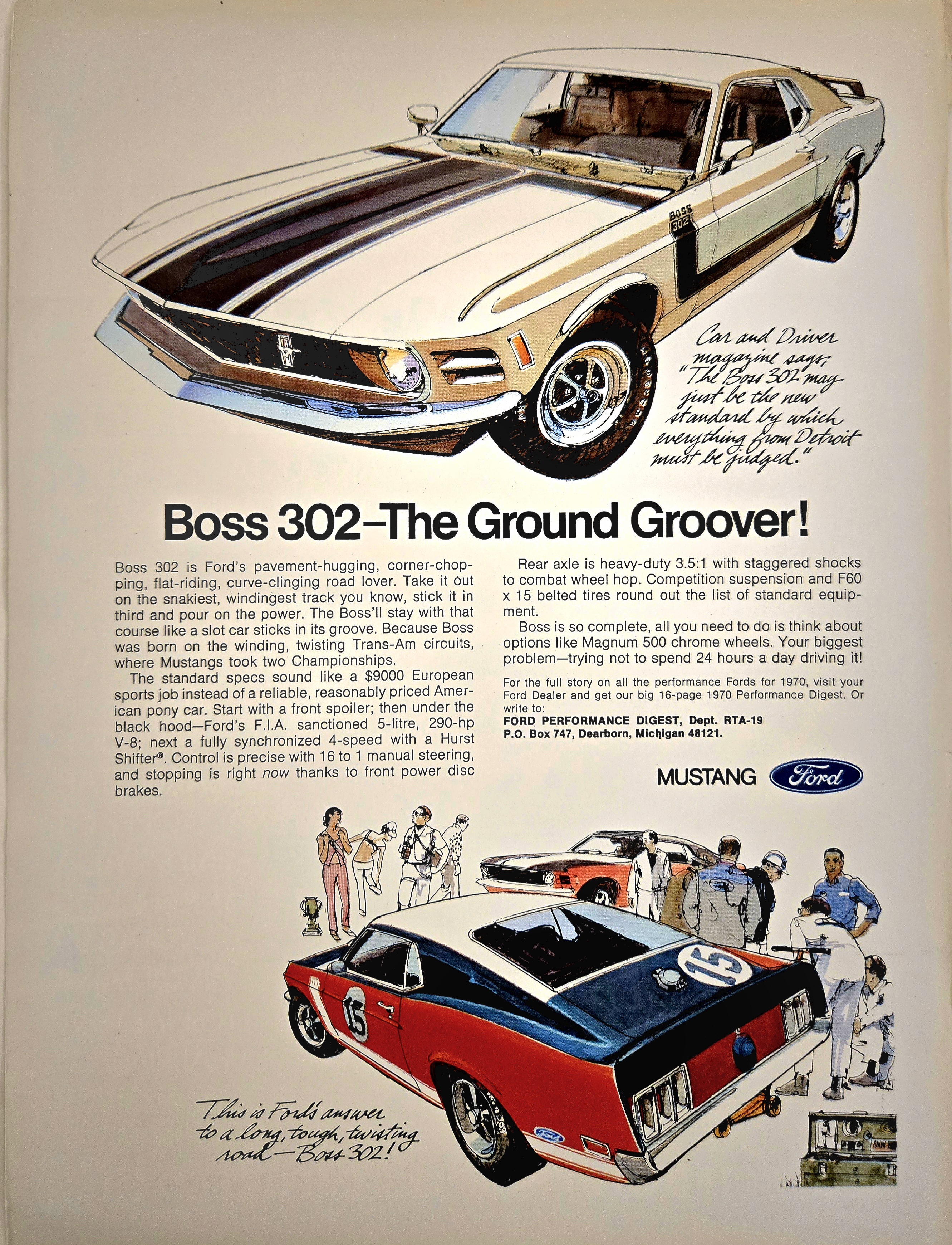
1970 Ford Mustang Boss 302 "The Ground Groover" Vintage Advertisement n 1970, the American "pony car" wars were at their absolute peak, waged fiercely both in showrooms and on the asphalt of the SCCA Trans-Am racing series. To compete directly with the Chevrolet Camaro Z/28, Ford developed the high-revving Boss 302. This advertisement, titled "Boss 302—The Ground Groover!", perfectly captures the dual-purpose nature of the vehicle. The visual layout employs a striking two-tier illustration strategy rather than standard photography. The top illustration showcases the aggressive street version, highlighting the iconic "C-stripe" graphics designed by legendary stylist Larry Shinoda, the front spoiler, and the Magnum 500 chrome wheels. The bottom vignette grounds the car in its racing pedigree, depicting a red and black #15 race-spec Boss 302 in an active pit lane setting. The copywriting is dense with technical bravado aimed squarely at the performance enthusiast. It touts the "F.I.A. sanctioned 5-litre, 290-hp V-8," a fully synchronized 4-speed transmission with a Hurst Shifter®, and "staggered shocks to combat wheel hop." By prominently quoting Car and Driver magazine—"The Boss 302 may just be the new standard by which everything from Detroit must be judged"—Ford masterfully leveraged third-party automotive journalism to validate its engineering prowess against both domestic rivals and $9,000 European sports cars.

Paper & Print Condition

Printed on a medium-weight, uncoated or matte-finished mechanical wood-pulp magazine stock typical of late 1960s and early 1970s American periodicals. The printing process employs classic four-color offset lithography (CMYK). Uniquely, the artwork relies on an "ink and wash" illustration style rather than standard photography. The print registry is exceptional, maintaining crisp, black architectural linework and smooth color gradients in the watercolor-style washes. The artifact is in excellent preservation state, exhibiting only mild, uniform oxidative yellowing (patina) typical of the era's paper chemistry, and minimal edge-wear from its historical extraction.

Provenance & Rarity

Provenance: This artifact originates from a premier North American automotive or men's lifestyle publication printed circa 1970. It was commissioned by the Ford Motor Company (attributed to the J. Walter Thompson agency) to market the Boss 302—a homologation special built to dominate the SCCA Trans-Am series—directly to performance enthusiasts. Rarity & Valuation: Classified as Collector’s Grade Ephemera. Although Ford's advertising presence was extensive, original print specimens featuring this specific "ink and wash" illustration style typical of the Larry Shinoda design era, without significant UV degradation or handling damage, are increasingly scarce. This piece holds substantial valuation among classic Mustang collectors, automotive art historians, and Trans-Am racing archivists.

Rarity & Condition Summary

Collector’s Grade Ephemera (Uncommon). The artifact is in excellent archival condition, featuring a rare "ink and wash" illustration style with sharp line work and high-contrast typography. It exhibits minimal organic degradation, specifically a light, uniform oxidative patina and negligible edge-wear. Highly prized for its historical link to Larry Shinoda’s design era and the Trans-Am racing legacy.
▶ Watch Video

Share This Archive

From the Journal

Related Articles

The Time Traveller's Dossier: The Sanctuary of the Highway – The 1968 Ford LTD and the Democratization of Silence — related article
Read Article

The Time Traveller's Dossier: The Sanctuary of the Highway – The 1968 Ford LTD and the Democratization of Silence

The evolution of the American domestic automobile during the mid-twentieth century was fundamentally propelled by a relentless pursuit of accessible luxury and physical isolation from the rapidly expanding, concrete-laden modern world. The historical artifact elegantly and securely positioned upon the analytical table of The Record Institute today is a striking, full-page print advertisement for the 1968 Ford LTD, originating from a highly volatile and transformative year in American history. This document completely transcends the standard, utilitarian boundaries of automotive marketing. It operates as a highly sophisticated, multi-layered cultural mirror, reflecting the precise era when raw horsepower was momentarily subjugated to the pursuit of absolute silence, and European-grade luxury was explicitly packaged and sold to the American middle-class consumer. This world-class, comprehensive dossier conducts a meticulous, unyielding, and exceptionally exhaustive examination of the artifact, operating under the absolute most rigorous parameters of historical, sociological, and material science evaluation. With the vast majority of our analytical focus dedicated to its immense historical gravity (80%), we will decode the brilliant marketing psychology embedded within Ford's audacious "Quiet" campaign, analyze the brutalist architectural juxtaposition of the concrete overpass against the sleek lines of the vehicle, and dissect the profound corporate semiotics of the iconic "Ford has a better idea" lightbulb logo. Furthermore, as we venture deeply into the chemical and physical foundations of this analog printed ephemera (10%), we will reveal the precise mechanical fingerprints of the CMYK halftone rosettes captured in the macro imagery of the wheel hubcap. Finally, we will assess its archival rarity (10%), exploring how the graceful, natural oxidation of the paper substrate cultivates a serene wabi-sabi aesthetic—a natural, irreversible phenomenon that serves as the primary engine driving up its market value exponentially within the elite global spheres of Vintage Commercial Ephemera and Automotive Archives.

True Blood of the Trans-Am: The 1970 Ford Mustang Boss 302 Legacy — related article
Read Article

True Blood of the Trans-Am: The 1970 Ford Mustang Boss 302 Legacy

Experience the raw spirit of an American muscle car legend through an authentic, pre-2000 analog magazine advertisement, carefully extracted as a single sheet.

The Time Traveller's Dossier: Gridline Velocity – Kenwood Car Stereo and the Cybernetic Dawn of Automotive High-Fidelity — related article
Read Article

The Time Traveller's Dossier: Gridline Velocity – Kenwood Car Stereo and the Cybernetic Dawn of Automotive High-Fidelity

The evolution of 1980s American consumer electronics was fundamentally defined by the aggressive pursuit of portable and automotive high-fidelity sound. Elegantly and securely positioned upon the analytical table of The Record Institute today is a visually arresting, neon-drenched full-page print advertisement for Kenwood Car Stereo. This document completely transcends the standard, utilitarian boundaries of automotive accessory marketing. It operates as a highly sophisticated cultural mirror, reflecting a precise era in consumer psychology where auditory power was directly equated with vehicular performance. By utilizing a breathtaking, airbrushed illustration of a futuristic, aerodynamic race car accelerating over a cybernetic gridscape, Kenwood brilliantly positioned its audio equipment not just as radios, but as extreme, high-octane performance upgrades capable of generating sound that will literally "blow your doors off." This world-class, comprehensive dossier conducts a meticulous, unyielding, and exceptionally exhaustive examination of the artifact, operating under the absolute most rigorous parameters of historical, sociological, and material science evaluation. Dedicating the overwhelming majority of our analytical focus (80%) to its immense historical gravity, we will decode the brilliant marketing psychology embedded within the "neon grid" visual narrative, analyze the profound cultural shift toward aftermarket car audio customization, and dissect the aggressive, performance-based copywriting. Furthermore, as we venture deeply into the chemical and physical foundations of this analog printed ephemera (10%), we will reveal the precise mechanical fingerprints of the CMYK halftone rosettes captured in the stunning macro imagery of the airbrushed car. Finally, we will assess its archival rarity (10%), exploring how the graceful, natural oxidation of the paper substrate cultivates a serene wabi-sabi aesthetic—a natural, irreversible phenomenon that serves as the primary engine driving up its market value exponentially within the elite global spheres of Vintage Commercial Ephemera, Audio History, and Outrun/Synthwave Art Archives.

The Time Traveller's Dossier: The Ten-Dollar Titan – The Autolite Ford Indianapolis 500 Exhibition — related article
Read Article

The Time Traveller's Dossier: The Ten-Dollar Titan – The Autolite Ford Indianapolis 500 Exhibition

The synthesis of high-stakes motorsport engineering and everyday consumer accessibility represents a pinnacle achievement in mid-twentieth-century American commercial strategy. The historical artifact elegantly secured upon the analytical table of The Record Institute today is a majestic full-page print advertisement for Autolite Ford Ignition Coils, originating from the golden era of 1960s automobile racing. This document completely transcends the traditional boundaries of automotive parts marketing. It operates as a profound, sophisticated declaration of how cutting-edge technological innovation on the racetrack was democratized and delivered directly into the hands of the American middle class, transforming the daily commute into an extension of the Indianapolis 500. ​This world-class, comprehensive dossier conducts a meticulous and deep examination of the artifact, operating under the absolute most rigorous parameters of historical, sociological, and material science evaluation. We will decode the brilliant, kinetic pit-stop scene capturing an open-wheel race car, and analyze the dramatic visual juxtaposition of this high-speed chaos against the highly structured, calculated copywriting of the Ford Motor Company. Furthermore, as we venture into the chemical and physical foundations of this analog printed ephemera, we will reveal the mechanical fingerprints of the CMYK halftone rosettes and the graceful, natural oxidation of the paper substrate. This precise intersection of visual nostalgia, motorsport heritage, and the chemistry of time cultivates a serene wabi-sabi aesthetic—a natural, irreversible phenomenon that serves as the primary engine driving up its market value exponentially within the elite global spheres of Vintage Automotive Ephemera and Motorsports Archives collecting.