THE RECORD · ARCHIVE PLAYER
MP4
■ PAUSED
1970 Fruit of the Loom Men's Underwear & Shirts Vintage AdvertisementANALOG ARCHIVE
1970 Fruit of the Loom Men's Underwear & Shirts Vintage Advertisement (1970) — Class B vintage Lifestyle & Vice
CLASS B
1 of 3

1970 Fruit of the Loom Men's Underwear & Shirts Vintage Advertisement

Category|Lifestyle & Vice
Year|1970
Rarity Class|CLASS B
Archive Views|1
Heritage AdvertisementsFashion & BeautyClothing
Ad Content TypeLifestyle

Last updated: 28 Apr 2026

Historical Context

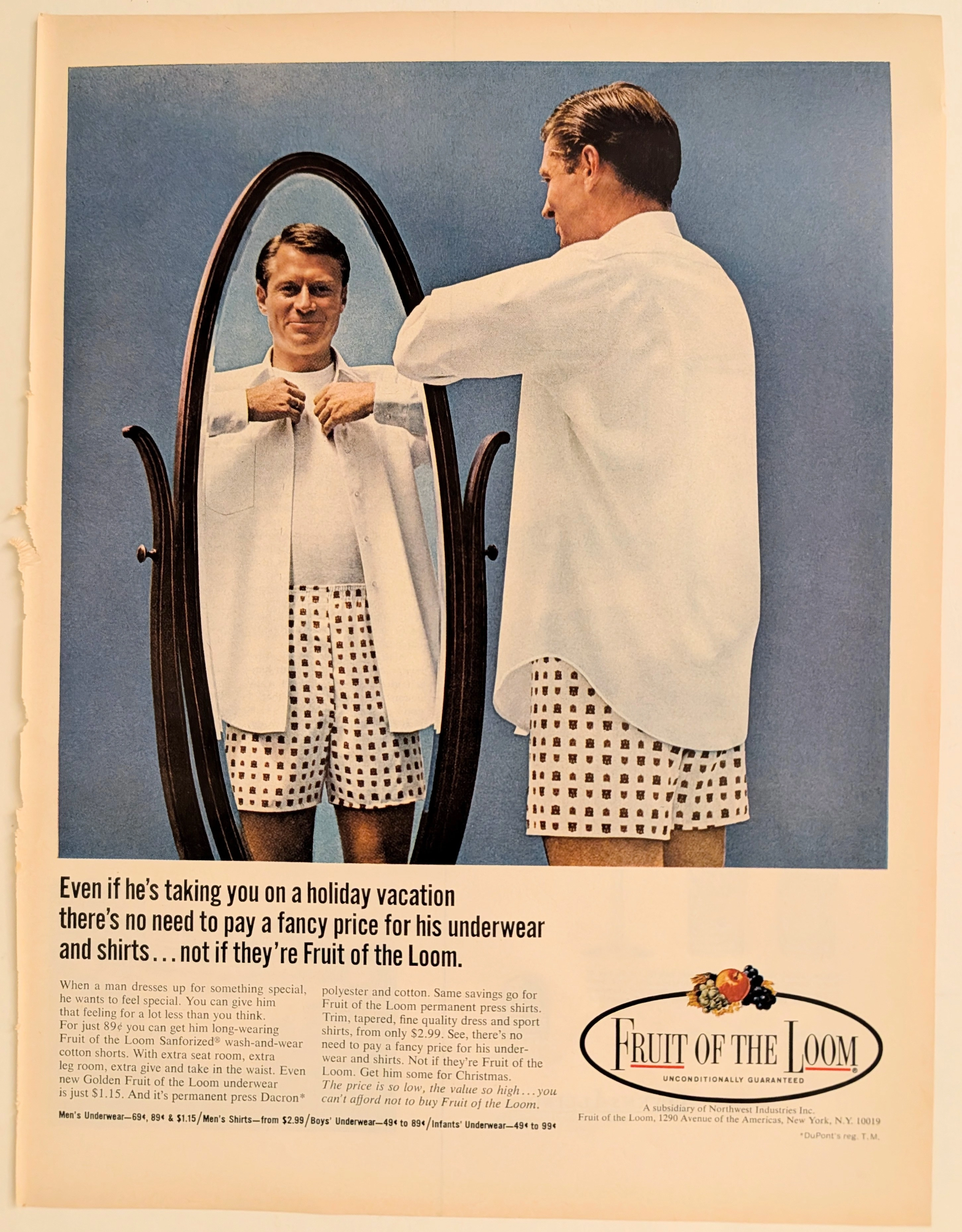
Published around 1970, this Fruit of the Loom advertisement provides a fascinating glimpse into mid-century consumer economics and textile innovation. The copy directly addresses the female consumer ("Even if he's taking you on a holiday vacation..."), reflecting the era's traditional domestic dynamic where women were the primary purchasers of household goods, including men's underwear and basic apparel. The advertisement heavily promotes "Sanforized" wash-and-wear cotton and "permanent press Dacron" (a DuPont polyester). During the 1960s and 70s, the mass commercialization of synthetic fiber blends and permanent press finishes revolutionized apparel care, promising busy mid-century homemakers liberation from the ironing board. Economically, the ad emphasizes value over prestige. By stating "there's no need to pay a fancy price" and prominently listing extraordinarily low price points (89¢ for shorts, $2.99 for shirts), Fruit of the Loom cemented its reputation as a reliable, budget-friendly staple against the backdrop of late-60s and early-70s inflation. The inclusion of the iconic fruit cluster logo served as an enduring stamp of quality, backed by their "unconditionally guaranteed" promise.

Paper & Print Condition

Printed on standard mid-century magazine stock. The paper shows natural toning along the untrimmed edges. The color registration is excellent, capturing the soft pastel blue background and the warm skin tones accurately, while the iconic fruit cluster logo remains crisp and vibrant.

Provenance & Rarity

Sourced from a mainstream American women's or lifestyle magazine. While advertisements for everyday basics are common, this piece holds specific value for textile historians documenting the shift towards synthetic blends (Dacron) and easy-care finishes in men's apparel.

Rarity & Condition Summary

A well-preserved artifact of 1970s domestic marketing. It effectively illustrates how commercial brands appealed to homemakers through the promise of economic value and reduced household labor.
Share This Archive

From the Journal

Related Articles

The Time Traveller's Dossier: The Architecture of Slumber – The 1967 Simmons Golden Value — related article
Read Article

The Time Traveller's Dossier: The Architecture of Slumber – The 1967 Simmons Golden Value

The evolution of the American domestic interior during the mid-twentieth century was heavily influenced by the golden age of travel and the rapid expansion of the luxury hospitality industry. The historical artifact elegantly secured upon the analytical table of The Record Institute today is a large-format, two-page centerfold print advertisement for the Simmons Mattress Company, copyrighted in 1967. This document transcends standard consumer goods marketing; it operates as a sophisticated sociological mirror, reflecting a highly specific moment when industrial sleep engineering and the aspirational luxury of the modern hotel were explicitly packaged and sold to the suburban American household. This world-class, comprehensive dossier conducts a meticulous, profound, and historically objective examination of the artifact, operating under the absolute most rigorous parameters of sociological and material science evaluation. We will decode the brilliant marketing psychology embedded within the "First Public Sale" messaging, analyze the iconic "Good Housekeeping" endorsement, and dissect the rich semiotics of the heraldic quilt patterns alongside the modernist architectural illustrations. Furthermore, as we venture deeply into the chemical and physical foundations of this analog printed ephemera, we will reveal the precise mechanical fingerprints of the CMYK halftone rosettes and the graceful, natural oxidation of the paper substrate. This precise intersection of visual nostalgia, mid-century commercial artistry, and the immutable chemistry of time cultivates a serene wabi-sabi aesthetic—a natural, irreversible phenomenon that serves as the primary engine driving up its market value exponentially within the elite global spheres of Vintage Commercial Ephemera and Mid-Century Lifestyle Archives collecting.

The Time Traveller's Dossier: The Architecture of Masculine Dominance – Pierre Cardin Editorial Illustration (Circa 1980s) — related article
Read Article

The Time Traveller's Dossier: The Architecture of Masculine Dominance – Pierre Cardin Editorial Illustration (Circa 1980s)

History is not merely written; it is tailored, draped, and aggressively padded at the shoulders. Long before digital algorithms dictated the sterile parameters of modern menswear, and before the casualization of the corporate wardrobe stripped the modern executive of his sartorial armor, societal engineering was executed through the calculated geometry of the designer suit. The historical artifact before us is not a mere disposable magazine tear sheet; it is a perfectly weaponized blueprint of 1980s hyper-masculinity, a visual manifesto of corporate dominance, and an unwavering testament to an era when clothing was utilized as a tool for physical and psychological intimidation. ​This museum-grade, academic archival dossier presents an exhaustive deconstruction of a late-analog editorial illustration featuring the revolutionary menswear of Pierre Cardin, dating to the pivotal "Power Suit" era of the 1980s. Operating on a profound, ruthless binary structure, this document records a calculated paradigm shift within the global fashion industry. It captures the precise historical fracture where menswear transitioned conceptually from the conservative, conformity-driven "Organization Man" of the mid-20th century into the aggressive, space-commanding "Power Broker" of the 1980s. Through the highly specialized lens of late-analog commercial artistry and stringent visual forensics, this document serves as a masterclass in the psychological marketing of gender and power. It established the foundational archetype for the modern, alpha-male aesthetic—an archetype that unconditionally dictates the visual and strategic totems of corporate dominance even today.

The Time Traveller's Dossier: The Zenith of the American Living Room – Admiral Rectangular Color TV — related article
Read Article

The Time Traveller's Dossier: The Zenith of the American Living Room – Admiral Rectangular Color TV

The evolution of the American domestic interior during the mid-twentieth century was fundamentally redefined by the introduction and subsequent democratization of color television. The historical artifact elegantly and securely positioned upon the analytical table of The Record Institute today is a majestic, full-page print advertisement for Admiral Color TV, originating from the transitional technological era of the late 1960s. This document completely transcends the traditional boundaries of consumer electronics marketing. It operates as a highly sophisticated, multi-layered cultural and historical mirror, reflecting the exact moment when the magic of color broadcasting collided with the rigorous aesthetic demands of suburban domestic styling on a single printed page. This world-class, comprehensive dossier conducts a meticulous, unyielding, and exceptionally deep examination of the artifact, operating under the absolute most rigorous parameters of historical, sociological, and material science evaluation. With our analytical focus dedicated heavily to its historical gravity, we will decode the brilliant marketing psychology embedded within the "rectangular" tube innovation, analyze the space-age luxury of the "Sonar" remote control, and dissect the rich semiotics of disguised technology through "genuine walnut veneers". Furthermore, as we venture deeply into the chemical and physical foundations of this analog printed ephemera, we will reveal the precise mechanical fingerprints of the CMYK halftone rosettes and the graceful, natural oxidation of the paper substrate. This precise intersection of visual nostalgia, mid-century commercial artistry, and the immutable chemistry of time cultivates a serene wabi-sabi aesthetic—a natural, irreversible phenomenon that serves as the primary engine driving up its market value exponentially within the elite global spheres of Vintage Commercial Ephemera, Consumer Electronics Archives, and Mid-Century Lifestyle collecting.

The Time Traveller's Dossier : 1980 The Architecture of Leisure and the Golden Age of the American Regional Department Store — related article
Read Article

The Time Traveller's Dossier : 1980 The Architecture of Leisure and the Golden Age of the American Regional Department Store

Before the algorithmic precision of digital feeds stripped the tactility from consumer longing, and long before the homogenization of global e-commerce, print media served as the grand architectural blueprint for the American lifestyle. Captured within the glossy confines of a late-20th-century publication—specifically indicated by the vertical marginalia of Playboy magazine—this Boston Traders advertisement stands as a pristine, museum-grade artifact. It masterfully encapsulates the ‘preppy-outdoor’ synthesis that dominated the sartorial landscape of the early 1980s. However, its true value extends far beyond its depiction of robust color-blocking and heritage-driven knitwear. This archival piece serves as a critical historical ledger of America’s evolving retail infrastructure. By permanently anchoring its brand legacy to iconic, and now profoundly defunct, regional department store giants, this document offers a rare, tightly datable window into the zenith of physical retail and the psychological marketing of the affluent weekend gentleman. It is a masterpiece of commercial archaeology.