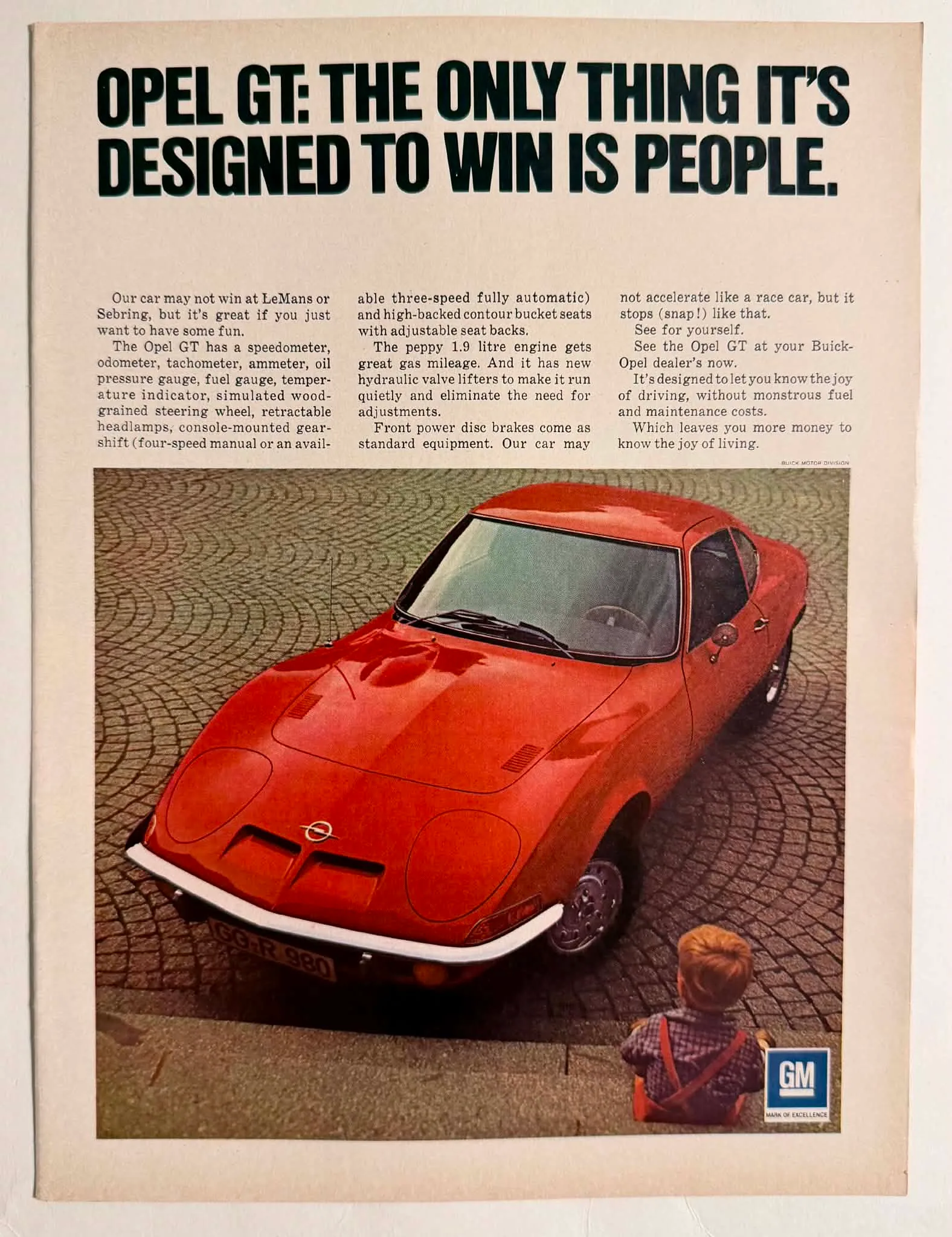
1970 Opel GT "Designed to Win People" Vintage Advertisement
During the late 1960s and early 1970s, the American automotive market experienced a surge in demand for compact, sporty imports. General Motors responded by importing the German-built Opel GT, distributing it through its established Buick dealership network. This specific advertisement brilliantly encapsulates the marketing strategy for the vehicle: acknowledging its exotic sports car aesthetics while firmly grounding its appeal in everyday drivability and economic sense. The bold headline, "OPEL GT: THE ONLY THING IT'S DESIGNED TO WIN IS PEOPLE," immediately sets a self-deprecating yet confident tone. By explicitly stating that the car "may not win at LeMans or Sebring," the copywriter subverts the typical performance-bragging tropes of the era. Instead, the focus pivots to the joy of driving and ownership. The copy meticulously lists features that suggest a premium sports car experience—retractable headlamps, a console-mounted gearshift, and a comprehensive suite of dashboard gauges—while reassuring the buyer with practical selling points like "great gas mileage" and the reliability of hydraulic valve lifters. Visually, the advertisement is striking. The top-down, slightly angled photographic perspective emphasizes the Opel GT's sweeping, aerodynamic lines—a design heavily influenced by GM's Corvette, leading to its enduring nickname, the "mini-Corvette." The vehicle is bathed in a vibrant red, contrasting sharply against the textured grey cobblestone street, subtly hinting at its European origins (further reinforced by the German "GG-R 980" license plate). In the foreground, a young boy gazes at the car, injecting a sense of youthful aspiration and wonder into the scene. This human element perfectly mirrors the headline's focus on "people" rather than professional racing drivers. Concluding with the pragmatic appeal of "driving, without monstrous fuel and maintenance costs," this advertisement is a sophisticated piece of demographic targeting. It offered the American middle class the visual thrill of an exotic European sports car, backed by the trusted infrastructure of General Motors and Buick.
Category: Cars
Year: 1970
Rarity Class: B
Paper & Print Condition
The document is preserved on standard mid-century periodical stock, exhibiting a slight, even marginal toning (patina) that authenticates its age without compromising the structural integrity of the paper fibers. Closer macro-level examination reveals a high-fidelity offset lithographic process. The CMYK halftone rosette pattern is exquisitely preserved and particularly visible in the complex textures of the cobblestone street and the nuanced woven pattern of the boy's shirt. The bold, sans-serif black typography remains razor-sharp, exhibiting zero ink bleed into the uncoated paper. Color saturation is exceptional; the robust, dynamic red of the Opel GT demonstrates remarkable resistance to UV degradation, while the cyan and magenta layers within the iconic GM "Mark of Excellence" logo remain perfectly registered.
Provenance & Rarity
This piece stands as crucial historical evidence of General Motors' strategic "captive import" initiative, which introduced the German-engineered Opel GT sports car to American consumers via the established Buick dealership network. The fusion of European design aesthetics with American mass-market advertising—evidenced by the prominent inclusion of GM's "Mark of Excellence" logo—makes this advertisement a vital automotive cultural bridge. Although categorized as a Class B archival asset (Standard Periodical Commercial Print), discovering surviving copies in pristine condition, free of binding creases or moisture damage, is increasingly uncommon. This specific variant of the campaign, which emphasizes a human-centric lifestyle narrative over traditional racetrack performance, is particularly coveted by GM archivists and classic sports car collectors studying the evolution of intercontinental automotive commerce in the 1970s.
Rarity & Condition Summary
A remarkably well-preserved Class B archival asset. The pristine retention of the color lithography, specifically the vibrant red of the vehicle against the textured cobblestone, combined with culturally significant copywriting, elevates its collectible status. The structural integrity of the mid-century periodical paper ensures it remains a highly desirable and valuable educational piece for historians studying international automotive commerce and captive import strategies in the 1970s.